> ## Documentation Index
> Fetch the complete documentation index at: https://orgo.space/docs/llms.txt
> Use this file to discover all available pages before exploring further.
# Linking Records
> How the import wizard finds the member, product, role or company a spreadsheet row refers to, and how to read the match preview before you start
Some files do not describe new things. They describe things that happen to
records you already have: a payment made by a member, a role given to a member,
a badge awarded to a member. Before Orgo can write such a row it has to find the
record the row is talking about, using nothing but the text in your spreadsheet.
**Built for** the migration where the payments file names payers by email and the
roles file names members by whatever the old system called them. **Replaces** the
guesswork of finding out after the fact which rows attached themselves to the
wrong person.
 ***
## Reference columns and their groups
In the mapping screen, the columns that point at an existing record are gathered
into groups named after the thing they identify: **Payer**, **Product**,
**Price tier**, **Member**, **Role**, **Unit**, **Company**, **Badge**.
A group usually offers several ways to name the same record, and you map at least
one column per required group. A payer can be given by legacy id, by email, or by
name; a role by legacy id or by name. The chips in the footer of the mapping
screen spell out the choice for you, for example **Payer: Payer email or Payer
name**, and turn green once one of the alternatives is mapped. Groups marked
optional, such as **Unit** on a role file, can be left unmapped entirely.
Where more than one column is offered, the order matters, and the rest of this
page is about that order.
***
## The match preview
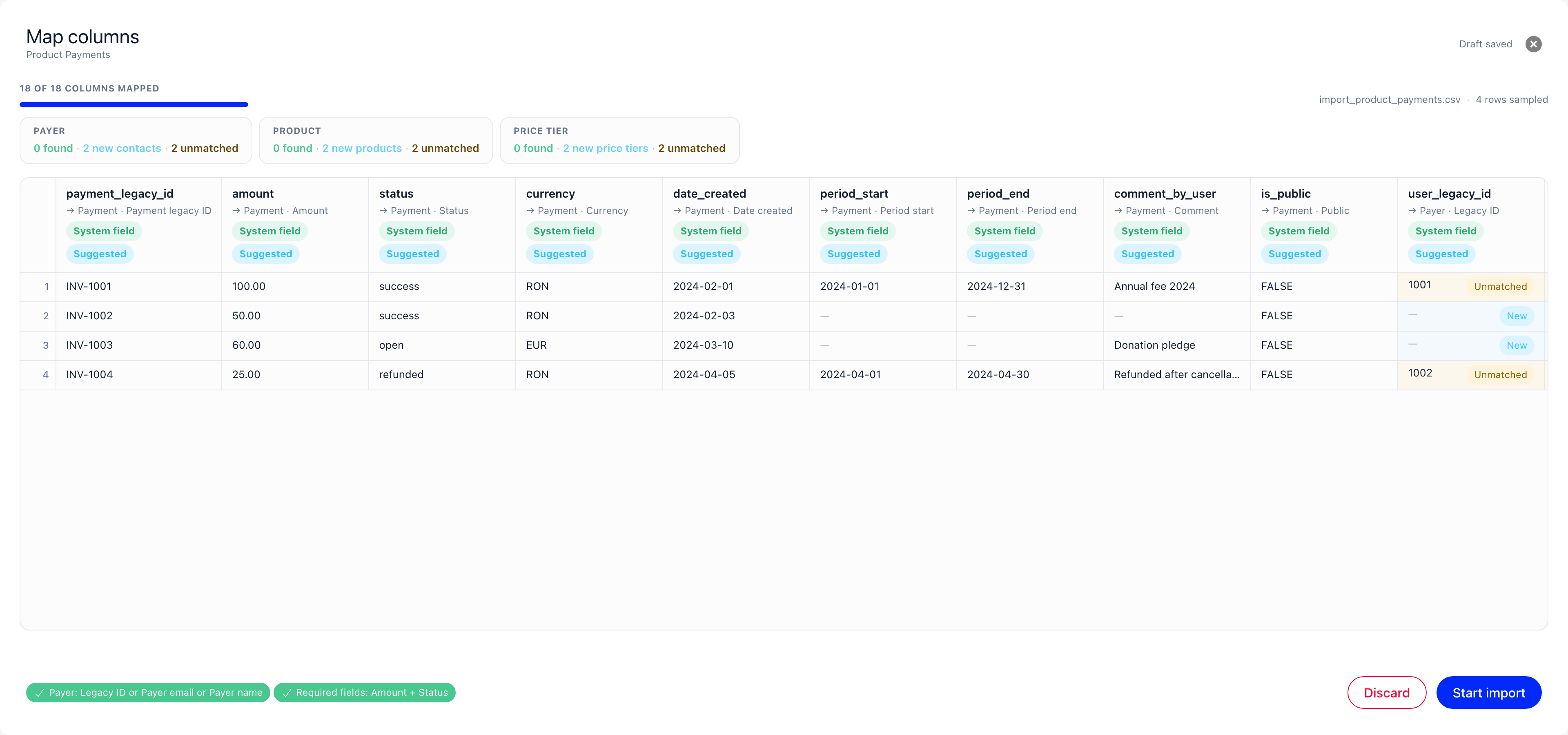
Once a group has at least one column mapped, a strip of tiles appears above the
sheet, one tile per group, each with three numbers.
| Number | What it counts |
| ------------------------------------------------------- | --------------------------------------------------------------------------------------------------------------------------------------------- |
| **found** | Rows whose reference resolved to exactly one existing record. The import will attach the row to it. |
| **new contacts**, **new products**, **new price tiers** | Rows that matched nothing, but carry enough detail for Orgo to create the missing record and use it. The wording names what would be created. |
| **unmatched** | Rows that matched nothing and cannot be created either, plus rows whose value matched more than one record. Both fail at import time. |
The sheet marks the individual cells too: a row that would create a record is
tagged **New**, and a row the chain cannot resolve is tagged **Unmatched**.
The tiles describe the mapping as last saved, so they refresh a moment after each
change you make and dim while the new answer is on its way.
The counts are rows, not people. Five rows naming the same payer show as five
under "new contacts" and produce one contact, because the creation step inserts
one record per distinct person, not one per row. Read the number as "rows that
will not attach to anything you already have", which is an upper bound on what
gets created.
The preview reads at most 20 rows from the start of your file, however large the
file is. "18 found, 2 unmatched" is a verdict on 20 rows and says nothing about
rows 21 onwards. A file whose clean rows happen to sit at the top previews
perfectly and can still fail thousands of rows further down.
Two smaller effects of the same sampling. If an optional group has no value in any
of the sampled rows, its tile disappears rather than showing zeros: that means
"not part of this import". And rows that leave an optional reference blank are
counted in none of the three numbers, so for optional groups the three figures do
not have to add up to the number of rows sampled.
### It never writes anything
Running the preview reads your data and nothing else. It looks up the values in
your own organisation, counts what it found, and stops. No contact, product, price
tier or anything else is created while you are still on the mapping screen, and
nothing at all is written until you press **Start import**. You can change the
mapping and let the numbers settle as many times as you like.
Unmatched rows do not block **Start import** either. They are a warning, and it is
your call whether to fix the file first.
***
## How each import type finds its records
Each group is tried in order, top to bottom, and the first step that finds
something wins. The steps near the top are exact identifiers; the steps near the
bottom are guesses at a name.
### Payments
**Payer**
| Order | Column | What Orgo looks for |
| ----- | --------------------------------------------------------------------------------------- | ------------------------------------------------------------------------------ |
| 1 | `user_legacy_id` | A member carrying that id from your old system |
| 2 | `payer_email` | A member with that email address, letter case ignored |
| 3 | `payer_email` | A contact with that email address |
| 4 | `payer_name`, together with `payer_email` and `payer_organisation` when they are mapped | Nothing to find. A new contact is created and the payment is booked against it |
If nothing matches and the row has no `payer_name`, the row fails with **Payer not
found for the supplied identifier**.
Step 4 is the one that surprises people. An email that belongs to no member is not
an error: Orgo creates a contact and books the payment to the contact. The money
is recorded, but it sits on a contact record rather than on a member profile, and
a payment held by a contact can never be a membership fee. See
[Contacts and money](/docs/platform/contacts/payments). If those payers are supposed to
be members, correct the email column and re-import rather than repairing
afterwards.
**Product**
| Order | Column | What Orgo looks for |
| ----- | ----------------------------------------------- | ----------------------------------------------------------------------------- |
| 1 | `product_legacy_id` | A product carrying that id |
| 2 | `product_name`, with `product_type` when mapped | A product of that name, letter case ignored. If there is none, one is created |
**Price tier**
| Order | Column | What Orgo looks for |
| ----- | ------------------------------------------------------------- | -------------------------------------------------------------------------------- |
| 1 | `product_price_legacy_id` | A price tier carrying that id |
| 2 | `product_name` plus `price_name` plus `amount` and `currency` | A tier of that name and amount on that product. If there is none, one is created |
Both groups are optional. Leave the product columns unmapped and the payment is
recorded with no product attached, which is how a donation looks. Products are
resolved before price tiers, so a tier can attach to a product that the same run
created moments earlier.
### Role assignments
| Group | Order | Column | Result |
| ---------- | ----- | ---------------- | ------------------------------------------ |
| **Member** | 1 | `user_legacy_id` | The member with that id |
| | 2 | `email` | The member with that email address |
| **Role** | 1 | `role_legacy_id` | The role with that id |
| | 2 | `role_name` | The role of that name, letter case ignored |
| **Unit** | 1 | `unit_legacy_id` | The unit with that id |
| | 2 | `unit_name` | The unit of that name, letter case ignored |
Nothing is ever created here. An unknown member or an unknown role fails the row
with **not found for the supplied identifier**, and the rest of the file carries
on. **Unit** is optional: if the row names no unit, or names one that does not
exist, the role is still assigned, without a unit. A unit name that matches two
units still fails the row.
### Company memberships
| Group | Order | Column | Result |
| ----------- | ----- | ------------------- | --------------------------------------------- |
| **Company** | 1 | `company_legacy_id` | The company with that id |
| | 2 | `company_name` | The company of that name, letter case ignored |
| **Member** | 1 | `user_legacy_id` | The member with that id |
| | 2 | `email` | The member with that email address |
Nothing is created. The company and the member both have to exist already, so
import your companies and your members before this file. A row naming either one
wrongly fails on its own.
### Badge awards
| Group | Order | Column | Result |
| ---------- | ----- | ----------------- | ------------------------------------------- |
| **Member** | 1 | `user_legacy_id` | The member with that id |
| | 2 | `email` | The member with that email address |
| **Badge** | 1 | `badge_legacy_id` | The badge with that id |
| | 2 | `badge_name` | The badge of that name, letter case ignored |
Nothing is created. An award naming a badge you have not created yet fails,
so import your badge types and badges first.
### List members
Adding people to a static list is mapped like the others, with a single **Member**
group offering `email`, `user_legacy_id`, `phone` and `name`. It is the one type
with no match preview: the run applies its own order rather than the one the
mapping declares, so a preview would tell you something other than what happens.
The order it uses is a member by email, then a member by legacy id, then a member
by phone number, then a contact by email, then a contact by phone number. If
nothing matches and the row carries an email or a name, a contact is created and
added to the list. A row with only a name links to an existing contact who has no
email address and the same name, which keeps a repeated upload from duplicating
that person, at the cost of treating two people of the same name as one.
***
## Choosing the columns that match reliably
| Reference | Best column | Next best | Do not rely on |
| ---------------------------------------- | ------------------------- | ---------------------------------------------- | ---------------------------------------------------------------------------------------------- |
| Payer | `user_legacy_id` | `payer_email` | `payer_name` on its own. It never finds anybody, it only creates a contact |
| Product | `product_legacy_id` | `product_name` | Duplicate product names, see below |
| Price tier | `product_price_legacy_id` | `product_name` plus `price_name` plus `amount` | `price_name` alone. The amount is part of the identity, so 50.00 and 55.00 are different tiers |
| Member, on role, company and badge files | `user_legacy_id` | `email` | Anything else. There is no name fallback and no creation, so an unknown member is a failed row |
| Role | `role_legacy_id` | `role_name` | Two roles of the same name. Every row naming that role fails |
| Unit | `unit_legacy_id` | `unit_name` | Leaving it blank is fine. An ambiguous name is not |
| Company | `company_legacy_id` | `company_name` | Duplicate company names, which fail the row |
| Badge | `badge_legacy_id` | `badge_name` | Duplicate badge names, which fail the row |
**Why an email column beats a name column.** A name is only ever an instruction to
create somebody. An email is the one value Orgo looks for among your members
first, among your contacts second, and the only value that lets a second import
recognise a person the first import created. Names are matched for roles, units,
companies, badges and products, where a name is the record's identity, but never
for people.
So if your file names people, include their email addresses. A large number under
"new contacts" on a payer column almost always means the email column is missing
or misspelled, not that all those payers are new.
Phone numbers are a poor key wherever they are offered. They are compared as
written, after trimming spaces at the ends, so `+40 712 345 678` and
`+40712345678` are two different people.
***
## Two behaviours to know before you re-import
**A person with no email address is created again every time.** Contact creation
recognises a person it created earlier by email and by nothing else. Import a
payment file whose payers have names but no email addresses, run it again next
month, and every one of those payers is created a second time. This is deliberate:
matching people by name inside one organisation would quietly merge two people who
happen to share a name. The practical rule is that a file without emails is a
one-shot file.
**The organisation column takes part in identifying a new contact.** A contact is
created per distinct combination of name and organisation. Two rows for Ana Pop,
one with `payer_organisation` filled in and one with it blank, are two different
people to the importer and produce two contacts, even when both rows carry the
same email address. Either fill the organisation column consistently for the same
person, or leave it unmapped.
***
## Duplicate products and price tiers
Where two products share a name, or two price tiers share a name and amount on the
same product, Orgo attaches every matching row to the oldest of them and says
nothing. There is no warning in the strip and no error in the import log, because
a bulk payment import is not allowed to stall on a pre-existing duplicate in your
catalogue.
This is the opposite of how duplicate roles, units, companies and badges behave,
where two records of the same name make the reference ambiguous and fail the row.
Tidy up duplicate products and price tiers before importing payments, not after.
Once a few thousand payments have attached themselves to the older of two products
named "Membership 2026", separating them again is manual work.
***
## Troubleshooting
The column you mapped is not the one that identifies the record, or its values
do not exist in Orgo. Check three things in order: that legacy id columns hold
the ids from the system you are migrating from and not row numbers; that name
columns are spelled as the records are spelled in Orgo, accents included; and
that the column really is mapped to the group you think, since the tile only
reflects the mapping as last saved. Remember also that "unmatched" covers a
value that matches two records as well as one that matches none. The import log
separates the two afterwards, with a message saying the lookup is ambiguous.
The email in the row did not match any member, so the payer chain fell through
to its last step and created a contact. Usually the address in the file is an
old one, a personal address where the member is registered with a work address,
or misspelled. Fix the email column and re-import; correcting it on the contact
afterwards does not move the payment. See
[Contacts and money](/docs/platform/contacts/payments) for what a contact-held
payment can and cannot do.
Almost always one of two causes. Either the file names people without email
addresses, in which case every run creates them again, or the organisation
column is filled for some of a person's rows and blank for others, which splits
them in two. Merge the resulting records from the contact list, then add or
tidy the email column before the next run.
Role assignments create nothing, so the role has to exist first. Either the
name in the file does not exist in Orgo, or two roles share that name and the
reference is ambiguous. Letter case does not matter; spelling and accents do.
Import or rename the roles first, or map `role_legacy_id` instead of the name.
The same applies to units, companies and badges.
The preview judged the first 20 rows. If your file is sorted so that the
well-identified rows come first, the rows further down can behave completely
differently. Sort or spot-check the file before importing, and after a large
run compare the counts in the import history with what you expected. A file
without email addresses, or with an inconsistent organisation column, will also
create more records than the row count suggests.
***
## Related
* [Data import](/docs/platform/customization/import) what the wizard is and where to start
* [Preparing your file](/docs/platform/customization/import/preparing-your-file) formats, headers and column values
* [Mapping columns](/docs/platform/customization/import/mapping-columns) the mapping screen and what blocks Start
* [Custom fields in an import](/docs/platform/customization/import/custom-fields) mapping onto profile fields and declaring new ones
* [Import reference](/docs/platform/customization/import/reference) every import type and the columns it reads
* [Contacts](/docs/platform/contacts) what a contact is and how the module is switched on
* [The contact record](/docs/platform/contacts/record) what a contact record holds
* [Contacts and money](/docs/platform/contacts/payments) what a contact can pay for and where it appears
* [Donations](/docs/platform/fees/donations) payments recorded without a product
* [Products and prices](/docs/platform/fees/products) products, price tiers and what makes them duplicate
* [Companies](/docs/platform/users/companies) corporate membership and company members
***
## Reference columns and their groups
In the mapping screen, the columns that point at an existing record are gathered
into groups named after the thing they identify: **Payer**, **Product**,
**Price tier**, **Member**, **Role**, **Unit**, **Company**, **Badge**.
A group usually offers several ways to name the same record, and you map at least
one column per required group. A payer can be given by legacy id, by email, or by
name; a role by legacy id or by name. The chips in the footer of the mapping
screen spell out the choice for you, for example **Payer: Payer email or Payer
name**, and turn green once one of the alternatives is mapped. Groups marked
optional, such as **Unit** on a role file, can be left unmapped entirely.
Where more than one column is offered, the order matters, and the rest of this
page is about that order.
***
## The match preview
Once a group has at least one column mapped, a strip of tiles appears above the
sheet, one tile per group, each with three numbers.
| Number | What it counts |
| ------------------------------------------------------- | --------------------------------------------------------------------------------------------------------------------------------------------- |
| **found** | Rows whose reference resolved to exactly one existing record. The import will attach the row to it. |
| **new contacts**, **new products**, **new price tiers** | Rows that matched nothing, but carry enough detail for Orgo to create the missing record and use it. The wording names what would be created. |
| **unmatched** | Rows that matched nothing and cannot be created either, plus rows whose value matched more than one record. Both fail at import time. |
The sheet marks the individual cells too: a row that would create a record is
tagged **New**, and a row the chain cannot resolve is tagged **Unmatched**.
The tiles describe the mapping as last saved, so they refresh a moment after each
change you make and dim while the new answer is on its way.
The counts are rows, not people. Five rows naming the same payer show as five
under "new contacts" and produce one contact, because the creation step inserts
one record per distinct person, not one per row. Read the number as "rows that
will not attach to anything you already have", which is an upper bound on what
gets created.
The preview reads at most 20 rows from the start of your file, however large the
file is. "18 found, 2 unmatched" is a verdict on 20 rows and says nothing about
rows 21 onwards. A file whose clean rows happen to sit at the top previews
perfectly and can still fail thousands of rows further down.
Two smaller effects of the same sampling. If an optional group has no value in any
of the sampled rows, its tile disappears rather than showing zeros: that means
"not part of this import". And rows that leave an optional reference blank are
counted in none of the three numbers, so for optional groups the three figures do
not have to add up to the number of rows sampled.
### It never writes anything
Running the preview reads your data and nothing else. It looks up the values in
your own organisation, counts what it found, and stops. No contact, product, price
tier or anything else is created while you are still on the mapping screen, and
nothing at all is written until you press **Start import**. You can change the
mapping and let the numbers settle as many times as you like.
Unmatched rows do not block **Start import** either. They are a warning, and it is
your call whether to fix the file first.
***
## How each import type finds its records
Each group is tried in order, top to bottom, and the first step that finds
something wins. The steps near the top are exact identifiers; the steps near the
bottom are guesses at a name.
### Payments
**Payer**
| Order | Column | What Orgo looks for |
| ----- | --------------------------------------------------------------------------------------- | ------------------------------------------------------------------------------ |
| 1 | `user_legacy_id` | A member carrying that id from your old system |
| 2 | `payer_email` | A member with that email address, letter case ignored |
| 3 | `payer_email` | A contact with that email address |
| 4 | `payer_name`, together with `payer_email` and `payer_organisation` when they are mapped | Nothing to find. A new contact is created and the payment is booked against it |
If nothing matches and the row has no `payer_name`, the row fails with **Payer not
found for the supplied identifier**.
Step 4 is the one that surprises people. An email that belongs to no member is not
an error: Orgo creates a contact and books the payment to the contact. The money
is recorded, but it sits on a contact record rather than on a member profile, and
a payment held by a contact can never be a membership fee. See
[Contacts and money](/docs/platform/contacts/payments). If those payers are supposed to
be members, correct the email column and re-import rather than repairing
afterwards.
**Product**
| Order | Column | What Orgo looks for |
| ----- | ----------------------------------------------- | ----------------------------------------------------------------------------- |
| 1 | `product_legacy_id` | A product carrying that id |
| 2 | `product_name`, with `product_type` when mapped | A product of that name, letter case ignored. If there is none, one is created |
**Price tier**
| Order | Column | What Orgo looks for |
| ----- | ------------------------------------------------------------- | -------------------------------------------------------------------------------- |
| 1 | `product_price_legacy_id` | A price tier carrying that id |
| 2 | `product_name` plus `price_name` plus `amount` and `currency` | A tier of that name and amount on that product. If there is none, one is created |
Both groups are optional. Leave the product columns unmapped and the payment is
recorded with no product attached, which is how a donation looks. Products are
resolved before price tiers, so a tier can attach to a product that the same run
created moments earlier.
### Role assignments
| Group | Order | Column | Result |
| ---------- | ----- | ---------------- | ------------------------------------------ |
| **Member** | 1 | `user_legacy_id` | The member with that id |
| | 2 | `email` | The member with that email address |
| **Role** | 1 | `role_legacy_id` | The role with that id |
| | 2 | `role_name` | The role of that name, letter case ignored |
| **Unit** | 1 | `unit_legacy_id` | The unit with that id |
| | 2 | `unit_name` | The unit of that name, letter case ignored |
Nothing is ever created here. An unknown member or an unknown role fails the row
with **not found for the supplied identifier**, and the rest of the file carries
on. **Unit** is optional: if the row names no unit, or names one that does not
exist, the role is still assigned, without a unit. A unit name that matches two
units still fails the row.
### Company memberships
| Group | Order | Column | Result |
| ----------- | ----- | ------------------- | --------------------------------------------- |
| **Company** | 1 | `company_legacy_id` | The company with that id |
| | 2 | `company_name` | The company of that name, letter case ignored |
| **Member** | 1 | `user_legacy_id` | The member with that id |
| | 2 | `email` | The member with that email address |
Nothing is created. The company and the member both have to exist already, so
import your companies and your members before this file. A row naming either one
wrongly fails on its own.
### Badge awards
| Group | Order | Column | Result |
| ---------- | ----- | ----------------- | ------------------------------------------- |
| **Member** | 1 | `user_legacy_id` | The member with that id |
| | 2 | `email` | The member with that email address |
| **Badge** | 1 | `badge_legacy_id` | The badge with that id |
| | 2 | `badge_name` | The badge of that name, letter case ignored |
Nothing is created. An award naming a badge you have not created yet fails,
so import your badge types and badges first.
### List members
Adding people to a static list is mapped like the others, with a single **Member**
group offering `email`, `user_legacy_id`, `phone` and `name`. It is the one type
with no match preview: the run applies its own order rather than the one the
mapping declares, so a preview would tell you something other than what happens.
The order it uses is a member by email, then a member by legacy id, then a member
by phone number, then a contact by email, then a contact by phone number. If
nothing matches and the row carries an email or a name, a contact is created and
added to the list. A row with only a name links to an existing contact who has no
email address and the same name, which keeps a repeated upload from duplicating
that person, at the cost of treating two people of the same name as one.
***
## Choosing the columns that match reliably
| Reference | Best column | Next best | Do not rely on |
| ---------------------------------------- | ------------------------- | ---------------------------------------------- | ---------------------------------------------------------------------------------------------- |
| Payer | `user_legacy_id` | `payer_email` | `payer_name` on its own. It never finds anybody, it only creates a contact |
| Product | `product_legacy_id` | `product_name` | Duplicate product names, see below |
| Price tier | `product_price_legacy_id` | `product_name` plus `price_name` plus `amount` | `price_name` alone. The amount is part of the identity, so 50.00 and 55.00 are different tiers |
| Member, on role, company and badge files | `user_legacy_id` | `email` | Anything else. There is no name fallback and no creation, so an unknown member is a failed row |
| Role | `role_legacy_id` | `role_name` | Two roles of the same name. Every row naming that role fails |
| Unit | `unit_legacy_id` | `unit_name` | Leaving it blank is fine. An ambiguous name is not |
| Company | `company_legacy_id` | `company_name` | Duplicate company names, which fail the row |
| Badge | `badge_legacy_id` | `badge_name` | Duplicate badge names, which fail the row |
**Why an email column beats a name column.** A name is only ever an instruction to
create somebody. An email is the one value Orgo looks for among your members
first, among your contacts second, and the only value that lets a second import
recognise a person the first import created. Names are matched for roles, units,
companies, badges and products, where a name is the record's identity, but never
for people.
So if your file names people, include their email addresses. A large number under
"new contacts" on a payer column almost always means the email column is missing
or misspelled, not that all those payers are new.
Phone numbers are a poor key wherever they are offered. They are compared as
written, after trimming spaces at the ends, so `+40 712 345 678` and
`+40712345678` are two different people.
***
## Two behaviours to know before you re-import
**A person with no email address is created again every time.** Contact creation
recognises a person it created earlier by email and by nothing else. Import a
payment file whose payers have names but no email addresses, run it again next
month, and every one of those payers is created a second time. This is deliberate:
matching people by name inside one organisation would quietly merge two people who
happen to share a name. The practical rule is that a file without emails is a
one-shot file.
**The organisation column takes part in identifying a new contact.** A contact is
created per distinct combination of name and organisation. Two rows for Ana Pop,
one with `payer_organisation` filled in and one with it blank, are two different
people to the importer and produce two contacts, even when both rows carry the
same email address. Either fill the organisation column consistently for the same
person, or leave it unmapped.
***
## Duplicate products and price tiers
Where two products share a name, or two price tiers share a name and amount on the
same product, Orgo attaches every matching row to the oldest of them and says
nothing. There is no warning in the strip and no error in the import log, because
a bulk payment import is not allowed to stall on a pre-existing duplicate in your
catalogue.
This is the opposite of how duplicate roles, units, companies and badges behave,
where two records of the same name make the reference ambiguous and fail the row.
Tidy up duplicate products and price tiers before importing payments, not after.
Once a few thousand payments have attached themselves to the older of two products
named "Membership 2026", separating them again is manual work.
***
## Troubleshooting
The column you mapped is not the one that identifies the record, or its values
do not exist in Orgo. Check three things in order: that legacy id columns hold
the ids from the system you are migrating from and not row numbers; that name
columns are spelled as the records are spelled in Orgo, accents included; and
that the column really is mapped to the group you think, since the tile only
reflects the mapping as last saved. Remember also that "unmatched" covers a
value that matches two records as well as one that matches none. The import log
separates the two afterwards, with a message saying the lookup is ambiguous.
The email in the row did not match any member, so the payer chain fell through
to its last step and created a contact. Usually the address in the file is an
old one, a personal address where the member is registered with a work address,
or misspelled. Fix the email column and re-import; correcting it on the contact
afterwards does not move the payment. See
[Contacts and money](/docs/platform/contacts/payments) for what a contact-held
payment can and cannot do.
Almost always one of two causes. Either the file names people without email
addresses, in which case every run creates them again, or the organisation
column is filled for some of a person's rows and blank for others, which splits
them in two. Merge the resulting records from the contact list, then add or
tidy the email column before the next run.
Role assignments create nothing, so the role has to exist first. Either the
name in the file does not exist in Orgo, or two roles share that name and the
reference is ambiguous. Letter case does not matter; spelling and accents do.
Import or rename the roles first, or map `role_legacy_id` instead of the name.
The same applies to units, companies and badges.
The preview judged the first 20 rows. If your file is sorted so that the
well-identified rows come first, the rows further down can behave completely
differently. Sort or spot-check the file before importing, and after a large
run compare the counts in the import history with what you expected. A file
without email addresses, or with an inconsistent organisation column, will also
create more records than the row count suggests.
***
## Related
* [Data import](/docs/platform/customization/import) what the wizard is and where to start
* [Preparing your file](/docs/platform/customization/import/preparing-your-file) formats, headers and column values
* [Mapping columns](/docs/platform/customization/import/mapping-columns) the mapping screen and what blocks Start
* [Custom fields in an import](/docs/platform/customization/import/custom-fields) mapping onto profile fields and declaring new ones
* [Import reference](/docs/platform/customization/import/reference) every import type and the columns it reads
* [Contacts](/docs/platform/contacts) what a contact is and how the module is switched on
* [The contact record](/docs/platform/contacts/record) what a contact record holds
* [Contacts and money](/docs/platform/contacts/payments) what a contact can pay for and where it appears
* [Donations](/docs/platform/fees/donations) payments recorded without a product
* [Products and prices](/docs/platform/fees/products) products, price tiers and what makes them duplicate
* [Companies](/docs/platform/users/companies) corporate membership and company members