> ## Documentation Index
> Fetch the complete documentation index at: https://orgo.space/docs/llms.txt
> Use this file to discover all available pages before exploring further.
# Insights & Ask Orgo
> Ask questions about your organisation in plain language, and read the built-in analytics dashboards
Orgo answers questions about your data in three ways. **Ask Orgo** is a chat
where you type a question in your own words and get a table or chart back.
**Analytics** is a set of prebuilt dashboards for membership, geography,
activity, and money. [Reports](/docs/platform/reports) is a builder you fill in
yourself, for the extract you download again every month.
**Built for** admins who need a number now and do not want to file a report
request or export three spreadsheets to get it.
**Replaces** ad hoc CSV exports, spreadsheet pivot tables, and asking a developer
to run SQL.
 ***
## Where to find it
| Surface | Route | Who can open it |
| -------------------------------- | -------------------------------------- | ------------------------------------------------------------------------- |
| **Ask Orgo** | `/ask-orgo`, sidebar item **Ask Orgo** | `ADMIN_TENANT` only |
| **Analytics** | `/stats`, sidebar item **Analytics** | The **Minimum access level** on the analytics module, then a per-tab role |
| **Database Queries** | Analytics, **DB Query** tab | `FINANCIAL_TENANT`, or any member a saved query was shared with |
| **[Reports](/docs/platform/reports)** | `/reports`, sidebar item **Reports** | `ADMIN_TENANT` only |
Analytics needs the analytics module active. The module switch is on **Settings**
→ **Modules** → **All Modules** (`/tenants/settings/features`), under
`analytics`. The **Minimum access level** and the per-tab roles are on **Settings**
→ **Modules** → **Users & Profiles** → **Security & Permissions**, which collects
those dropdowns from every active module onto one page.
***
## Ask Orgo
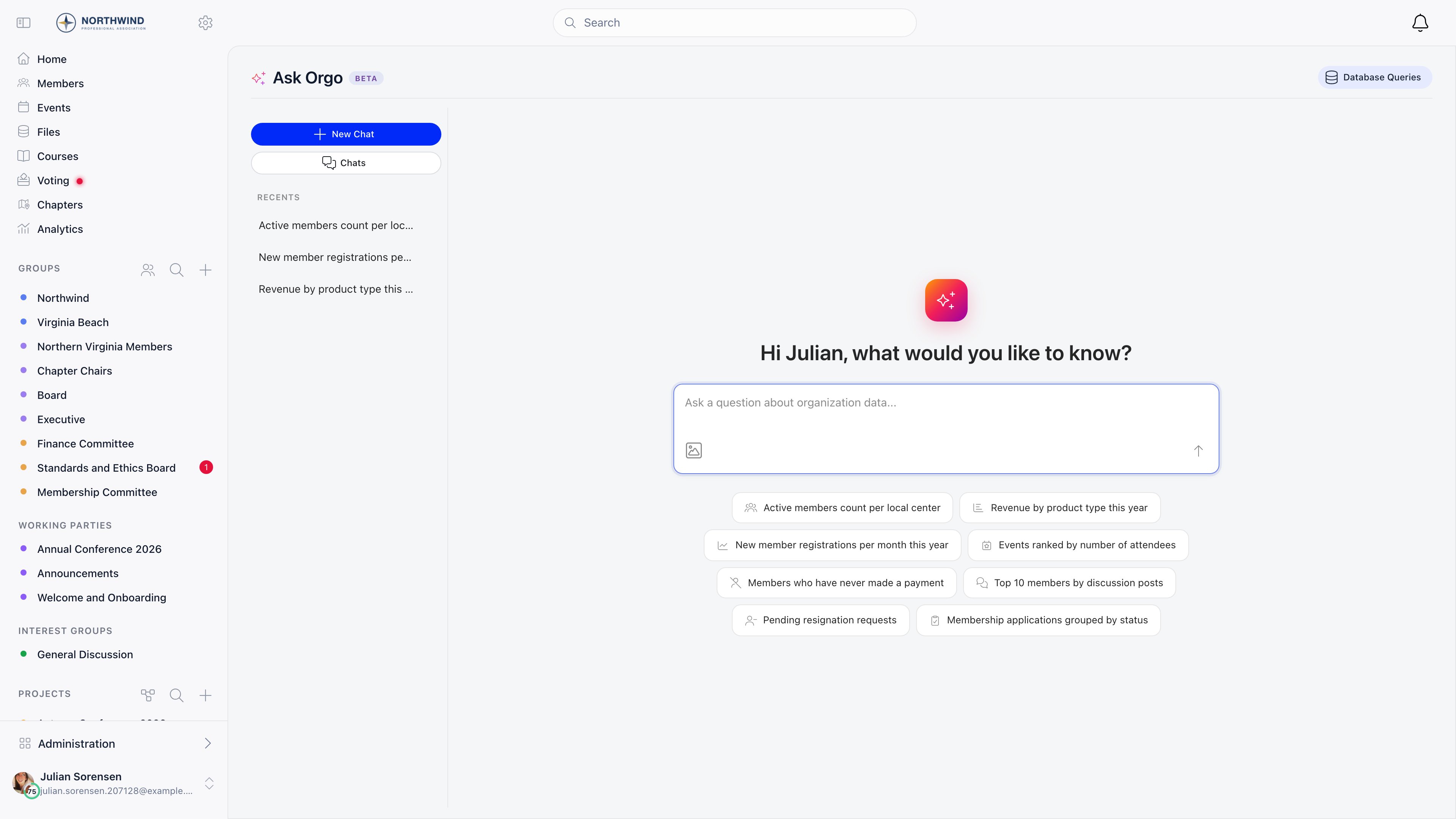
Type a question and press Enter. Questions are capped at 1000 characters, and you
can attach one image (PNG, JPEG, GIF, or WebP, up to 5 MB). The welcome screen
offers eight starting points, including **Active members count per local
center**, **Revenue by product type this year**, **Members who have never made a
payment**, and **Top 10 members by discussion posts**.
Ask Orgo replies with one of three things:
* a **result**: a summary sentence, a table, and a chart when the shape of the
data suits one;
* a **clarifying question**, when the request is too vague to turn into a query;
* a **segment proposal**, when you asked it to build or save a list rather than
show one. It shows the criteria and an estimated member count, with **Open in
editor** to finish it as an [email list](/docs/platform/emails/email-lists).
Follow-ups stay in the same chat and modify the previous query, so "add their
email", "only active ones", "break it down by month", and "show as a chart" all
work. Name the values you want, in business terms, rather than pointing at rows
on screen: the assistant cannot read the result table. A conversation keeps its
most recent 20 messages; your chat list shows your own last 50 conversations,
newest first, with a search box. You can delete a chat, and rate an answer with
the thumbs up and down buttons.
Ask Orgo carries a **Beta** badge, and the page warns that it can make mistakes
and that database entries are worth checking.
***
## What Ask Orgo can reach
Ask Orgo has no free access to the database. It works from a fixed catalogue of
55 record types and, within each, a hand-picked list of fields.
| Area | Record types in the catalogue |
| -------------- | ------------------------------------------------------------------------------------------------------------------------------------- |
| **People** | Members, contacts, families and family members, companies and company membership, roles and role assignments, group memberships, tags |
| **Structure** | Local centers, units, towns, counties, countries |
| **Membership** | Adhesions (applications), resignation requests, waitlist entries, certifications, identity verification records |
| **Money** | Products, product prices and add-ons, payments, fee payments, invoices, subscription profiles |
| **Events** | Events, registrations and attendance, attendance add-ons |
| **Learning** | Courses, sections, lessons, enrolments, badges, badge awards, badge points |
| **Engagement** | Discussions, newsletters and their recipients, email delivery log, forms and submissions, votes and voting sessions, referrals |
| **Work** | Projects, tasks, contracts and contract assignments, official gazettes, custom field definitions and values |
Some are reachable only through a related record: registrations always through
their event, prices through their product.
Not in the catalogue: credentials, tokens, and session data. Identity
verification records expose only the upload date, validation status, and
validation date, because ID and personal numbers are stored encrypted and are not
queryable (see [Identity validation](/docs/platform/identity-validation)). Voting
records expose only whether a member voted, never which option they chose (see
[E-voting](/docs/platform/e-voting)).
Values stored in encrypted [custom fields](/docs/platform/users/custom-fields) come
back in their stored encrypted form through Ask Orgo, because results are read
as raw rows rather than as full records. Read those values on the member profile
instead.
***
## How a question becomes an answer
Orgo sends Anthropic's Claude API your question, the catalogue above (record
and field names with their descriptions), and the structured queries from
earlier turns in the same chat. It does not send result rows, which is why a
follow-up cannot refer to "those ones" and has to name the values.
A structured description: which record type to start from, which related
records to join, filters, columns, grouping, and sorting.
Unknown record types, fields, and operators are rejected. A query may use at
most 6 joins, 20 filters, 20 columns, and 5 aggregate filters, and the page
size is clamped to 500 rows. Queries that would inflate totals by combining
several one-to-many relations are refused with an explanation rather than
returning a wrong number.
Before anything else is added, the compiler pins the query to your
organisation, and every joined record hangs off that filter. Only SELECT
statements are allowed, and a non-SELECT is refused before it reaches the
database.
The round trip has a 30 second budget. A query that is too heavy comes back
asking you to narrow it: a date range, one local center, or a count instead of
the detail rows.
Ask Orgo runs with full tenant-admin reach: an `ADMIN_TENANT` user can ask about
any member in the organisation, including data they would have to click through
several profiles to see. Grant `ADMIN_TENANT` accordingly. Local admins do not
get Ask Orgo at all.
***
## Working with a result
***
## Where to find it
| Surface | Route | Who can open it |
| -------------------------------- | -------------------------------------- | ------------------------------------------------------------------------- |
| **Ask Orgo** | `/ask-orgo`, sidebar item **Ask Orgo** | `ADMIN_TENANT` only |
| **Analytics** | `/stats`, sidebar item **Analytics** | The **Minimum access level** on the analytics module, then a per-tab role |
| **Database Queries** | Analytics, **DB Query** tab | `FINANCIAL_TENANT`, or any member a saved query was shared with |
| **[Reports](/docs/platform/reports)** | `/reports`, sidebar item **Reports** | `ADMIN_TENANT` only |
Analytics needs the analytics module active. The module switch is on **Settings**
→ **Modules** → **All Modules** (`/tenants/settings/features`), under
`analytics`. The **Minimum access level** and the per-tab roles are on **Settings**
→ **Modules** → **Users & Profiles** → **Security & Permissions**, which collects
those dropdowns from every active module onto one page.
***
## Ask Orgo
Type a question and press Enter. Questions are capped at 1000 characters, and you
can attach one image (PNG, JPEG, GIF, or WebP, up to 5 MB). The welcome screen
offers eight starting points, including **Active members count per local
center**, **Revenue by product type this year**, **Members who have never made a
payment**, and **Top 10 members by discussion posts**.
Ask Orgo replies with one of three things:
* a **result**: a summary sentence, a table, and a chart when the shape of the
data suits one;
* a **clarifying question**, when the request is too vague to turn into a query;
* a **segment proposal**, when you asked it to build or save a list rather than
show one. It shows the criteria and an estimated member count, with **Open in
editor** to finish it as an [email list](/docs/platform/emails/email-lists).
Follow-ups stay in the same chat and modify the previous query, so "add their
email", "only active ones", "break it down by month", and "show as a chart" all
work. Name the values you want, in business terms, rather than pointing at rows
on screen: the assistant cannot read the result table. A conversation keeps its
most recent 20 messages; your chat list shows your own last 50 conversations,
newest first, with a search box. You can delete a chat, and rate an answer with
the thumbs up and down buttons.
Ask Orgo carries a **Beta** badge, and the page warns that it can make mistakes
and that database entries are worth checking.
***
## What Ask Orgo can reach
Ask Orgo has no free access to the database. It works from a fixed catalogue of
55 record types and, within each, a hand-picked list of fields.
| Area | Record types in the catalogue |
| -------------- | ------------------------------------------------------------------------------------------------------------------------------------- |
| **People** | Members, contacts, families and family members, companies and company membership, roles and role assignments, group memberships, tags |
| **Structure** | Local centers, units, towns, counties, countries |
| **Membership** | Adhesions (applications), resignation requests, waitlist entries, certifications, identity verification records |
| **Money** | Products, product prices and add-ons, payments, fee payments, invoices, subscription profiles |
| **Events** | Events, registrations and attendance, attendance add-ons |
| **Learning** | Courses, sections, lessons, enrolments, badges, badge awards, badge points |
| **Engagement** | Discussions, newsletters and their recipients, email delivery log, forms and submissions, votes and voting sessions, referrals |
| **Work** | Projects, tasks, contracts and contract assignments, official gazettes, custom field definitions and values |
Some are reachable only through a related record: registrations always through
their event, prices through their product.
Not in the catalogue: credentials, tokens, and session data. Identity
verification records expose only the upload date, validation status, and
validation date, because ID and personal numbers are stored encrypted and are not
queryable (see [Identity validation](/docs/platform/identity-validation)). Voting
records expose only whether a member voted, never which option they chose (see
[E-voting](/docs/platform/e-voting)).
Values stored in encrypted [custom fields](/docs/platform/users/custom-fields) come
back in their stored encrypted form through Ask Orgo, because results are read
as raw rows rather than as full records. Read those values on the member profile
instead.
***
## How a question becomes an answer
Orgo sends Anthropic's Claude API your question, the catalogue above (record
and field names with their descriptions), and the structured queries from
earlier turns in the same chat. It does not send result rows, which is why a
follow-up cannot refer to "those ones" and has to name the values.
A structured description: which record type to start from, which related
records to join, filters, columns, grouping, and sorting.
Unknown record types, fields, and operators are rejected. A query may use at
most 6 joins, 20 filters, 20 columns, and 5 aggregate filters, and the page
size is clamped to 500 rows. Queries that would inflate totals by combining
several one-to-many relations are refused with an explanation rather than
returning a wrong number.
Before anything else is added, the compiler pins the query to your
organisation, and every joined record hangs off that filter. Only SELECT
statements are allowed, and a non-SELECT is refused before it reaches the
database.
The round trip has a 30 second budget. A query that is too heavy comes back
asking you to narrow it: a date range, one local center, or a count instead of
the detail rows.
Ask Orgo runs with full tenant-admin reach: an `ADMIN_TENANT` user can ask about
any member in the organisation, including data they would have to click through
several profiles to see. Grant `ADMIN_TENANT` accordingly. Local admins do not
get Ask Orgo at all.
***
## Working with a result
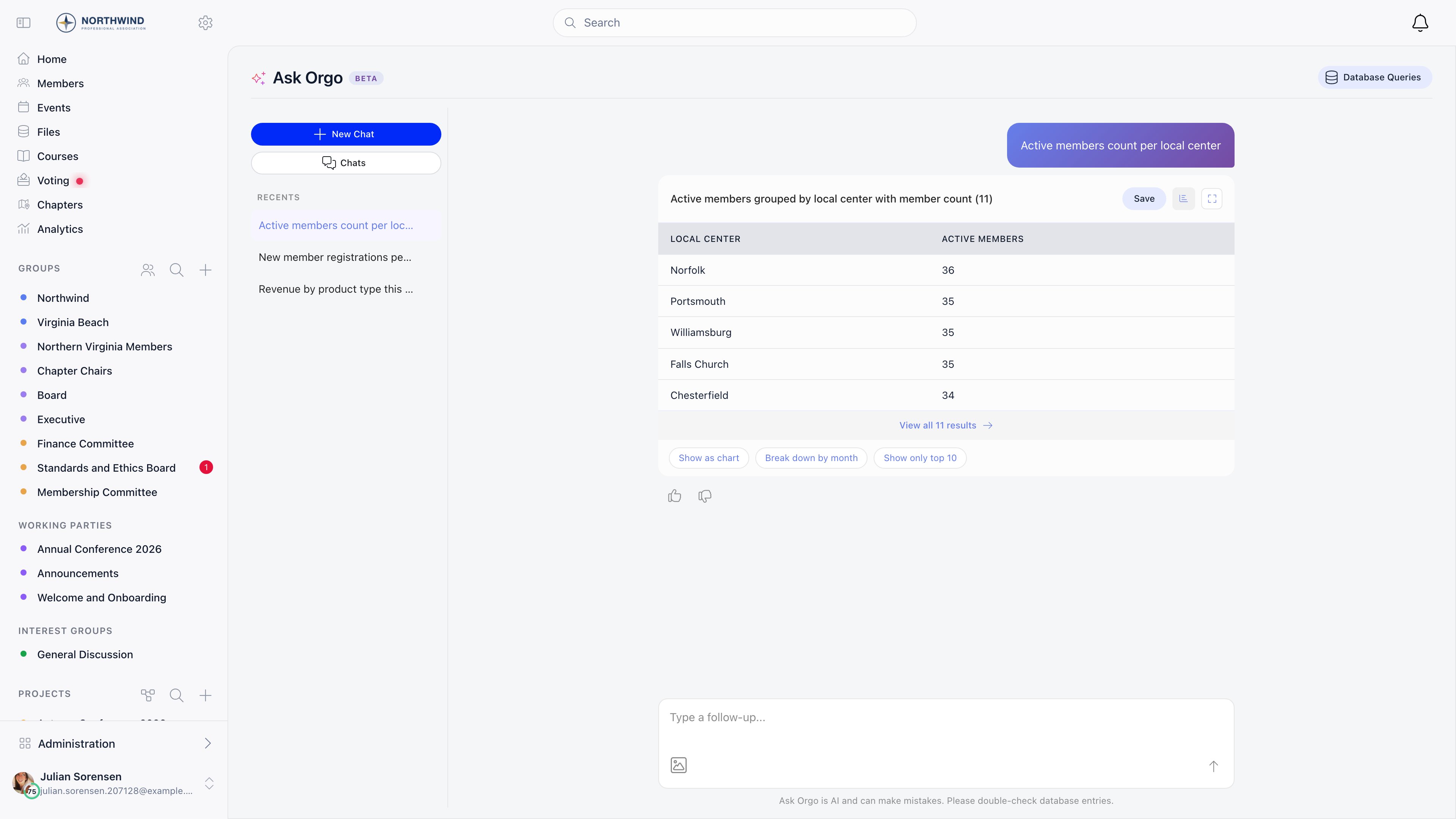 | Action | What it does |
| ------------------- | ------------------------------------------------------------------------------------------------------------------ |
| **Expand table** | Opens the result in the full-width panel with pagination, 50 rows a page |
| Chart toggle | Switches between the table and the chart the model recommended (available for aggregate results with 2 to 30 rows) |
| **Export CSV** | Downloads the full result set, 10,000 rows per file, as several files if needed |
| **Save** | Stores the query under a name in **Database Queries** |
| **Save as segment** | Opens the email list editor prefilled from the question, for results that are lists of people |
Column headers come back in the language you asked the question in.
***
## Analytics
| Action | What it does |
| ------------------- | ------------------------------------------------------------------------------------------------------------------ |
| **Expand table** | Opens the result in the full-width panel with pagination, 50 rows a page |
| Chart toggle | Switches between the table and the chart the model recommended (available for aggregate results with 2 to 30 rows) |
| **Export CSV** | Downloads the full result set, 10,000 rows per file, as several files if needed |
| **Save** | Stores the query under a name in **Database Queries** |
| **Save as segment** | Opens the email list editor prefilled from the question, for results that are lists of people |
Column headers come back in the language you asked the question in.
***
## Analytics
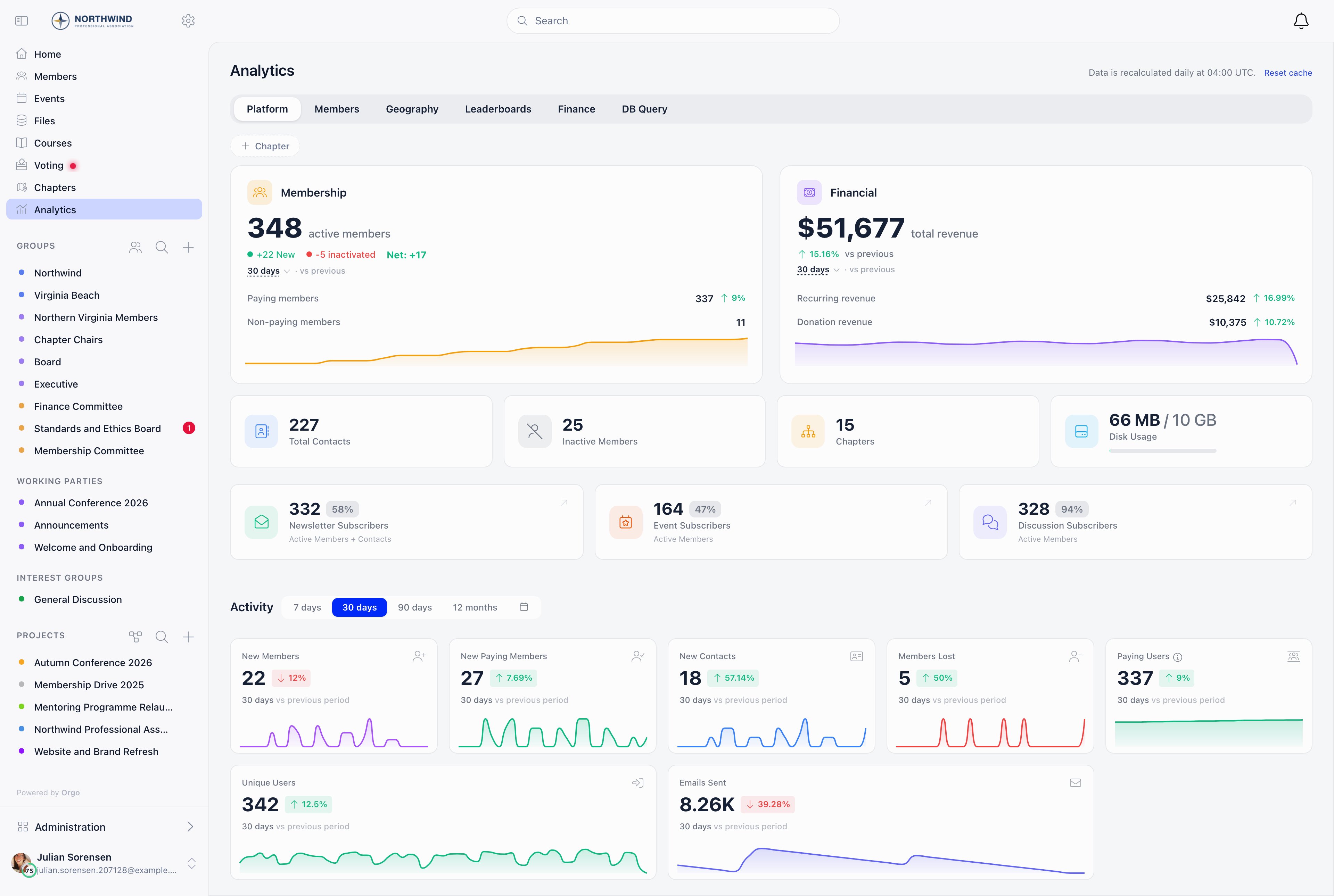 Tabs appear only if you hold the role configured for them. Defaults:
| Tab | Default role | Shows |
| ---------------- | -------------------- | -------------------------------------------------------------------------------------------------------------------------------------------------------------------------------------------------------------------------------------- |
| **Platform** | `ADMIN_TENANT` | Active and inactive members, new members and members lost, contacts, emails sent, newsletter and notification subscription splits, discussions, comments, reactions, events, disk usage, revenue totals, paying and non-paying members |
| **Members** | `HR_TENANT` | Members by status, by user type, by gender, average age, signups and exits over time, fees paid by year |
| **Geography** | Any signed-in member | Members by town, county or state, country, and local center |
| **Leaderboards** | Any signed-in member | Top members by posts, reactions, events, referrals, and badge points, over 7 days, 30 days, or all time |
| **Finance** | `FINANCIAL_TENANT` | Total, recurring, and donation revenue, and payment counts over a period. Needs online payments active |
| **DB Query** | `FINANCIAL_TENANT` | Saved database queries |
The Platform tab is also open to `ADMIN_LOCAL` and `ADMIN_PARENT_LOCAL` when
local centers are in use, scoped to their own local center and its descendants,
never organisation-wide. Membership and geography tabs accept a local center
filter and check the local equivalent of the tab role against it.
Period selectors offer 7 days, 30 days, 90 days, 12 months, and a custom range.
Daily totals are aggregated overnight, at 04:00 UTC for the previous day, and the
page says so. Today's figures are computed live and added on top, and responses
are cached for five minutes. **Reset cache** next to the page title clears that
cache and reloads, which is the fix when a number looks stale after a bulk import
or a large payment run.
***
## Database Queries
Anything you save from Ask Orgo lands here as a named query that admins can run
again without the chat. Opening one runs it and shows the results, with
**Export** for a download. It is stored as the finished statement, with your
organisation's filter baked in, so it keeps returning your data only. `FINANCIAL_TENANT`
admins see every saved query in the organisation; everyone else sees only the
queries shared with them, listed under **Extra access** on the query. Every run
is recorded in the activity log with the query name and who ran it.
***
## Troubleshooting
Give it a scope: "how many active members joined each month this year" works
better than "membership trends".
Two settings are checked before the page renders, and failing either one
redirects you to the dashboard with no message. The analytics module has to
be active, and you have to clear the analytics setting labelled **Minimum
access level**, which ships as any signed-in member.
Worked example: an organisation raises **Minimum access level** to
`HR_TENANT` so that ordinary members stop seeing the numbers. That works, but
it also takes away the Geography and Leaderboards tabs, which default to any
signed-in member and were the two tabs the organisation actually wanted
everyone to have. The minimum is a gate on the whole page, evaluated before
any per-tab role.
If you get in and the page is empty, the minimum passed and none of the tab
roles did.
Finance needs the role and online payments switched on. The tab checks both,
so an organisation that collects fees by bank transfer only never sees it,
whoever is looking. Revenue totals still show on the Platform tab.
**DB Query** is the other tab keyed to `FINANCIAL_TENANT`, and it does not
check the payments setting, so seeing Database Queries but no Finance is the
normal shape of that combination rather than a fault.
No, on both counts. The route, the sidebar entry and every endpoint behind
the chat require `ADMIN_TENANT`, and the sidebar entry is written into the
menu in code rather than drawn from your configurable menu, so it cannot be
added to another role's menu or moved.
Someone without `ADMIN_TENANT` who follows a link to Ask Orgo is sent to the
login screen rather than shown a permission message, which reads like an
expired session and is not one. The same is true of any page in Orgo that
they lack the role for. There is no read-only or delegated version of the
chat; if a colleague needs an answer regularly, save the query and give them
access to it, with the caveat in the next answer.
Sharing works, the way in does not. Adding somebody under **Extra access**
lets them run that query, and once at least one query is shared with them a
**queries** entry appears in their sidebar. That entry points at the
Database Queries tab of Analytics, and the tab itself renders only for
`FINANCIAL_TENANT`, so they land on Analytics without it.
Send them the query's own address instead, the one in your browser bar when
you have the query open. That page has no role gate of its own and checks the
share, so it opens for them and records the run in the activity log under
their name.
The related setting is the analytics `hasQuery` flag: turning it off removes
the sidebar entry for everyone but leaves the tab in place for finance
admins.
It refuses when the arithmetic would be wrong rather than returning a number
that looks fine.
Worked example: ask for total fees paid and the number of events attended,
per member. Both hang off the member as separate one-to-many branches, so
joining them multiplies every fee row by every attendance row: a member with
4 payments and 5 events contributes 20 rows, and the fee total comes back
five times too high. Orgo detects the shape, blocks the sum, and tells you to
query each metric separately.
Ask it as two questions, then line the answers up by member in a spreadsheet,
or ask for counts rather than sums when you only need magnitude.
The export from the chat asks for pages of 10,000 rows, but every query,
including that one, is capped at 500 rows per request. So a result of more
than 500 rows exports as a single file holding the first 500, and the
completion message still says the export finished.
Worked example: a question matching 3,000 members reports 3,000 in the chat
and downloads a CSV with 500 rows in it.
For a full extract, use **Save** to store the query, then run and export it
from **Database Queries**. Saving deliberately drops the paging limit, so the
saved statement returns the whole result set. The other option is to narrow
the question until it fits, one local center or one month at a time.
Saving removes any row limit of 50 or more, on the assumption that it came
from the default paging rather than from your question. Limits below 50 are
kept, because those look like something you asked for.
Worked example: "top 100 members by discussion posts" answers with 100 rows
in the chat. Saved and re-run from Database Queries, it returns every member
ranked by posts, which for a large organisation is a much heavier query than
the one you tested. "Top 25" saves as 25.
If you want a fixed cut-off in a saved query, ask for fewer than 50, or add
the real filter you mean (a date range, a status) instead of relying on the
count.
A conversation keeps 20 messages: the first two, which hold the original
framing, and the most recent eighteen. Turns in the middle are dropped, so in
a long session a follow-up can no longer see a constraint you set twenty
turns ago. Restate it, or start a fresh chat for a new line of questioning.
Reopening an old chat shows at most 50 rows of the last result, because that
is the size of the snapshot stored with the conversation. It is a record of
what you saw, not a live result. Re-run the question to page through
everything or to pick up data that has changed since.
Your chat list shows your own conversations only, and there is no shared
inbox of everyone's chats. But conversations are stored per organisation
rather than sealed per person, and another organisation admin who has the
address of one can open it.
In practice this changes little, because the feature is limited to
`ADMIN_TENANT` and any admin can ask the same question themselves and get the
same data. Treat chats as a shared admin workspace rather than private notes,
and delete a conversation when you want its text and its stored rows gone.
**Reset cache** requires `ADMIN_TENANT`, while the tabs themselves can be
opened by `HR_TENANT`, `FINANCIAL_TENANT` or ordinary members depending on
your settings. A finance admin looking at a stale figure after a large
payment run has no button to press and has to wait out the five minute cache,
or ask an organisation admin.
**Reset cache** also only clears the five minute cache. It does not rebuild
the overnight aggregation, so a figure that is a whole day out rather than
minutes out will not move until the next nightly run, however many times you
press it.
Check the assumptions in the summary line. Ask Orgo defaults to active
members, successful payments, and published events unless you say otherwise.
Ask "include inactive members too" to widen it.
Result rows are never sent. What leaves Orgo is your question, the catalogue
of record and field names, and the structured queries from the same chat; an
attached image goes with the question and is not stored on the conversation
afterwards. The conversation itself lives in your organisation's own data as
the message text, the structured query, and a snapshot of up to 50 rows from
the last result, so reopening a chat does not re-run the query. Deleting the
conversation removes all of it.
***
## Related
* [Members](/docs/platform/users) for the directory the answers are drawn from
* [Email lists](/docs/platform/emails/email-lists) for where a segment proposal ends up
* [Permissions](/docs/platform/permissions) for what `ADMIN_TENANT` and `FINANCIAL_TENANT` unlock
* [Custom fields](/docs/platform/users/custom-fields) for which values are encrypted
* [Event analytics](/docs/platform/events/analytics) for per-event numbers, separate from these dashboards
Tabs appear only if you hold the role configured for them. Defaults:
| Tab | Default role | Shows |
| ---------------- | -------------------- | -------------------------------------------------------------------------------------------------------------------------------------------------------------------------------------------------------------------------------------- |
| **Platform** | `ADMIN_TENANT` | Active and inactive members, new members and members lost, contacts, emails sent, newsletter and notification subscription splits, discussions, comments, reactions, events, disk usage, revenue totals, paying and non-paying members |
| **Members** | `HR_TENANT` | Members by status, by user type, by gender, average age, signups and exits over time, fees paid by year |
| **Geography** | Any signed-in member | Members by town, county or state, country, and local center |
| **Leaderboards** | Any signed-in member | Top members by posts, reactions, events, referrals, and badge points, over 7 days, 30 days, or all time |
| **Finance** | `FINANCIAL_TENANT` | Total, recurring, and donation revenue, and payment counts over a period. Needs online payments active |
| **DB Query** | `FINANCIAL_TENANT` | Saved database queries |
The Platform tab is also open to `ADMIN_LOCAL` and `ADMIN_PARENT_LOCAL` when
local centers are in use, scoped to their own local center and its descendants,
never organisation-wide. Membership and geography tabs accept a local center
filter and check the local equivalent of the tab role against it.
Period selectors offer 7 days, 30 days, 90 days, 12 months, and a custom range.
Daily totals are aggregated overnight, at 04:00 UTC for the previous day, and the
page says so. Today's figures are computed live and added on top, and responses
are cached for five minutes. **Reset cache** next to the page title clears that
cache and reloads, which is the fix when a number looks stale after a bulk import
or a large payment run.
***
## Database Queries
Anything you save from Ask Orgo lands here as a named query that admins can run
again without the chat. Opening one runs it and shows the results, with
**Export** for a download. It is stored as the finished statement, with your
organisation's filter baked in, so it keeps returning your data only. `FINANCIAL_TENANT`
admins see every saved query in the organisation; everyone else sees only the
queries shared with them, listed under **Extra access** on the query. Every run
is recorded in the activity log with the query name and who ran it.
***
## Troubleshooting
Give it a scope: "how many active members joined each month this year" works
better than "membership trends".
Two settings are checked before the page renders, and failing either one
redirects you to the dashboard with no message. The analytics module has to
be active, and you have to clear the analytics setting labelled **Minimum
access level**, which ships as any signed-in member.
Worked example: an organisation raises **Minimum access level** to
`HR_TENANT` so that ordinary members stop seeing the numbers. That works, but
it also takes away the Geography and Leaderboards tabs, which default to any
signed-in member and were the two tabs the organisation actually wanted
everyone to have. The minimum is a gate on the whole page, evaluated before
any per-tab role.
If you get in and the page is empty, the minimum passed and none of the tab
roles did.
Finance needs the role and online payments switched on. The tab checks both,
so an organisation that collects fees by bank transfer only never sees it,
whoever is looking. Revenue totals still show on the Platform tab.
**DB Query** is the other tab keyed to `FINANCIAL_TENANT`, and it does not
check the payments setting, so seeing Database Queries but no Finance is the
normal shape of that combination rather than a fault.
No, on both counts. The route, the sidebar entry and every endpoint behind
the chat require `ADMIN_TENANT`, and the sidebar entry is written into the
menu in code rather than drawn from your configurable menu, so it cannot be
added to another role's menu or moved.
Someone without `ADMIN_TENANT` who follows a link to Ask Orgo is sent to the
login screen rather than shown a permission message, which reads like an
expired session and is not one. The same is true of any page in Orgo that
they lack the role for. There is no read-only or delegated version of the
chat; if a colleague needs an answer regularly, save the query and give them
access to it, with the caveat in the next answer.
Sharing works, the way in does not. Adding somebody under **Extra access**
lets them run that query, and once at least one query is shared with them a
**queries** entry appears in their sidebar. That entry points at the
Database Queries tab of Analytics, and the tab itself renders only for
`FINANCIAL_TENANT`, so they land on Analytics without it.
Send them the query's own address instead, the one in your browser bar when
you have the query open. That page has no role gate of its own and checks the
share, so it opens for them and records the run in the activity log under
their name.
The related setting is the analytics `hasQuery` flag: turning it off removes
the sidebar entry for everyone but leaves the tab in place for finance
admins.
It refuses when the arithmetic would be wrong rather than returning a number
that looks fine.
Worked example: ask for total fees paid and the number of events attended,
per member. Both hang off the member as separate one-to-many branches, so
joining them multiplies every fee row by every attendance row: a member with
4 payments and 5 events contributes 20 rows, and the fee total comes back
five times too high. Orgo detects the shape, blocks the sum, and tells you to
query each metric separately.
Ask it as two questions, then line the answers up by member in a spreadsheet,
or ask for counts rather than sums when you only need magnitude.
The export from the chat asks for pages of 10,000 rows, but every query,
including that one, is capped at 500 rows per request. So a result of more
than 500 rows exports as a single file holding the first 500, and the
completion message still says the export finished.
Worked example: a question matching 3,000 members reports 3,000 in the chat
and downloads a CSV with 500 rows in it.
For a full extract, use **Save** to store the query, then run and export it
from **Database Queries**. Saving deliberately drops the paging limit, so the
saved statement returns the whole result set. The other option is to narrow
the question until it fits, one local center or one month at a time.
Saving removes any row limit of 50 or more, on the assumption that it came
from the default paging rather than from your question. Limits below 50 are
kept, because those look like something you asked for.
Worked example: "top 100 members by discussion posts" answers with 100 rows
in the chat. Saved and re-run from Database Queries, it returns every member
ranked by posts, which for a large organisation is a much heavier query than
the one you tested. "Top 25" saves as 25.
If you want a fixed cut-off in a saved query, ask for fewer than 50, or add
the real filter you mean (a date range, a status) instead of relying on the
count.
A conversation keeps 20 messages: the first two, which hold the original
framing, and the most recent eighteen. Turns in the middle are dropped, so in
a long session a follow-up can no longer see a constraint you set twenty
turns ago. Restate it, or start a fresh chat for a new line of questioning.
Reopening an old chat shows at most 50 rows of the last result, because that
is the size of the snapshot stored with the conversation. It is a record of
what you saw, not a live result. Re-run the question to page through
everything or to pick up data that has changed since.
Your chat list shows your own conversations only, and there is no shared
inbox of everyone's chats. But conversations are stored per organisation
rather than sealed per person, and another organisation admin who has the
address of one can open it.
In practice this changes little, because the feature is limited to
`ADMIN_TENANT` and any admin can ask the same question themselves and get the
same data. Treat chats as a shared admin workspace rather than private notes,
and delete a conversation when you want its text and its stored rows gone.
**Reset cache** requires `ADMIN_TENANT`, while the tabs themselves can be
opened by `HR_TENANT`, `FINANCIAL_TENANT` or ordinary members depending on
your settings. A finance admin looking at a stale figure after a large
payment run has no button to press and has to wait out the five minute cache,
or ask an organisation admin.
**Reset cache** also only clears the five minute cache. It does not rebuild
the overnight aggregation, so a figure that is a whole day out rather than
minutes out will not move until the next nightly run, however many times you
press it.
Check the assumptions in the summary line. Ask Orgo defaults to active
members, successful payments, and published events unless you say otherwise.
Ask "include inactive members too" to widen it.
Result rows are never sent. What leaves Orgo is your question, the catalogue
of record and field names, and the structured queries from the same chat; an
attached image goes with the question and is not stored on the conversation
afterwards. The conversation itself lives in your organisation's own data as
the message text, the structured query, and a snapshot of up to 50 rows from
the last result, so reopening a chat does not re-run the query. Deleting the
conversation removes all of it.
***
## Related
* [Members](/docs/platform/users) for the directory the answers are drawn from
* [Email lists](/docs/platform/emails/email-lists) for where a segment proposal ends up
* [Permissions](/docs/platform/permissions) for what `ADMIN_TENANT` and `FINANCIAL_TENANT` unlock
* [Custom fields](/docs/platform/users/custom-fields) for which values are encrypted
* [Event analytics](/docs/platform/events/analytics) for per-event numbers, separate from these dashboards