> ## Documentation Index
> Fetch the complete documentation index at: https://orgo.space/docs/llms.txt
> Use this file to discover all available pages before exploring further.
# Orgo Support
> The support chat inside your workspace: who sees it, who answers it, and what Orgo can see
**Built for** organization admins with a question about Orgo itself.
**Replaces** writing to [support@orgo.space](mailto:support@orgo.space) and waiting for a reply in your inbox.
A chat launcher sits in the corner of the app for organization admins. It reaches
Orgo, not your members. This is the opposite direction to the
[Help Desk](/docs/platform/help-desk), which is where your own members write to you.
***
## Turning it on
Nothing. There is no module to enable and no setting to configure. The launcher
appears for the people described below and for nobody else.
***
## Who sees it
| Who | Sees the launcher |
| ----------------------------------------------------------------------- | ----------------- |
| Holders of `ADMIN_TENANT` in your organization | Yes |
| Orgo's own administrators and super admins | Yes |
| Chapter and local admins (`ADMIN_LOCAL`, and the parent-chapter levels) | No |
| Every other member | No |
Members never see it, so it is not a route for them to reach you. Give them the
[Help Desk](/docs/platform/help-desk) instead.
***
## Where it appears
* Inside the signed-in workspace, on any page.
* On desktop only. It is hidden at phone widths, so an admin looking for it on
their phone will not find it.
* Not on the login or register screens. You have to be signed in, which means a
member who cannot sign in cannot use the chat to say so: they need
[support@orgo.space](mailto:support@orgo.space), or you on their behalf.
* Not in the [Event App](/docs/platform/events/event-app), which has its own separate
sign-in and is meant for attendees.
The launcher disappears while you are impersonating another member, so a question
you raise is never attributed to the person whose account you were viewing. Stop
impersonating first.
***
## Who answers
**An AI agent answers first.** Fin is Orgo's agentic AI support assistant. It
reads your question, works out what you are trying to do, and answers from the
same documentation you are reading now, citing the pages it used so you can check
them. It handles follow-up questions in context, so you can keep the conversation
going rather than starting again.
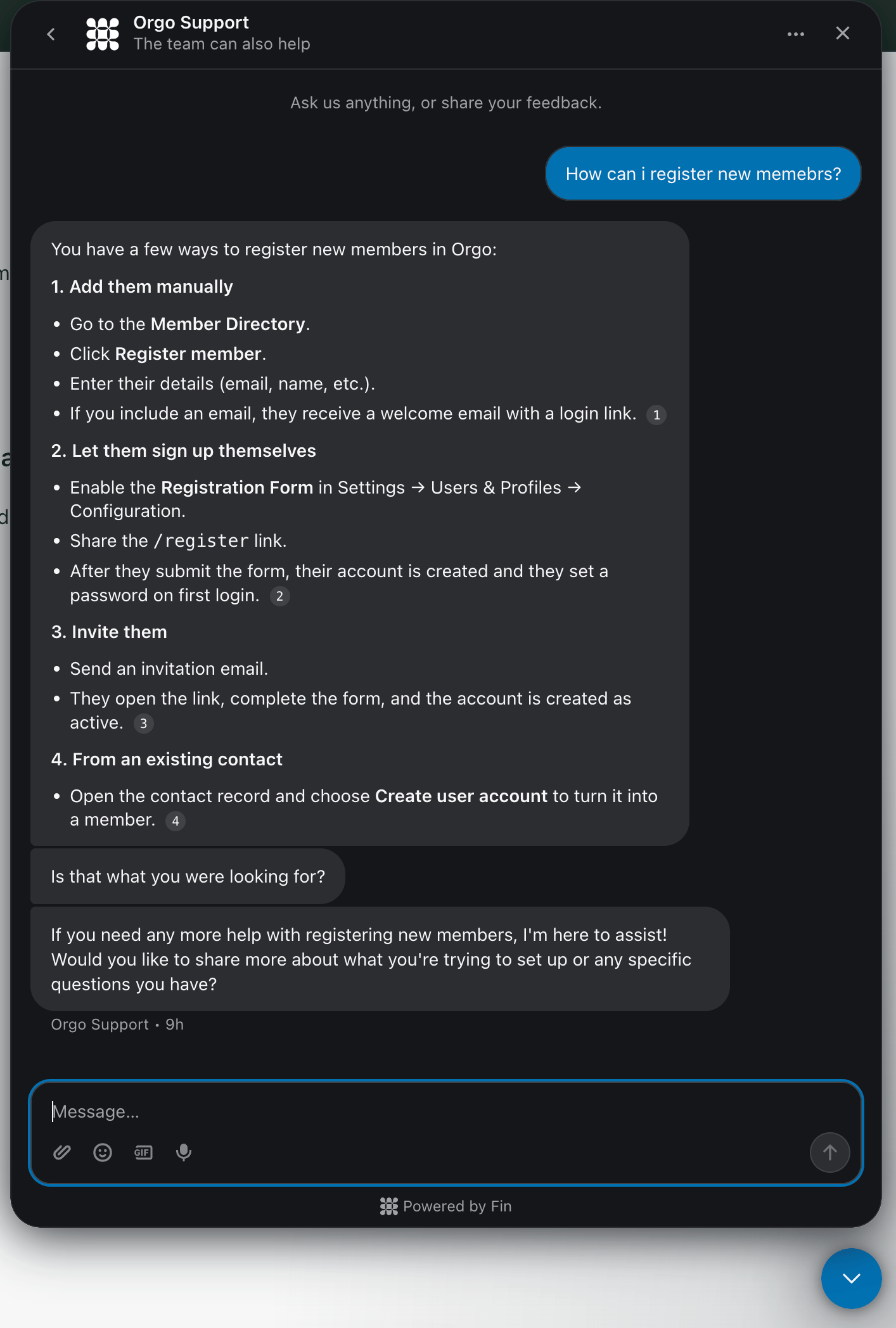
A real answer. The question was typed with a typo and still understood, the reply
sets out each route in order, and the small numbers beside the steps are citations
back to the documentation pages the answer came from.
 Anything it cannot resolve is handed to a person on the Orgo support team, in the
same conversation. You do not have to ask for the handover or repeat yourself,
and the person picking it up can see what you already asked.
You are talking to an AI first, and it will say so. If you would rather have a
person, ask for one and the conversation is passed on. Treat its answers the
way you would treat any assistant's: it is reliable on documented behaviour and
worth double checking on anything specific to your own configuration or data,
because it cannot see inside your workspace.
***
## What Orgo can see
Opening the chat passes a small amount of context so that support knows who is
writing and from which organization:
| Shared | Not shared |
| --------------------------------- | ------------------------------------------ |
| Your name and email address | Any of your members' records |
| The date your account was created | Their names, emails, payments or documents |
| Your interface language | Anything held inside your workspace |
| Your organization's name and plan | |
The chat carries the account you are signed in as and the organization you are
in. It does not give the support team a way to read your data.
***
## Common questions
Direction. This chat is you writing to Orgo about the platform. The
[Help Desk](/docs/platform/help-desk) is a ticket board inside your workspace where
your members write to your own admins. They share nothing: a ticket raised in
the Help Desk never reaches Orgo, and a message in this chat never appears on
your ticket board.
Expected. It is limited to `ADMIN_TENANT`, so chapter-level admins do not get
it however wide their local permissions are. Either raise the question
yourself, or write to [support@orgo.space](mailto:support@orgo.space).
It is desktop only. Open the workspace on a computer, or email
[support@orgo.space](mailto:support@orgo.space).
Do it from your own account, not while impersonating theirs: the launcher is
hidden during impersonation, and a question raised that way would carry the
wrong identity.
No. Only your own name, email, account creation date and interface language
reach the conversation, along with your organization's name and plan. Member
records are never part of it.
***
## Related
* [Help Desk](/docs/platform/help-desk) - the other direction: your members writing to you
* [Permissions](/docs/platform/permissions) - what `ADMIN_TENANT` covers
* [Troubleshooting Access](/docs/platform/users/troubleshooting-access) - sign-in problems you can solve without support
Anything it cannot resolve is handed to a person on the Orgo support team, in the
same conversation. You do not have to ask for the handover or repeat yourself,
and the person picking it up can see what you already asked.
You are talking to an AI first, and it will say so. If you would rather have a
person, ask for one and the conversation is passed on. Treat its answers the
way you would treat any assistant's: it is reliable on documented behaviour and
worth double checking on anything specific to your own configuration or data,
because it cannot see inside your workspace.
***
## What Orgo can see
Opening the chat passes a small amount of context so that support knows who is
writing and from which organization:
| Shared | Not shared |
| --------------------------------- | ------------------------------------------ |
| Your name and email address | Any of your members' records |
| The date your account was created | Their names, emails, payments or documents |
| Your interface language | Anything held inside your workspace |
| Your organization's name and plan | |
The chat carries the account you are signed in as and the organization you are
in. It does not give the support team a way to read your data.
***
## Common questions
Direction. This chat is you writing to Orgo about the platform. The
[Help Desk](/docs/platform/help-desk) is a ticket board inside your workspace where
your members write to your own admins. They share nothing: a ticket raised in
the Help Desk never reaches Orgo, and a message in this chat never appears on
your ticket board.
Expected. It is limited to `ADMIN_TENANT`, so chapter-level admins do not get
it however wide their local permissions are. Either raise the question
yourself, or write to [support@orgo.space](mailto:support@orgo.space).
It is desktop only. Open the workspace on a computer, or email
[support@orgo.space](mailto:support@orgo.space).
Do it from your own account, not while impersonating theirs: the launcher is
hidden during impersonation, and a question raised that way would carry the
wrong identity.
No. Only your own name, email, account creation date and interface language
reach the conversation, along with your organization's name and plan. Member
records are never part of it.
***
## Related
* [Help Desk](/docs/platform/help-desk) - the other direction: your members writing to you
* [Permissions](/docs/platform/permissions) - what `ADMIN_TENANT` covers
* [Troubleshooting Access](/docs/platform/users/troubleshooting-access) - sign-in problems you can solve without support