A Bettermode alternative built
for membership organizations
Bettermode excels at helping SaaS companies build visually customized customer communities, with a no-code Design Studio, strong discussion and gamification tools, and native integrations with HubSpot, Salesforce, and Zendesk. But when your organization needs native dues collection, multi-chapter management, and governance tools your bylaws can rely on, there's Orgo.
This page includes an honest comparison. We'll show you where Bettermode actually wins, who should stick with them, and where Orgo genuinely does it better. You decide.
TLDR: Quick verdict
The main difference between Bettermode and Orgo is that Bettermode is a customer community platform built for B2B SaaS brands, while Orgo is a complete membership management platform that combines native dues collection, multi-chapter coordination, community features, and governance tools in a single system.
Choose Orgo if:
You collect membership dues and need native renewals without Zapier workarounds You manage 500+ paying members across multiple chapters or regions You need governance tools: elections, eVoting, eDocuments, and eSignatures Your members expect a native mobile app, not just a mobile browser You want API access without a $1,500/month minimum
Choose Bettermode if:
You're a B2B SaaS company building a free customer community for support deflection and product feedback Visual customization and no-code brand control are your primary requirements You need deep integrations with a SaaS stack (HubSpot, Salesforce, Zendesk, Jira) Your members are customers who don't pay dues, and your revenue comes from elsewhere
Why organizations look for alternatives to Bettermode
Bettermode is a well-built platform with genuine strengths for SaaS customer communities. But three gaps emerge consistently in reviews from organizations with membership management needs.
Orgo vs Bettermode
Both platforms offer community features: discussions, gamification, member profiles, and events. The overlap is real. Where they diverge is in what wraps around those community features. Bettermode is a community engagement tool. Orgo is a complete membership management platform that includes community as one of its modules.
The table below covers features both platforms share, areas where Bettermode has a genuine edge, and areas where Orgo provides capabilities Bettermode does not.
Side-by-side feature comparison
Every cell has been verified against both platforms' current websites and user-reported data.
| Feature | | |
|---|---|---|
| Core membership | ||
| Member database and profiles | ||
| Membership dues and renewals | ||
| Custom membership forms | ||
| Multi-tier memberships | ||
| Approval workflows | ||
| Community & engagement | ||
| Discussion forums, Q&A, threads | ||
| Gamification (points, badges, leaderboards) | ||
| Member networking and directory | ||
| Event management | ||
| Email campaigns and newsletters | Email digest only | |
| Visual customization / design studio | Custom branding and domain | |
| Multilingual / translation | Multiple interface languages | |
| Payments & billing | ||
| Online payment processing | ||
| Administration & security | ||
| Granular permissions / RBAC | ||
| Analytics and reporting | Built-in; users cite limited depth | |
| SSO | JWT/SAML on Premium only (custom pricing) | |
| API and webhooks | Growth plan only ($1,500/month) | |
| Data residency (EU/US) | ||
| Platform & integrations | ||
| Native mobile app (iOS/Android) | ||
| CRM and SaaS integrations | ||
| AI features | ||
A Bettermode alternative with complete membership management
Bettermode covers community engagement well. These are the capabilities that membership organizations need beyond that, and that only Orgo provides natively.
| Your organization needs... | | |
|---|---|---|
| Membership operations | ||
| Native dues collection and automated renewals | ||
| Learning management system (courses, quizzes, certificates) | ||
| Project management and help desk | ||
| Multi-chapter management | ||
| Multi-chapter hierarchy (HQ, regions, local chapters) | Spaces system; no chapter autonomy or hierarchy | |
| Member transfers between chapters | ||
| Per-chapter Stripe payment accounts | ||
| Governance | ||
| eVoting and elections | ||
| eDocuments and eSignatures | ||
| Mobile | ||
| Branded native mobile app (iOS/Android) | ||
These capabilities are not on Bettermode's roadmap because they fall outside its core use case. The platform is built for customer communities, not membership organizations. If your operations depend on any of these, Orgo was designed with them as first-class features.
Why membership organizations choose Orgo over Bettermode
Both platforms build member communities. The difference is what else they do around that community.
The Orgo way
Orgo manages the full membership lifecycle. A member discovers your organization, submits an application, pays their dues through Stripe, gets assigned to their chapter, participates in discussion groups, votes in elections, and renews automatically each year. No external tools. No Zapier. No manual steps.
The community features are connected to the membership data. You can send targeted campaigns to members by chapter, tenure, or engagement level. Renewal reminders go out automatically. Lapsed members are tracked without manual spreadsheet work.
The Bettermode way
Bettermode builds polished customer communities for SaaS companies. Its no-code Design Studio, discussion tools, and gamification features are genuinely well-built and praised in reviews. For a company building a free community around a software product, where members are customers and revenue comes from the product itself, Bettermode fits the use case well.
For organizations where membership fees are the revenue model and dues management is the operational core, adding Stripe and Zapier alongside Bettermode means maintaining three tools. Each requires its own setup, monitoring, and troubleshooting when something breaks.
The question is not which platform has better community features. It is whether your organization needs community features alone, or community features as part of a complete membership management system.
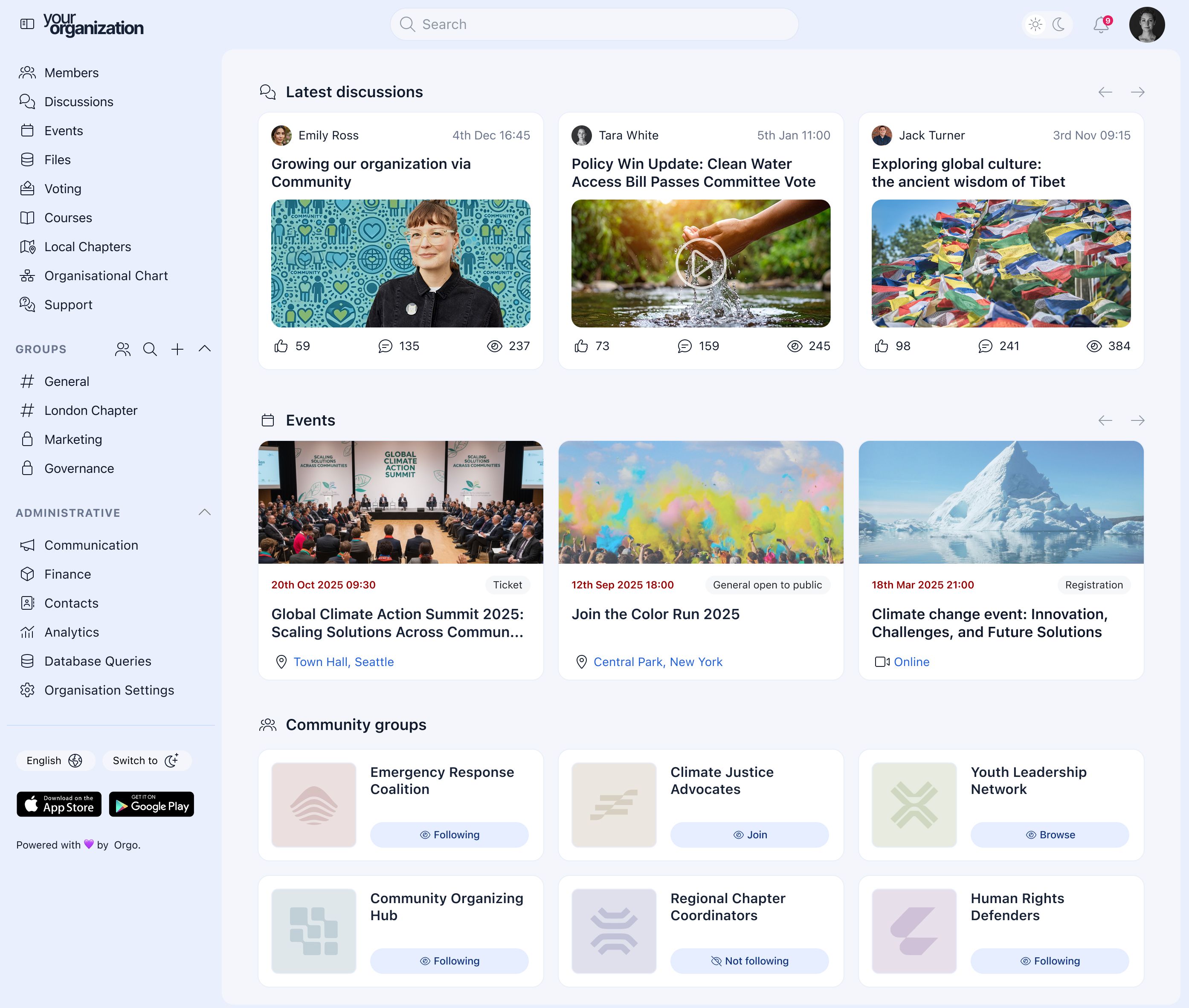
Orgo dashboard
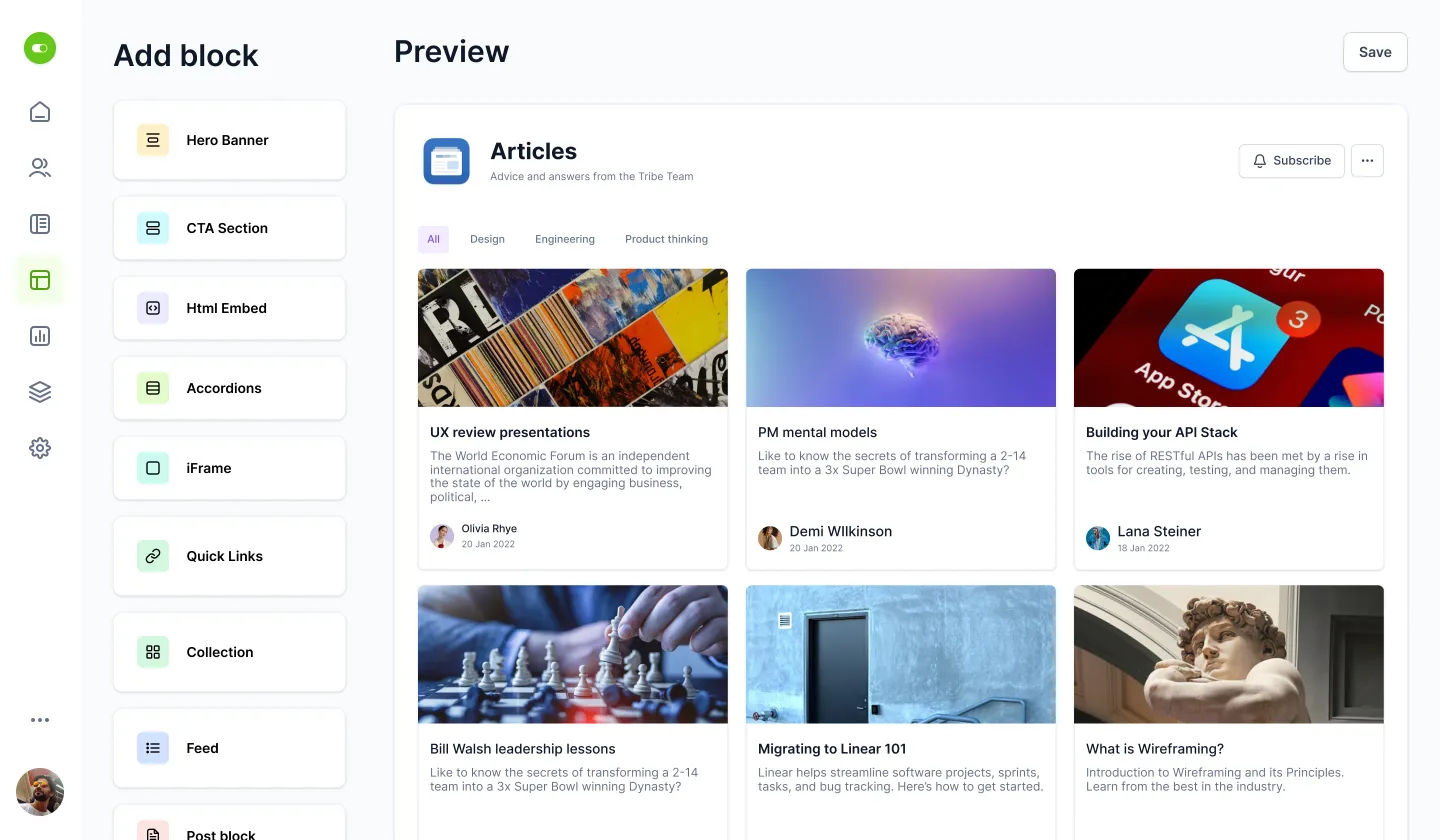
Bettermode community dashboard
Nonprofits and associations operate under bylaws that define how decisions are made. A polls feature and a governance-grade voting system are very different tools.
The Orgo way
Orgo's eVoting module runs binding elections with anonymous encrypted ballots, configurable eligibility rules, audit trails, and result reporting. Organizations use it to elect board members, pass resolutions, and conduct ratification votes under their governing documents. Chapters can run local elections independently while headquarters maintains oversight.
eDocuments and eSignatures (Scale plan) handle the document layer: membership agreements, consent forms, board resolutions. These are built for the compliance requirements of member-governed organizations.
The Bettermode way
Bettermode's polls feature works well for its intended purpose: gathering community input, collecting product feedback, and running preference votes on feature roadmaps. For a SaaS company asking customers which features to build next, polls are the right tool.
For a nonprofit that needs to run a binding board election under its articles of association, a community polls feature is not a substitute. There are no anonymous ballots, no configurable eligibility rules, no audit trail, and no document signing capabilities. Bettermode was not built for this use case.
Organizing members into groups is different from running a multi-chapter organization. One is a community feature. The other is an organizational structure with financial, permission, and governance implications.
The Orgo way
Orgo supports a multi-tier structure (headquarters, regions, local chapters) in a single account. Each chapter gets its own leadership roles, its own Stripe account for local dues, and granular permissions so chapter leaders manage their members without seeing the rest of the system. Headquarters sees everything in one dashboard.
Member transfers between chapters are a built-in workflow. Local chapters can run their own events, collect fees, and manage their own communications, while the national office maintains consolidation and oversight. No spreadsheet merging required.
The Bettermode way
Bettermode's Spaces system allows communities to be organized into sub-groups, which works well for product lines, regional user groups, and customer segments. For a SaaS company running separate spaces for different product areas or geographic markets, this is a clean solution.
Spaces do not carry the organizational structure of a federation or multi-chapter association. There is no chapter-level financial autonomy, no chapter-to-chapter hierarchy, no member transfer workflow, and no consolidated reporting across chapter units. These capabilities are outside Bettermode's design scope.
What our clients say about Orgo
""I appreciate the reliability that comes with using an established product like Orgo, which is developed by people who understand our organizational context and can provide ongoing support and development. The focus on community building enhances its utility, transforming it from just a membership management tool into a robust community platform. I'm very satisfied with the service and would highly recommend it!"


Find the right fit
When Orgo is the better fit
Orgo is built for organizations like yours if:
You collect membership dues and need renewals managed without external tools You manage 500+ paying members across multiple chapters or regions You need elections or board votes that comply with your governing documents You want a branded mobile app your members can download from the App Store You need chapter-level autonomy with centralized HQ oversight You care about EU-based data hosting and GDPR compliance
If this sounds like your organization, get a demo and we'll show you exactly how Orgo handles your structure.
Get a DemoWhen Bettermode is the better fit
We believe in transparency. Bettermode is probably the better choice if:
You're a B2B SaaS company building a free customer community for peer support and product feedback Visual brand customization through a no-code Design Studio is a core requirement You need native integrations with a full SaaS stack (HubSpot, Salesforce, Zendesk, Jira) Your community members do not pay dues, and your revenue model is separate from the community Multilingual community support across many languages is a primary requirement
But if your organization needs dues, chapters, governance, and a native app alongside community features, that is exactly the combination Orgo was built to provide.
Switching from Bettermode is easier than you think
The biggest objection after "does it do what I need?" is "how painful is the switch?" Our team handles the migration end to end. You stay focused on your members while we move your data, configure your structure, and get your team up to speed.
Data migration
We handle the heavy lifting. Your member database, organizational structure, and community content are imported by our team. Not your staff. We've successfully migrated 40 years' worth of member lifecycle data for one of our clients. No matter how deep your records go, we've done it before.
Stripe payment continuity
If you're currently routing membership dues through Stripe, your existing recurring subscriptions will not be interrupted. All active subscriptions continue seamlessly in Orgo. No re-billing. No member disruption. This also means you can retire the Zapier layer you built around Bettermode.
Dedicated onboarding
A real person walks your team through setup, configuration, and training. Typical timeline: 2 to 4 weeks from kickoff to launch.
Chapter setup
We configure your multi-tier hierarchy (headquarters, regions, local chapters) to mirror your actual organization from day one. Regional coordinators and chapter leaders get their own access and permissions immediately.
Your brand first
Extensive white-label branding options ensure your platform looks and feels like your organization. Not like a generic software tool.
Orgo vs Bettermode pricing
Both platforms publish public pricing. Here is how they compare at each tier, and what you get for the cost.
Orgo pricing
Orgo offers 3 plans based on active member count, starting at $59/month for 200 members on the Grow plan (annual billing).
Grow includes core membership management, eVoting, LMS (courses), fundraising, gamification, and custom branding, with a 2% platform fee on transactions. Impact (the most popular plan) adds multi-chapter management (up to 50 chapters), workflows, and API access with a reduced 1% platform fee, starting at $359/month for 1,000 members. Scale offers custom pricing with unlimited chapters, eDocuments, eSignatures, a branded mobile app, 0% platform fee, and a dedicated customer success manager.
All plans use Stripe directly (46+ countries). No forced payment processor. No surcharges.
See full Orgo pricingBettermode pricing
Bettermode offers 3 tiers. The Starter plan is $399/month (up to 10,000 members, 5 collaborators). The Growth plan is $1,500/month (up to 25,000 members, 10 collaborators). The Premium plan requires a custom quote (up to 100,000 members). Annual billing saves approximately 33%.
The Starter plan includes discussions, gamification, member profiles, Spaces, and native translation — a solid community feature set for B2B SaaS use cases. API, webhooks, and integrations with HubSpot, Salesforce, Zendesk, and Jira are available starting on the Growth tier ($1,500/month). SSO via JWT or SAML is Premium-only. Organizations that need these capabilities when starting on Starter should factor in the tier gap when budgeting.
Bettermode does not include native payment processing. Organizations that need to charge community members require an external Stripe account and Zapier automation to manage access.
The bottom line
Orgo's Impact plan ($359/month for 1,000 members) includes multi-chapter management, API access, and all membership tools. Bettermode's Starter plan ($399/month for up to 10,000 members) includes community features but locks API access and integrations behind the $1,500/month Growth tier.
For membership organizations that need both community engagement and membership management, Orgo delivers both at a lower combined cost, without requiring a Zapier layer or a second platform for dues collection.
Bettermode migration: Frequently asked questions
Yes. Most organizations run both platforms for 2 to 4 weeks during onboarding. This lets your team get comfortable with Orgo before you fully switch over. We'll help you plan the transition timeline so nothing falls through the cracks.
We recommend timing your migration to align with your Bettermode renewal date. Our onboarding team will work with your schedule to minimize billing overlap. Most transitions complete within one billing cycle.
Yes. Orgo handles membership dues, renewals, and payment processing natively through Stripe. There is no need for Zapier or external payment tools. Members join, pay dues, and access the community all within the same platform. Your Zapier automation becomes redundant once you migrate.
Orgo is THE Bettermode alternative
for membership organizations
Bettermode works for SaaS companies building free customer communities. But when your organization needs native dues collection, multi-chapter management, governance tools, and a branded mobile app alongside community features, Orgo is the alternative built for exactly that.
Also worth reading:
- Orgo vs Hivebrite: Another community platform comparison for membership organizations.
- Orgo vs Khoros: How Orgo compares to an enterprise brand community platform.
- Orgo Pricing