

The Hivebrite alternative built for
multi-chapter nonprofits
Hivebrite is built for alumni networks and large-scale community engagement. But when your organization coordinates multiple chapters and needs each one to operate with genuine autonomy, formal governance tools, and transparent pricing, there's Orgo.
Hivebrite is a strong platform for the right use case. This page lays out exactly where that use case ends and where Orgo's begins. Read it and decide for yourself.
Hivebrite alternative: quick verdict
The main difference between Hivebrite and Orgo is that Hivebrite is built for large-scale community engagement (alumni networks, corporate communities, mentoring programs), while Orgo is built for multi-chapter nonprofits and associations that need genuine chapter autonomy, formal governance tools built into the platform, and transparent subscription-based pricing.
Choose Orgo if:
- You manage multiple chapters or regions, each with their own leadership and dues
- You need chapter leaders to have genuine administrative control, not just group moderation
- You run elections, board votes, or formal governance processes
- You need eSignatures and digital documents built into your platform
- You want a platform fee that's flatly 0% on every plan, instead of one that isn't published anywhere
Choose Hivebrite if:
- You're a university alumni office, business school, or corporate alumni program
- Your primary goals are community engagement, mentoring, and alumni networking at scale
- You have an annual platform budget of $10,000 or more
- You do not need formal governance tools, eVoting, or eSignatures
- AI-powered member matching and structured mentoring programs are core requirements
Why organizations look for alternatives to Hivebrite
Hivebrite serves a specific audience very well. But three recurring themes emerge across user reviews on Capterra, G2, and Software Advice. These frustrations most commonly push organizations to explore other options.
Orgo vs Hivebrite: feature comparison
Both platforms serve membership organizations, but they were designed for different primary use cases. Hivebrite is purpose-built for alumni engagement and corporate communities. Orgo is built for multi-chapter nonprofits and associations that need genuine chapter autonomy, formal governance, and operational membership administration.
The comparison below covers features both platforms share, areas where Orgo has a clear edge, and areas where Hivebrite leads. Every cell has been verified against both platforms' current websites.
| Feature | | |
|---|---|---|
| Core membership | ||
| Member database and profiles | ||
| Membership dues and renewals | Advanced dues configuration | |
| Custom registration forms | ||
| Multi-tier membership packages | ||
| Member directory with search and filtering | Map view and geo-location filtering | |
| Engagement and community | ||
| Event management and ticketing | Add-ons, speakers, QR check-in | |
| Email campaigns and newsletters | ||
| Discussion groups and forums | Public and private groups | |
| Member networking and direct messaging | ||
| Donations and fundraising | Campaign pages, donor recognition | |
| Mentoring programs | AI-powered matching via Orbiit | |
| Job board | ||
| Learning | ||
| Learning management system (LMS) | Courses, quizzes, graded assessments, certificates | Journeys onlyPassive pathways, no graded assessments |
| Gamification | Points, badges, leaderboards | |
| Payments and billing | ||
| Online payment processing | Stripe direct, 46+ countries | Stripe/PayPal |
| Platform transaction fee | 0% on every plan (disclosed upfront) | Not published; ~1.5% reported in reviews, unconfirmed |
| Governance | ||
| eVoting and elections | Anonymous encrypted ballots; included on every plan | |
| eDocuments and eSignatures | Scale plan and up | |
| Administration and security | ||
| Granular role-based access control | Unlimited custom roles | PartialGroup admins lack granular permission control |
| Multi-chapter hierarchy (HQ, regions, chapters) | Per-chapter dues, Stripe, and leadership roles | Sub-communitiesLimited chapter-level autonomy |
| Analytics and reporting | PartialPayment and email analytics flagged as insufficient | |
| SSO | Google, Apple, Microsoft | |
| API access | Included on every plan, including Grow | Extended access on higher tiers |
| Data hosting | EU (AWS Frankfurt); other AWS regions available on request | Cloud-based |
| Platform | ||
| Branded mobile app | Paid add-on, all plans; white-labeled to your identity | Paid add-on; exact tier not published |
| Drag-and-drop page builder | Included free on every plan, including Grow | |
An alternative to Hivebrite built for multi-chapter organizations
Hivebrite is designed around community engagement. For organizations that need genuine chapter autonomy, formal governance tools, and transparent pricing, these are the capabilities that make the difference.
| Your organization needs... | | |
|---|---|---|
| Multi-chapter management | ||
| Multi-chapter hierarchy with genuine chapter autonomy Chapter admins control their own space, events, and members without relying on central HQ for every change | Per-chapter permissions and leadership roles | Sub-communities onlyGroup admins cannot control granular posting and event permissions |
| Per-chapter Stripe accounts Each chapter collects its own dues directly without routing revenue through headquarters | ||
| Member transfers between chapters Move members across chapters with full history intact. No manual re-entry | ||
| Governance | ||
| eVoting with encrypted, anonymous ballots Run board elections, bylaw amendments, and member referendums without a third-party tool | Included on every plan | |
| eSignatures and eDocuments Generate contracts from templates, collect digital signatures, and store signed documents in one place | Scale plan and up | |
| Learning | ||
| Full LMS with graded assessments and certificates Run volunteer training, certification programs, and member onboarding courses with quizzes and completion tracking | Journeys onlyPassive content pathways. No graded assessments or interactive quizzes | |
| Payments | ||
| A transaction fee disclosed upfront, on every plan 0% platform fee on every plan, Stripe fees only. Every Orgo plan states its fee upfront, so you know the number before you sign | 0% on every plan | No transaction fee published; ~1.5% reported in reviews, unconfirmed |
Organizations that need to coordinate autonomous chapters, run elections, sign documents, or reduce platform fees as they grow find that Hivebrite's architecture cannot support these requirements. Orgo was built with multi-chapter management and governance as first-class features.
Why multi-chapter nonprofits choose Orgo over Hivebrite
Multi-chapter management with real autonomy
Managing a federation or multi-chapter association requires a specific architecture: chapters need their own administrative space, their own leadership roles, and often their own dues collection. At the same time, headquarters needs consolidated visibility. Most platforms offer one or the other. Orgo offers both.
The Orgo way
Orgo supports a multi-tier structure (headquarters, regions, local chapters) within a single account. Each chapter gets its own space with locally assigned leadership roles and its own Stripe account for dues collection. Chapter leaders manage their own members, events, and communications without touching other chapters' data.
Headquarters sees everything: consolidated membership trends, revenue breakdowns by chapter, and chapter-level performance comparisons. All from a single dashboard. Member transfers between chapters are a built-in workflow. No manual re-entry.
The Hivebrite way
Hivebrite supports sub-communities and groups, which are suitable for interest-based segments within a single large community. But group admins cannot control granular permissions, such as who posts events in their specific group. This is a documented complaint in G2 and Capterra reviews.
For organizations where chapters are operationally independent units with their own leadership and dues, Hivebrite's sub-community model does not map to that structure. A chapter leader who cannot control their own administrative space is not really administering a chapter. They are moderating a group.
Governance tools built into the platform
For nonprofits, associations, and federations, governance is not a nice-to-have. Elections happen on fixed schedules. Board resolutions require documented digital signatures. Bylaw amendments need verified member votes with a complete audit trail. When your platform does not support these processes, your organization compensates with separate tools, email chains, and manual processes.
The Orgo way
Orgo includes eVoting natively on every plan, starting with Grow. Administrators create a vote, define the eligible electorate, set a ballot window, and the system handles everything: voter authentication, anonymous encrypted ballots, real-time results, and a cryptographic integrity report for your records.
eDocuments and eSignatures work the same way, from the Scale plan up. Generate a contract from a template, send it to the required signatories, and collect legally binding digital signatures. All documents are stored in your platform, attached to the relevant member or chapter records.
For organizations that run elections once or twice a year and sign dozens of agreements with chapter leaders, sponsors, and vendors, this eliminates a category of administrative overhead entirely.
The Hivebrite way
Hivebrite does not offer eVoting, eSignatures, or eDocuments. The platform is designed around community engagement: feeds, events, forums, and networking. Governance is outside its scope.
Organizations that need to run formal elections or collect digital signatures must purchase and integrate separate tools. That means additional subscriptions, separate logins for members, and manual reconciliation of governance records with your community platform. The data that belongs together lives in different places.
Pricing that grows with you, not against you
Most organizations grow their membership over time. The more dues they collect, the more their platform should return in value. A transaction fee model works in the opposite direction: as your membership revenue grows, your platform costs grow proportionally. For a mission-driven organization, this creates a structural tension between growth and cost.
The Orgo way
Orgo charges a plan subscription fee and nothing else. The platform transaction fee is 0% on every plan, from Grow up to Enterprise. Only Stripe's standard processing fee applies, the same fee every payment processor charges, and Orgo lets the payer cover it at checkout instead of the organization absorbing it. More than half typically choose to.
As your membership grows and dues revenue increases, Orgo's cost stays predictable. The relationship between platform cost and membership revenue is decoupled. More members means more platform value, not a larger check to the software vendor.
The Hivebrite way
Hivebrite's pricing page does not state a transaction fee. A 1.5% figure is often repeated in reviews and third-party write-ups, but it doesn't trace back to Hivebrite itself, so it isn't something you can budget against with confidence.
For an organization trying to model total cost of a multi-year contract, that's a real gap: whatever the actual number is, you find it out from a sales conversation, not from the pricing page. Orgo publishes its number for every plan: 0%, full stop.
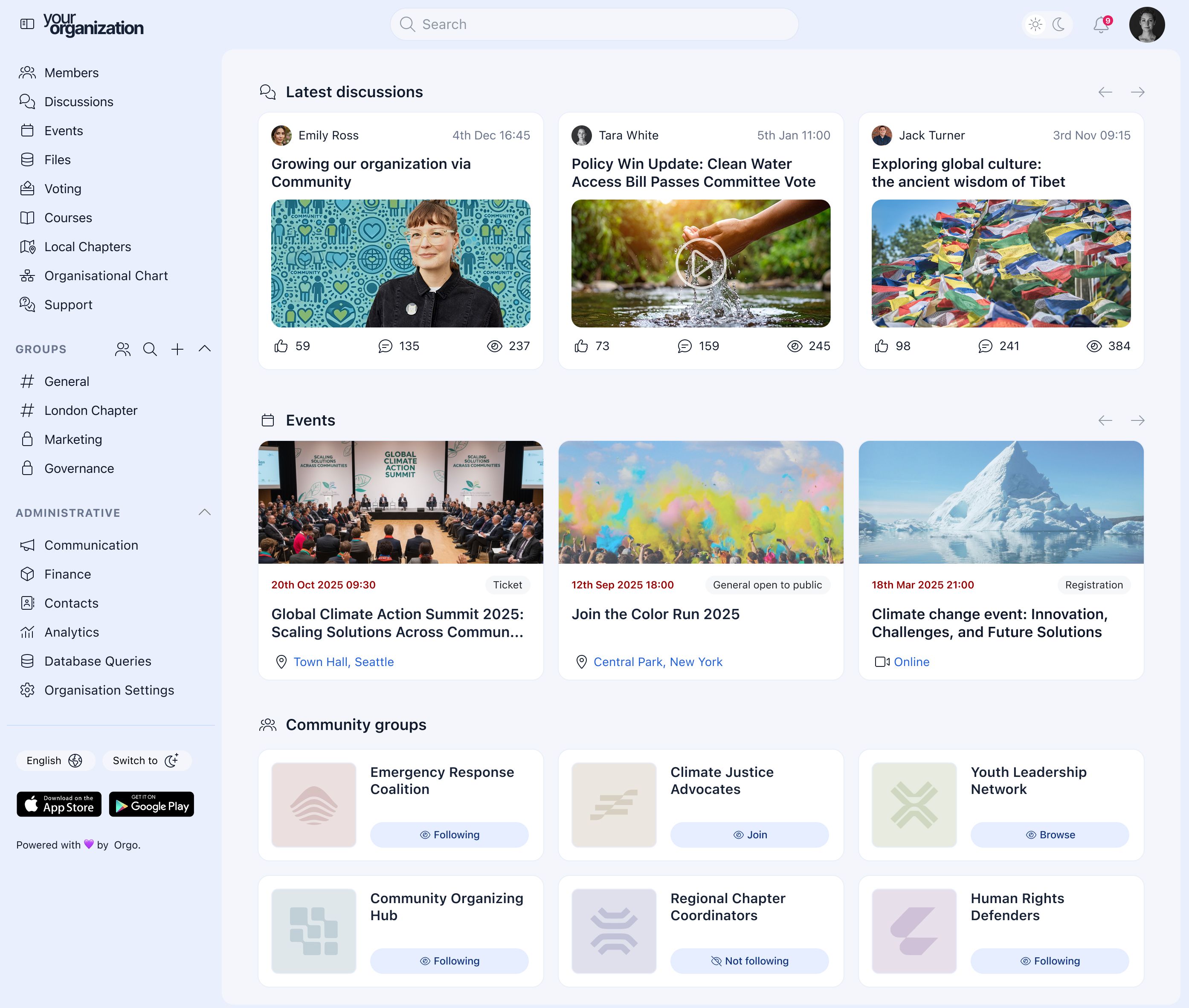
Orgo dashboard
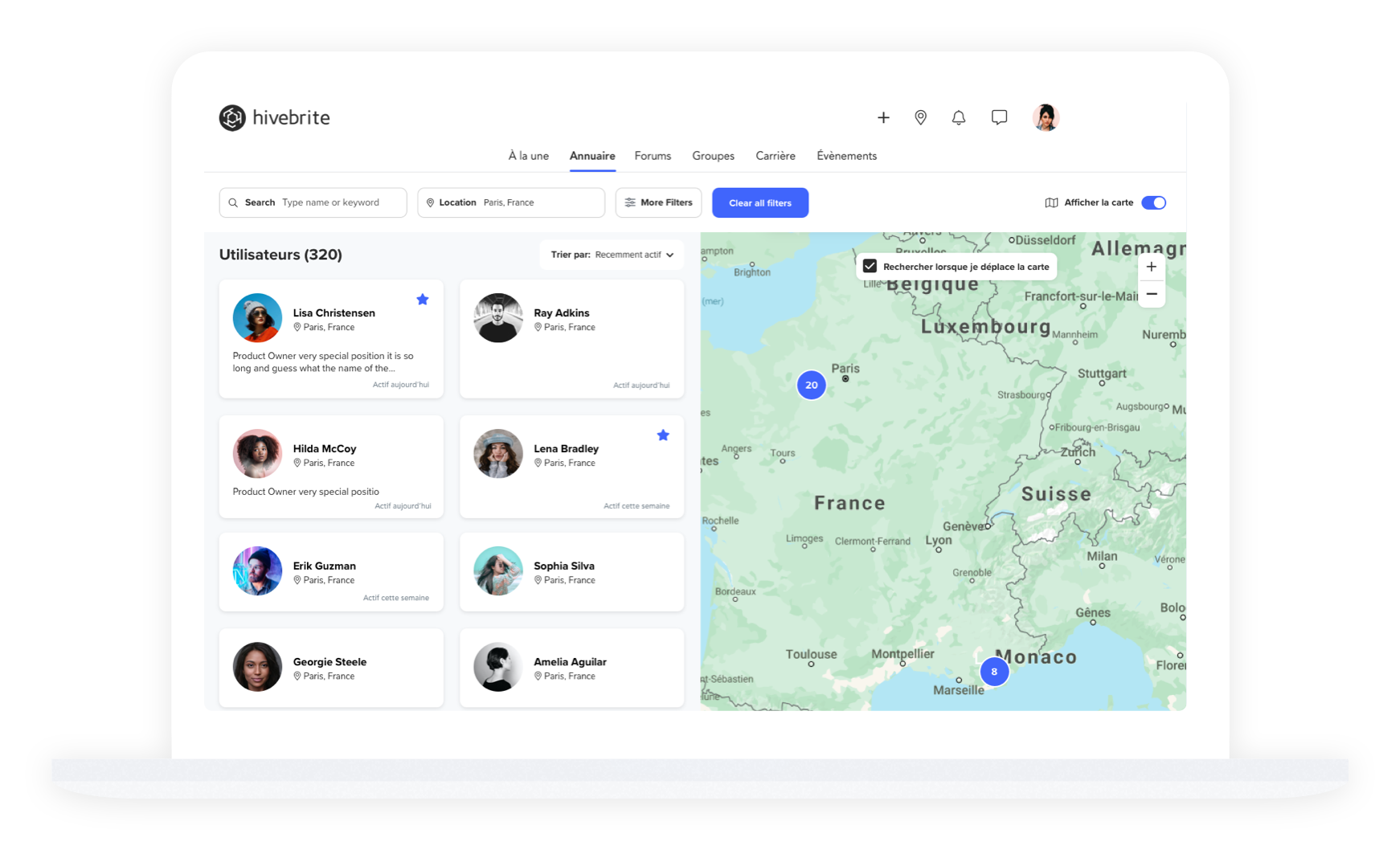
Hivebrite dashboard
What our clients say about building on Orgo
""I've been using ORGO since September 2023 and I am extremely satisfied. The biggest advantage of the platform is the team behind it. I needed help at various times, and each time I received quick responses and effective solutions. They are always available, patient, and open to suggestions."
"Another aspect that impressed me is how they introduced improvements precisely when needed, sometimes even before I realized the need myself. It's clear they are always one step ahead and strive to offer users the best possible experience."














Find the right fit
When Orgo is the better fit
Orgo is built for organizations like yours if:
- You manage 500+ members across multiple chapters, regions, or local units
- You need chapter leaders to manage their own space without relying on central HQ
- You run formal governance processes: elections, board votes, bylaw amendments
- You need eSignatures, digital documents, or a full LMS built into the platform
- You want a platform fee that's flatly 0%, on every plan, not something you find out later
- You care deeply about EU data hosting and member privacy compliance
If this sounds like your organization, get a demo and we'll show you exactly how Orgo handles your structure.
Get a DemoWhen Hivebrite is the better fit
We believe in transparency. Hivebrite is probably the better choice if:
- You're a university alumni office, business school, or corporate alumni program
- AI-powered member matching and structured mentoring are core to your community value
- Your primary focus is engagement, networking, and career development, not governance
- You have a $10,000+/year platform budget and an enterprise-scale community
- You do not need eVoting, eSignatures, or multi-chapter administrative autonomy
But if your organization needs governance tools, chapter autonomy, or a platform fee that's genuinely 0%, that is exactly the complexity Orgo was built for.
Switching from Hivebrite is easier than you think
Hivebrite locks organizations into annual contracts, which means the concern is rarely "can we leave?" It's "is the migration worth it?" For organizations that need governance tools, real chapter autonomy, and a platform that charges 0% on every payment, the answer is consistently yes. Here's what moving to Orgo actually looks like.
Data migration
Hivebrite holds your member profiles, group memberships, event records, and community content. All of it comes with you. Our team handles the full import: member data, dues history, and organizational structure. Your staff touches nothing. We've brought over decades of member history for organizations in far more complex situations than a platform migration.
Know your fee before you sign, not after
Hivebrite processes payments through Stripe or PayPal. Whether it also takes a cut of each transaction isn't stated on its pricing page. When you migrate to Orgo, your existing Stripe subscriptions transfer directly and continue without interruption. Members are not re-billed. And you'll know exactly what you're paying: 0%, on every plan, disclosed before you sign anything.
Governance configured from day one
A real person walks your team through every module, including the ones Hivebrite never offered: eVoting setup, eSignature workflows, and chapter permission structures. Typical timeline: 2 to 4 weeks from kickoff to launch. You go live with everything configured, not just the membership database.
From sub-communities to real chapters
Hivebrite's sub-community model gives group moderators limited control. Orgo's chapter architecture gives chapter leaders genuine administrative authority. We configure the full hierarchy (headquarters, regions, local chapters) to reflect how your organization actually operates. Each chapter leader arrives on day one with their own space, their own roles, and their own permissions already in place.
Your identity, not Hivebrite's
Hivebrite's visual structure is largely fixed: your colors and logo sit inside their framework. Orgo's white-label branding goes deeper. Your platform carries your identity throughout, not just a surface coat. Members experience your organization, not the software vendor behind it.
Orgo vs Hivebrite pricing
Pricing is often the deciding factor. The two platforms have fundamentally different pricing structures. Here is how they compare.
Orgo pricing
Orgo offers three plans. Grow starts at $340/month (billed annually, up to 1,000 members) and is built for a single organization run as one body. It includes the member database, events, discussions, newsletter campaigns, fundraising, eVoting, courses, files drive, a website builder, API access, and custom branding. Transaction fee: 0%.
Scale is where multi-chapter management begins, up to 100 chapters, with per-chapter Stripe accounts, federated association and political party structures, eDocuments and eSignatures, workflows, project management, and webhooks. It starts at $450/month (billed annually, up to 1,000 members) and scales with your member count up to 10,000, with the exact price confirmed on your call. Transaction fee: 0%. This is the most popular plan for growing associations.
Enterprise is custom-priced for national networks and federations with the most complex requirements. It adds unlimited members and chapters, a 99.9% uptime SLA, security and legal review, custom integrations, and complex data migration support. Transaction fee: 0%.
All plans use Stripe directly in 46+ countries. Every plan charges 0% on transactions: only Stripe's standard processing fee applies, and Orgo lets the payer cover that fee at checkout. No hidden surcharges, no forced payment processor.
Hivebrite pricing
Hivebrite's Core plan starts at $895/month (billed annually, 2 global admins, 5 groups). Flex starts at $1,995/month (billed annually, 5 global admins, 10 groups). Both are priced by admin seats and group allotments, not member count: members are unlimited on every tier. There is no free trial on any plan.
Hivebrite's pricing page does not state a transaction fee. A 1.5% figure is commonly cited in reviews and third-party write-ups, but it traces back to an unverified forum answer rather than a Hivebrite source, so treat it as unconfirmed rather than a stated fact.
Premium features and integrations (advanced analytics, AI matching, extended API, multi-language, CRM connectors) require higher tiers or add-ons, none of which are publicly priced. All plans require an annual commitment.
Pricing for Prime and Custom Fit, Hivebrite's top two tiers, is not publicly listed. Prospective buyers must engage with the sales team before seeing numbers.
The bottom line
Orgo's entry point is $340/month. Hivebrite's entry point is $895/month. For membership organizations that are not university alumni offices or enterprise-funded corporate programs, the pricing difference is significant.
The deeper difference is transparency. Orgo discloses its transaction fee on every plan: 0%, full stop. Hivebrite doesn't publish one at all. Whatever it charges beyond the subscription, you find out from a sales conversation, not a pricing page.
Hivebrite migration: frequently asked questions
Yes. Hivebrite requires an annual commitment, so most organizations have a natural wind-down window. We typically recommend launching Orgo 3 to 4 weeks before your Hivebrite contract ends. Your team gets comfortable with the new platform, and you go live on Orgo right as the Hivebrite contract closes. Nothing falls through the cracks.
Hivebrite bills annually upfront, so the key is aligning your Orgo launch with your Hivebrite contract expiry. Our onboarding team reviews your renewal date early in the process and builds the migration timeline around it. Most organizations complete the switch within one billing cycle with zero overlap.
Yes. Hivebrite uses Stripe and PayPal for payment processing. If your members currently pay via Stripe, those subscriptions transfer directly to Orgo without interruption. No re-billing, no gap in payment cycles, and no member-facing change. One difference: whatever per-transaction commission Hivebrite may have been charging (Hivebrite doesn't publish this rate) no longer applies. Orgo charges 0% platform fee on every plan. Only Stripe's standard processing fee applies, and Orgo lets the payer cover it at checkout.
Yes. Hivebrite exports member profiles, group memberships, event records, and community data in standard formats. Our team handles the full import into Orgo, including dues history and your organizational structure. Your staff does not touch a spreadsheet. We've handled migrations from platforms far more complex than Hivebrite, and we do it without disrupting your ongoing operations.
Yes, but it's a paid add-on rather than a plan inclusion. It's available on every plan for $170/month (billed annually), plus a one-time $1,740 setup fee and a per-member scaling charge as your membership grows. It's fully branded with your organization's identity, and members download your app, not a generic Orgo-branded experience. Available for both iOS and Android.
Orgo is THE Hivebrite alternative for multi-chapter nonprofits
Hivebrite serves alumni networks and corporate communities well. But when your organization coordinates multiple chapters that each need genuine administrative autonomy, formal governance tools built into the platform, and pricing that doesn't scale with every payment you collect, Orgo is the alternative built for exactly that.