Trade association management software
Your members are companies, not people. Orgo is built around that.
- Member companies put their staff on seats, with an admin who controls who has access
- One dues payment from the company covers every seat, no per-person billing
- Unlimited membership classes, each with its own price, term, and renewal rules
Built for national and regional trade associations, industry groups, and chambers whose members are companies, not individuals.
Trade association capabilities at a glance
| Member record | Legal name, registration number, billing address, logo, and website per company; staff join through it |
|---|---|
| Seats per company | Set by the plan the company buys; a value of 0 means unlimited seats; pending invitations count toward the total |
| Staff without logins | Contacts hold a seat and appear in the member list without an account, but carry no fee date since they have no fee record |
| Membership classes | Unlimited classes, each with its own price, term, and renewal behavior |
| Voting eligibility | Set per ballot through a group or a private voter list, independent of membership class |
| Vote count | One member, one vote; anonymous and auditable, no third-party tool required |
| Payment methods | Stripe checkout, or bank transfer recorded by your team |
| Renewal reminders | Automatic ladder at 30 and 7 days before expiry, on the expiry date, then 1, 7, 14, and 30 days after |
| Proration | Measured from the company's join date, not the payment date, and recalculated automatically |
| Terminology | Every structural label is renamable, in your organization's own language |
| Import | CSV import for companies, for company members, and for their roles |
Trusted by leading organizations















Everything you need to run a trade association
Member companies
Your members are companies, not individuals. Orgo is built around that model from the ground up.
Each member company holds a record with its legal name, registration number, billing address, logo, and website.
Staff are invited by email onto a seat. Invitations expire after 30 days, and an admin can resend or revoke them at any time. Seat availability is checked both when the invitation is sent and when it's accepted, so a company can't invite past its limit.
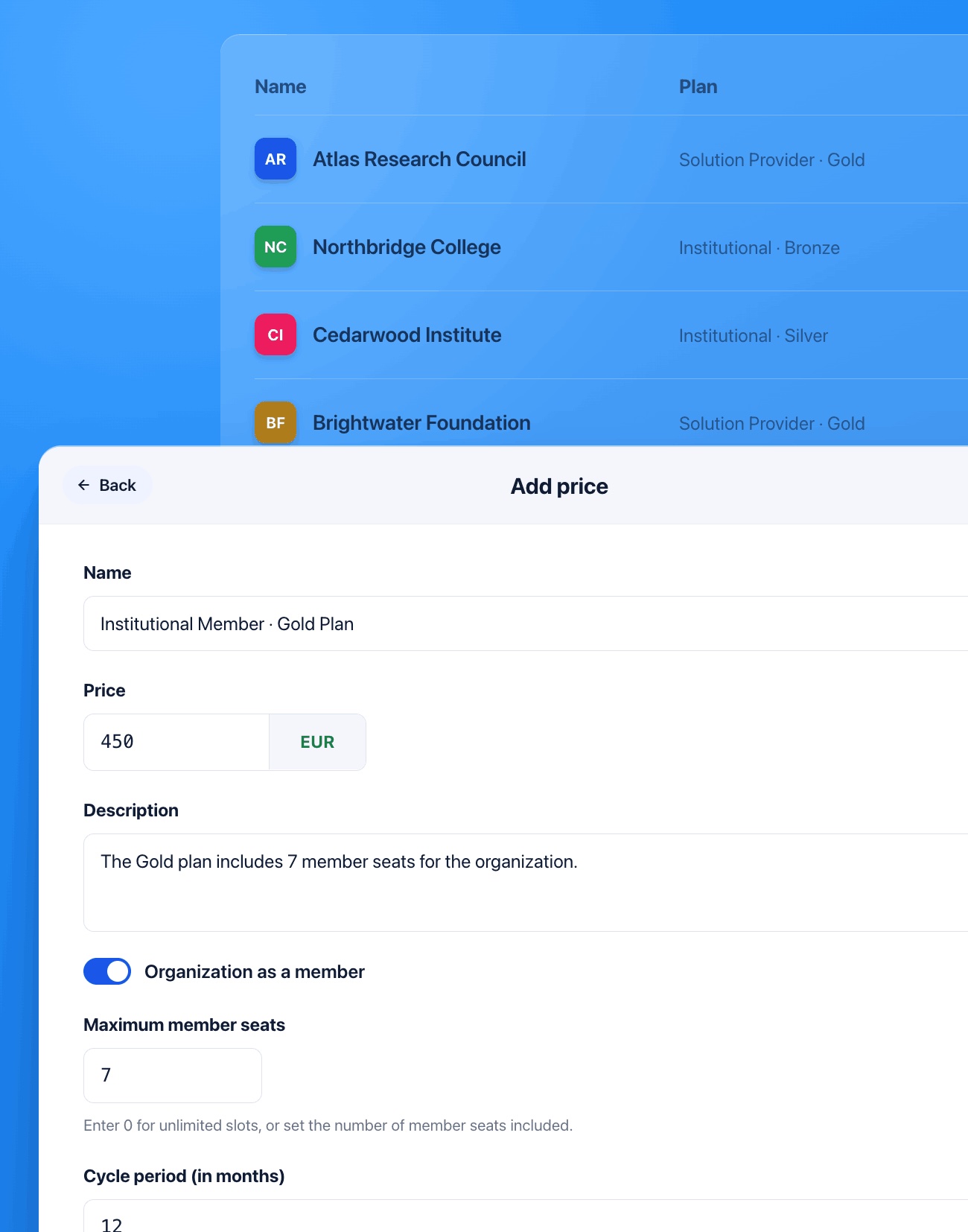
An outstanding invitation counts against the seat total the same as an accepted one, so a company always sees its real headroom, not just who has logged in.
Seat allowance is set by the plan the company buys. A value of 0 means unlimited seats.
When the company's fee is paid, Orgo copies its valid-until date onto every member who has an account. Nobody on the team pays individually.
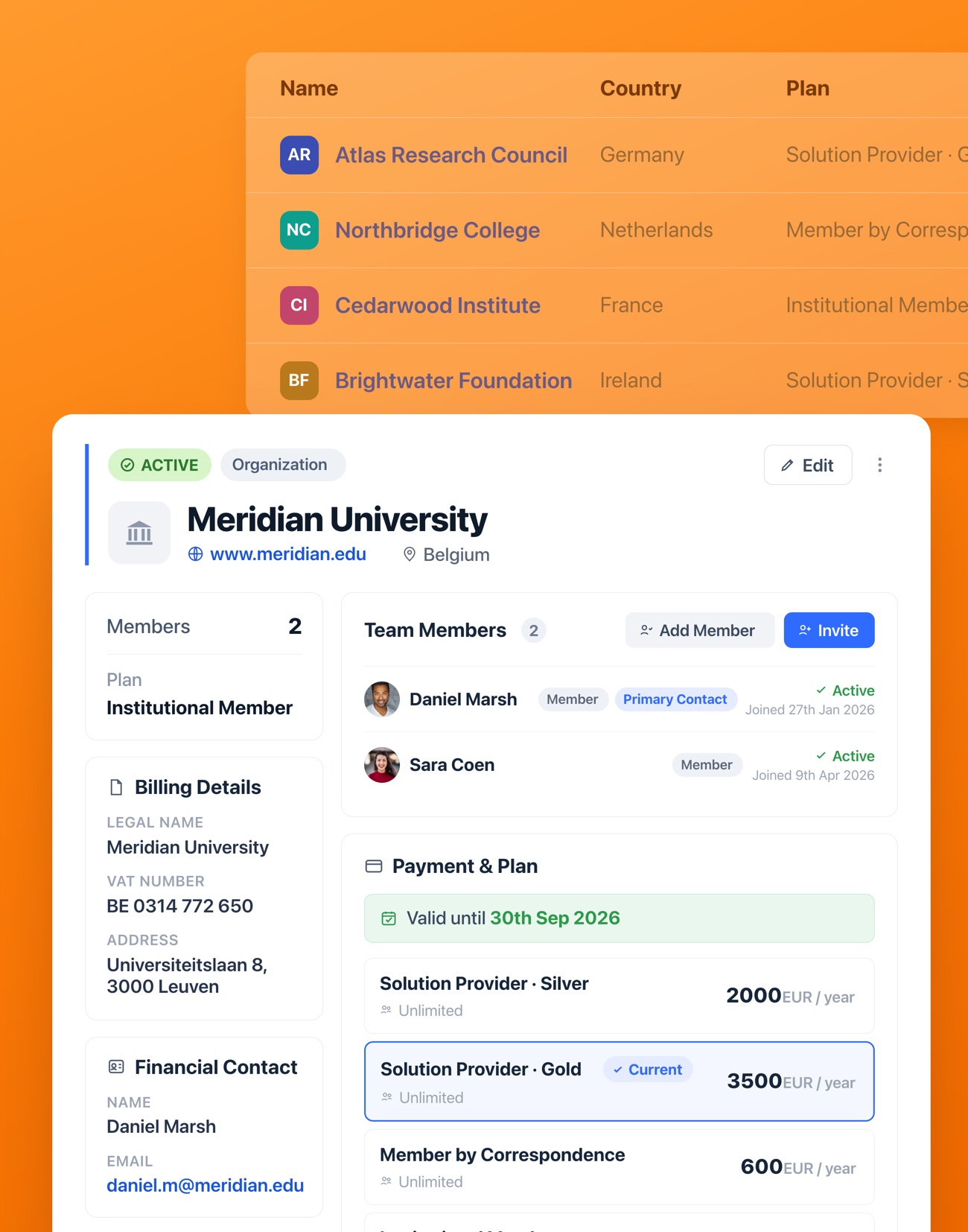
A contact holds a seat and appears in the member list without ever creating an account. Since a contact has no fee record, they don't inherit a validity date the way a full member does.
A person belongs to one company at a time. Roles at the company level are Primary Contact and Voting Representative, the contact who speaks for the company.
Membership classes
Generic membership platforms handle tiering worst, and trade associations need it most.
Create as many membership classes as your bylaws need. Each one carries its own price, term, and renewal behavior.
Classes can run on different terms:
- Annual, auto-renewing
- Multi-year, paid once with no auto-renewal
- Lifetime, paid in full
Companies in the industry, with full voting rights and eligibility for board seats.
Suppliers and service providers selling into the industry. Priced separately from regular members, with directory and event access. You can scope ballots to leave associate members out of votes on industry positions.
Academic, international, retired, honorary, whatever your bylaws call for. Each with its own price, term, and access.
Membership class determines price and access. Voting eligibility is set separately, per ballot, through a group or a private voter list, so you decide exactly who's eligible each time, whether that's every regular member or one specific committee.
Dues and payments
Member companies pay by invoice and bank transfer far more than by card. Orgo is built for both.
Bank transfer is the default for most member companies. Payments are recorded manually against the company's invoice, with a payment identifier for reconciliation.
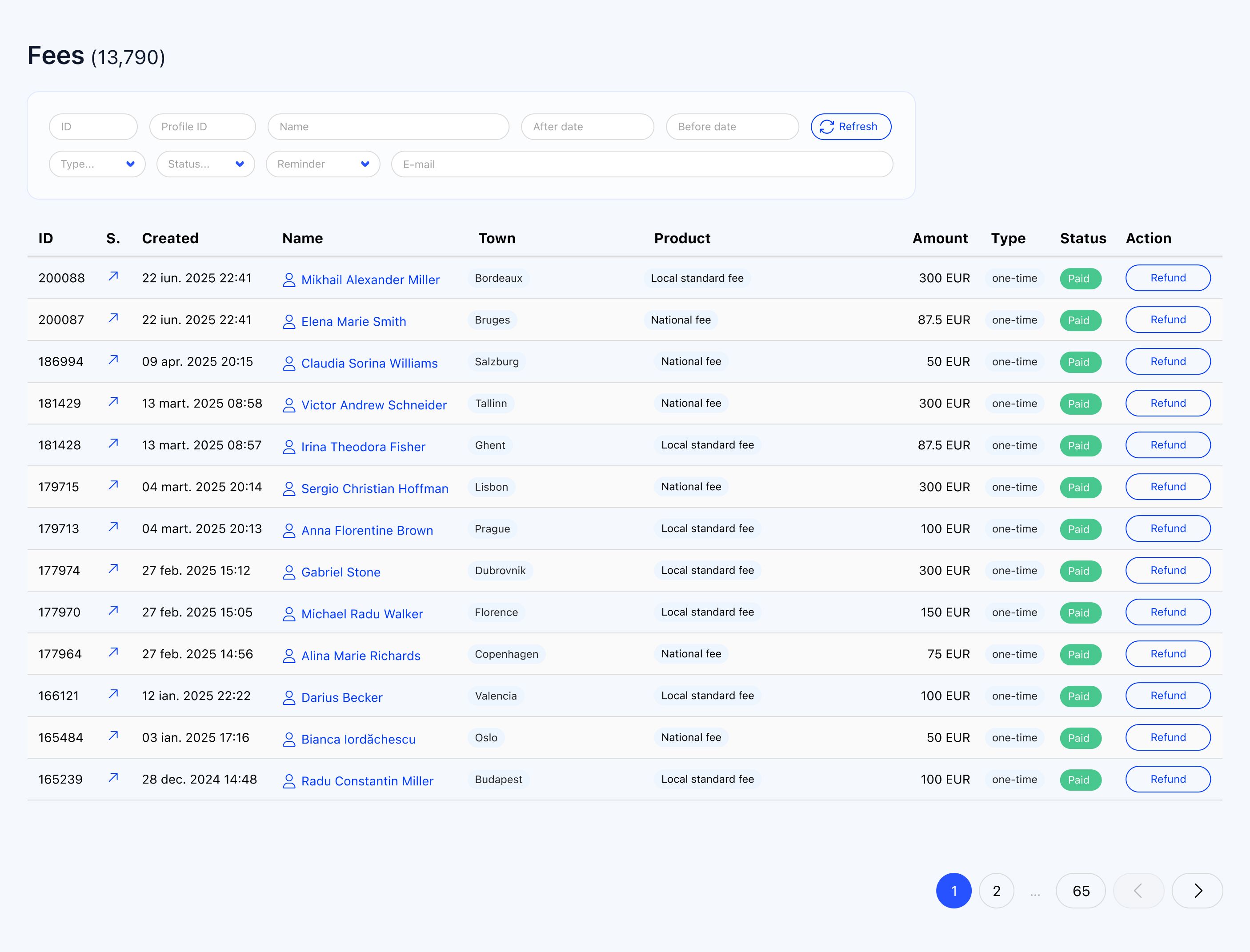
Stripe checkout is also available for companies who'd rather pay by card.
Dues scale with the seat count a company buys, from a single admin to the whole staff list.
There's no automatic calculation from company headcount. Size-banded dues work through separate membership classes, self-declared at signup, for example a small-company class priced below the standard rate.
Proration is measured from the company's join date, not the date it pays. A company that joins in January but settles its invoice in June still buys the January-to-June period, recalculated automatically.
An automatic reminder goes out 30 days before expiry, 7 days before, on the expiry date itself, then 1, 7, 14, and 30 days after. Each one is addressed to the financial contact and copies the active Primary Contacts plus two additional Cc addresses you set.
Turn on Fee Payment Mandatory and a company whose validity date has passed gets redirected to its own fee page until it pays.
Voting
Ballots run on the platform: anonymous, auditable, no separate tool. Eligibility is yours to set.
Every eVoting ballot counts one vote per person. There's no company-level or weighted vote. If your bylaws call for one vote per company, the common way to model it is a single Voting Representative account per company, with the ballot scoped to that group.
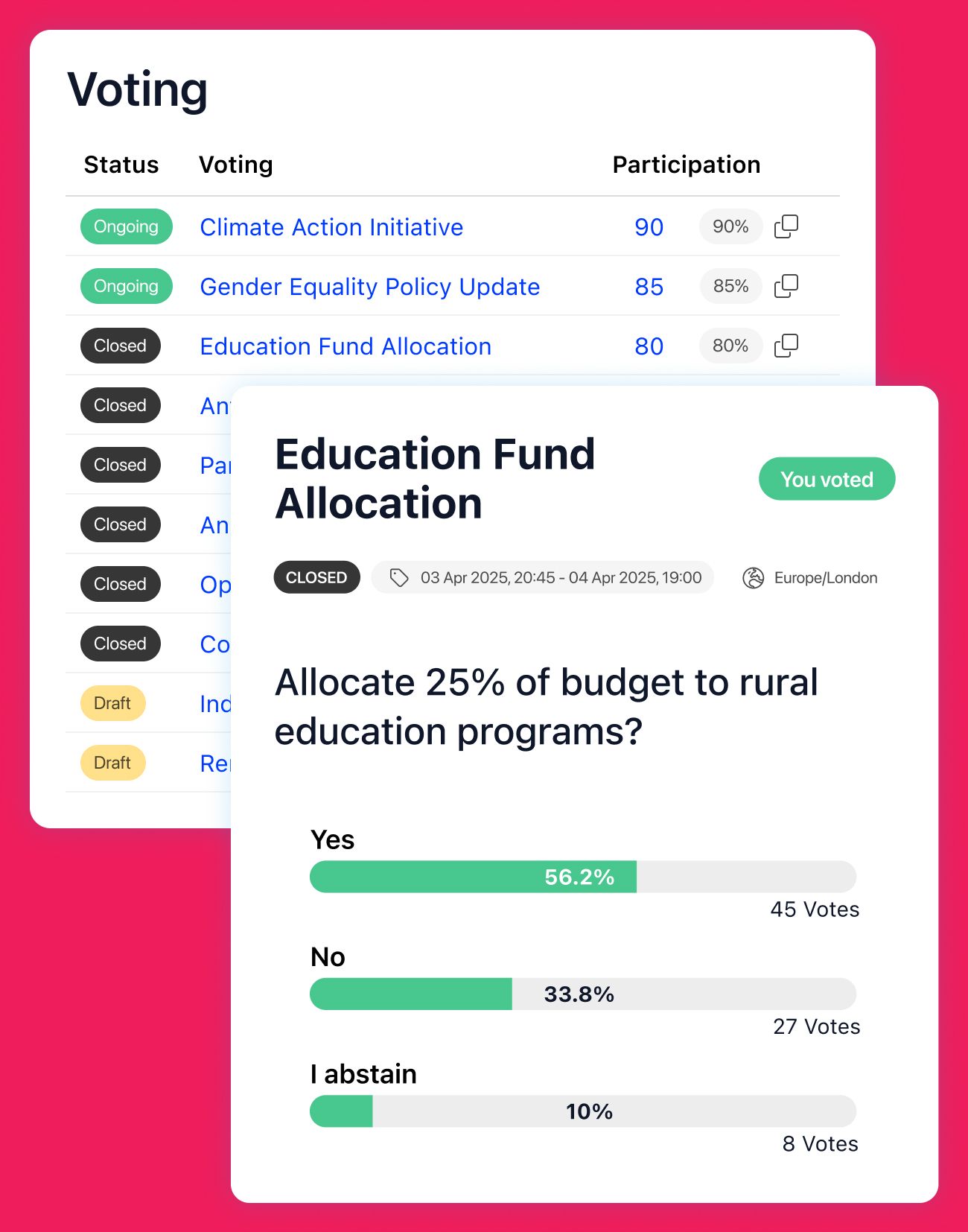
You decide who's eligible for each vote through a group or a private voter list, whether that's every regular member, one membership class's Voting Representatives, or a single working group.
Member identity and vote are separated. Results are independently verifiable after the ballot closes.
Board elections, bylaw amendments, and policy resolutions all run inside Orgo. Nothing exports to a separate voting platform.
Committees, councils, and working groups
Trade associations call these committees, councils, or working groups, sometimes all three, for different bodies.
Set up a group for a standing committee or a short-lived working group. Both work the same way.
Each body gets its own discussion space and document sharing, visible only to its members.
A group can auto-populate from a role, for example every board member or every committee chair. Membership updates automatically as people gain or lose the role.
Committee seats are held by people from member companies, not the companies themselves, so a committee roster is a list of individuals with their company affiliation attached.
Member company directory
A directory of member companies is a benefit members notice, and often the reason associate members are willing to pay to be listed.
Members search the directory by company name, sector, and location.
Each listing carries the company's logo, website, and description, pulled straight from its company record.
For associate members selling into the industry, visibility in the directory in front of every regular member is often the single biggest reason to keep paying dues.
Annual meeting and trade show
The business meeting vote runs on the same platform as the event itself.
Members register and pay for the annual meeting or trade show online, with paid or free tickets.
Every ticket carries a QR code, scanned at the door. No separate check-in tool.
The event runs inside your own branded app: agenda, personal schedule, and networking, under your name, not Orgo's.

If your annual meeting includes a formal vote, it runs on the same eVoting system as any other ballot. Delegates don't switch tools between the trade show and the vote.
Attendance, revenue, and feedback are ready as soon as the event ends.
Communications
Reach the right slice of your membership, not everyone at once.
Target a campaign by membership class, sector, or committee, instead of blasting the entire list.
Time-sensitive updates reach members on their phone through the branded app.
Members talk to each other between events, inside the platform.
Reporting for the board
One dashboard instead of a report someone compiles by hand before every board meeting.
Member company count, and retention broken down by membership class.
See which companies are current and which have lapsed, without waiting on a report.
Ticket revenue and attendance from the annual meeting and any other events, in the same view.
Track which companies are active and which have gone quiet.
Export the dashboard for a board pack in one click.
Case study DECT Forum
DECT Forum is the industry association for the wireless communications sector built on the DECT standard. Its members are companies, not individuals: Siemens, Panasonic, Shure, Sennheiser, Schneider Electric, Legrand, HP, Nordic Semiconductor, and Spectralink among them. Orgo is DECT Forum's member platform, sitting behind its existing website rather than replacing it.
Bring your existing member list
CSV import for companies and their members
Import member companies from a spreadsheet by legal name, then company members linked to their company. Roles import as their own step, so Primary Contact and Voting Representative assignments come across with everyone else.
Human-led implementation
An Orgo specialist sets up your organization. Not a self-service wizard.
Most organizations go live in 2 to 4 weeks
That includes data migration, platform configuration, and training your team.
Support A team that knows how this works
You talk to the people who built Orgo, not an account executive working from a script.

Vasile Darie
CEO

Alex Plosceac
CTO

Radu Vrabie
CCO
Orgo is built and supported by the same team, whether you're 40 member companies or 400. When you have a question about your setup, you're talking to someone who has configured this exact model before, not a support queue reading from a script.
People-first support
Real people who know the platform, reachable when something comes up.
Included in every migration
Data cleanup, configuration, and training for your team, not just the initial import.
Patience and availability
Support adapts to your team's pace, whether your staff is technical or not.
Built for your kind of trade association
Manufacturing
Standards committees and safety certification programmes for member companies.
Construction and building products
Codes, certifications, and regional dealer networks that need their own committees.
Food and beverage
Ingredient and labeling standards debated in working groups before they reach a vote.
Technology and telecom
Interoperability standards set by member companies who compete everywhere except the standards table.
Transportation and logistics
Safety and compliance standards that carriers and suppliers negotiate together.
Professional services
Continuing education and credentialing run alongside the membership itself.
Energy
Regulatory positions coordinated across member companies before they go to a regulator.
Healthcare suppliers
Compliance standards and group purchasing coordinated across a membership of competitors.
Financial services
Regulatory positions and compliance standards coordinated across member firms.
If your members join through state or regional associations
Some trade associations are federations: companies join a separately incorporated state or regional body, which is itself a member of the national organization, with dues flowing upward. That's a different architecture from the one on this page. It's handled by Orgo's federation management and multi-chapter management instead of by company records directly.
See your membership model in Orgo
- 1 Pick a 30-minute slot. You talk to the people who built Orgo, not an account executive working from a script.
- 2 We set up Orgo with your real membership classes and company structure during the call.
- 3 You keep the sandbox to evaluate with your team, plus a written plan for migrating the data you already have.
Trade association management FAQ
Yes. One dues payment from the company covers every seat on its plan. Orgo copies the company's valid-until date onto every member who has an account, so nobody on the team pays individually.
As many as the seat allowance on its plan. A value of 0 means unlimited seats. Pending invitations count toward the total the same as accepted ones, so a company always sees its real headroom.
Yes, but it isn't automatic by membership class. Ballot eligibility is set per vote through a group or a private voter list, so you scope each ballot to whoever should be eligible, for example every regular member, and leave associate members off it.
Orgo's eVoting counts one vote per person. If your bylaws call for one vote per company, the common way to model it is a single Voting Representative account per company, with the ballot scoped to that group.
Yes. Bank transfer is the default for most member companies, recorded against the company's invoice with a payment identifier for reconciliation. Stripe checkout is also available for anyone who'd rather pay by card.
There's no automatic calculation from headcount. Size-banded dues work through separate membership classes, self-declared at signup, for example a small-company class priced below the standard rate.
Yes. A contact holds a seat and appears in the member list without ever creating an account. Since a contact has no fee record, they don't inherit the company's validity date the way a full member does.
CSV import for companies, then a separate CSV import for company members linked to their company, then a roles import to bring Primary Contact and Voting Representative assignments across. An Orgo specialist runs the migration with you.
Each reminder is addressed to the financial contact and copies the active Primary Contacts plus two additional Cc addresses you set. Reminders go out 30 and 7 days before expiry, on the expiry date, then 1, 7, 14, and 30 days after.
Yes. Every structural label in Orgo is renamable, in your organization's own language, across the whole platform.
No. Orgo is the member platform behind your existing website. It handles registration and join forms, event and ticketing pages, payment pages, and the member portal, all linked from your own site. It doesn't build or host the site itself.
Related features
Membership management software
The member records, fees, and directory behind every company account.
Learn moreElectronic voting
Anonymous, auditable ballots for board elections and policy votes.
Learn moreFederation management software
For associations whose members join through a state or regional body.
Learn moreEvent management software
Registration, ticketing, and reporting for the annual meeting and trade show.
Learn more