Political party membership platform
Orgo runs a political party from the national office down to the smallest local branch.
- Membership applications signed online, checked against an ID and approved by the branch
- National, regional and local branches, each with its own officers and dues
- Secret-ballot internal elections, from branch leadership to congress
Built for political parties and movements that admit members formally, collect dues and donations, and vote on their leadership.
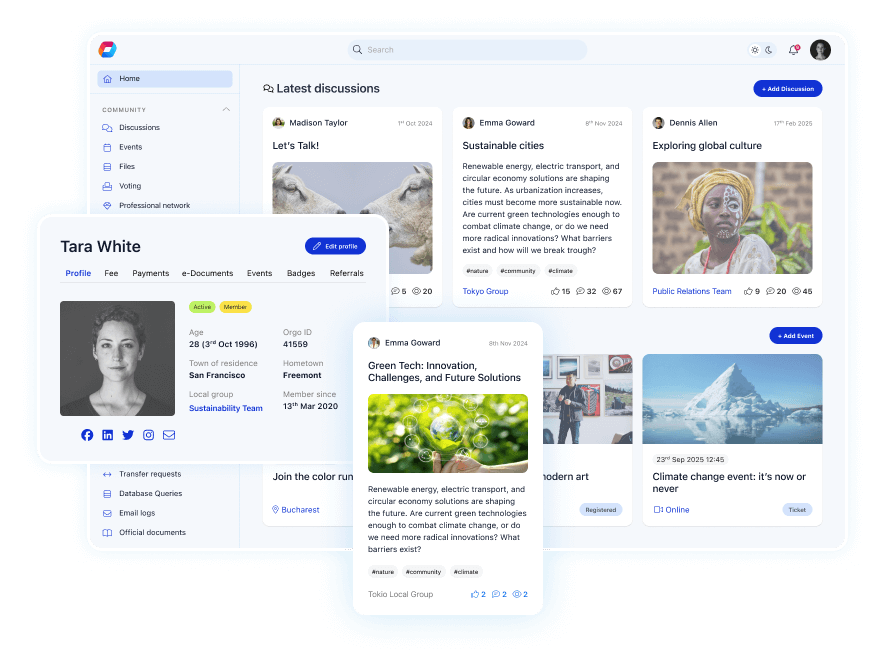
Political party software at a glance
| Territorial structure | Party, regions and counties as parent chapters nested to any depth, local branches as chapters, and units inside a branch |
|---|---|
| Officer permissions | Set on roles at organisation, parent chapter or chapter level. A regional permission reaches every branch below it, never a neighbouring region |
| Membership application | A form you define, an ID upload and a signature on screen. Orgo generates the signed PDF from your own template |
| Application review | Sent, form validated, background checked, interviewed, then approved or rejected. The log records who took each step and when |
| ID document reading | Automatic for Romanian ID cards and passports. Other countries are typed in by a reviewer. PNG, GIF or JPEG uploads |
| Branch transfers | Raised with a written reason and approved by the receiving branch |
| Dues | One price per membership category, paid through Stripe or by bank transfer. Optional branch dues paid into the branch's own Stripe account |
| Donations | Public campaign pages with suggested amounts, one-time or monthly giving, a donor wall and embeddable widgets |
| Internal votes | Anonymous by default. Electorate is a branch or group, a named delegate list, or the attendees of a congress |
| Vote integrity | Each voter in the member app gets an integrity code that confirms stored ballots were not changed afterwards |
| Official documents | A dated, typed register of decisions and statutes, one file per entry, readable by every signed-in member |
| Mobile apps | Orgo Community for iOS and Android with push notifications. A branded app under the party's name on request |
Trusted by parties, federations and associations














Everything a political party runs on, in one platform
National, regional and local branches
Orgo models a party as a tree of chapters that follows your statutes. Each tier has its own officers, members and dues, and the national office sees all of it.

A region can hold counties, and a county can hold local branches. The chapters list indents each tier under its parent and shows a (+N) member count for everything below it.
Permissions sit on roles at three levels: organisation, parent chapter and chapter. A county chair with a parent-chapter role manages that county and its branches. The same role gives no access to a neighbouring county.
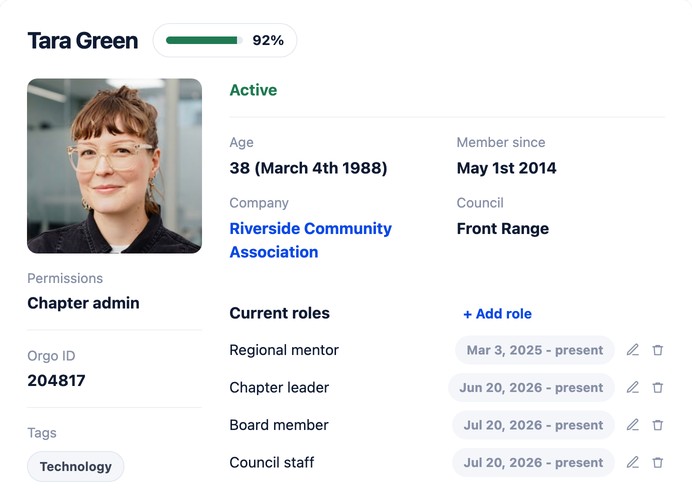
Units divide a branch into working sections, with a unit type you define. Use them for youth wings, women's organisations or campaign teams.
A member has one home branch. A transfer request carries a written reason, and the receiving branch approves it. Dues history and invoices stay where they were created.
Membership applications signed online
In a party, joining is a formal act. Orgo's adhesion module turns the paper application into a signed online file with a review chain behind it.
You choose the profile and custom fields the applicant fills in. The applicant signs on screen, and Orgo renders the PDF from your own HTML template with the signature embedded.
The applicant uploads the front of an ID, and the back when needed. Orgo reads Romanian ID cards and passports automatically. For other countries a reviewer types the details in.
With review steps on, every application moves through the same stages:
- Form validated, only after the ID is validated
- Background checked
- Interviewed
- Approved or rejected, only after both conclusions are saved
Branch secretaries see applications for their own branch only. National HR sees the whole party. The per-application log names who validated, interviewed and decided, with a timestamp for each.
Staff at a branch office can enter an application on someone's behalf. They upload the signed paper form instead, up to five files.
Internal elections and congress voting
Orgo's eVoting runs branch leadership elections, candidate selection and congress motions. Ballots are anonymous by default.
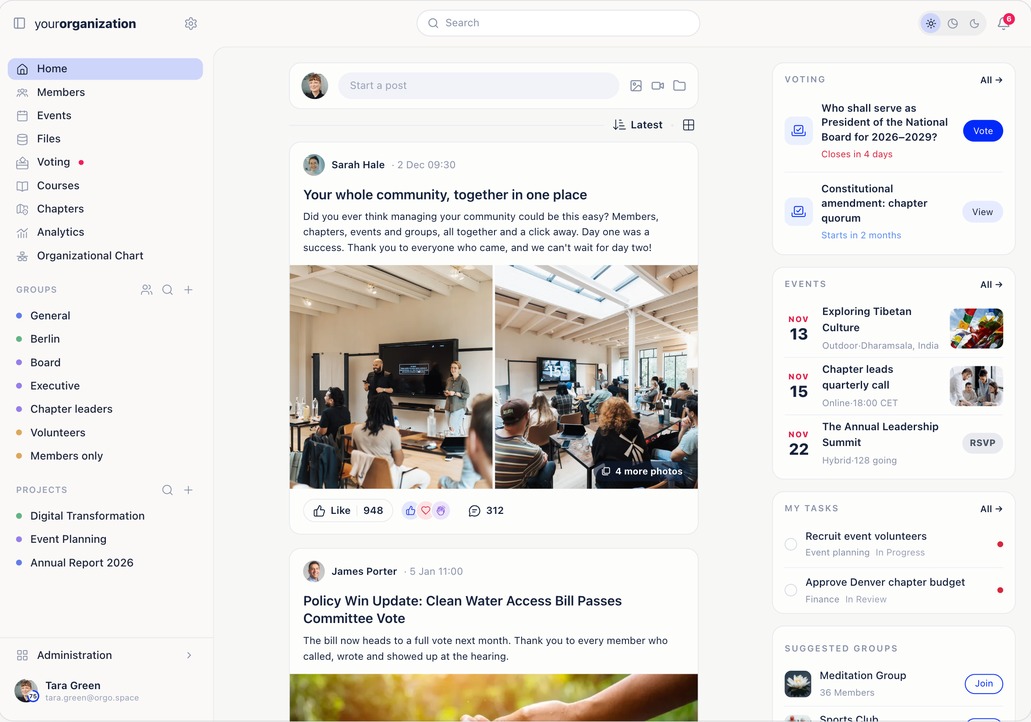
Choose the electorate on the vote itself:
- Group vote: a branch, a role group, or every active member
- Private vote: a named list, such as congress delegates
- Event attendees: everyone registered for the congress
With anonymous voting on, a ballot is stored with no link to the voter. Administrators see who voted, never what they chose. The setting freezes once the vote is published.
A member who votes in the member app receives an integrity code. Pasting it into the vote confirms that no stored ballot was changed, removed or added afterwards.
Results show counts and percentages per option, per question. Fullscreen mode puts them on the projector with your party's logo.
Orgo reports raw counts and turnout. Your electoral commission applies the quorum and majority rules in your statutes.
Dues, donations and payment compliance
Orgo collects membership dues and political donations in one ledger, through Stripe or recorded bank transfer. Identity checks can sit in front of online payments.
Each membership category gets its own price on one fee product. With Fee Payment Mandatory on, members whose dues have expired lose access to the platform until they pay.
Branches can charge their own dues and connect their own Stripe account. A branch treasurer records cash or bank transfers from a member fees table, and a national officer approves the batch.
Each campaign gets a public page with suggested amounts, one-time or monthly giving, a donor wall and donor messages. Embeddable widgets put the same form on your party website.
With Require for Online Payments on, a payment waits for an identity document. Donors can also choose confidentiality, which keeps their name off the public donor wall.
Orgo does not enforce legal donation caps or file reports with an electoral authority. Donations produce a thank-you email, not a receipt document. Your treasurer exports the payment records for statutory reporting.
Official documents, leadership and communications
Orgo gives a party one place to publish its decisions, show who holds which office, and tell members about both.
The Official Gazette holds congress resolutions, executive decisions, statutes and minutes. Each entry has a type, a subject, a document date, an optional number and one attached file.
Every signed-in member can read every entry. Only national HR can add, edit or delete entries. Keep restricted documents in Files, which has folder and group permissions.
The chart draws your leadership from roles and who holds them today. Each box shows a role and how many active members hold it.

Publishing a document notifies nobody on its own. Announce it in a newsletter with open and click tracking, or in a discussion post inside the branch or national group.
Mobile app for members and activists
Members use Orgo on iOS and Android through the Orgo Community app. Every screen of the web platform works in the app.
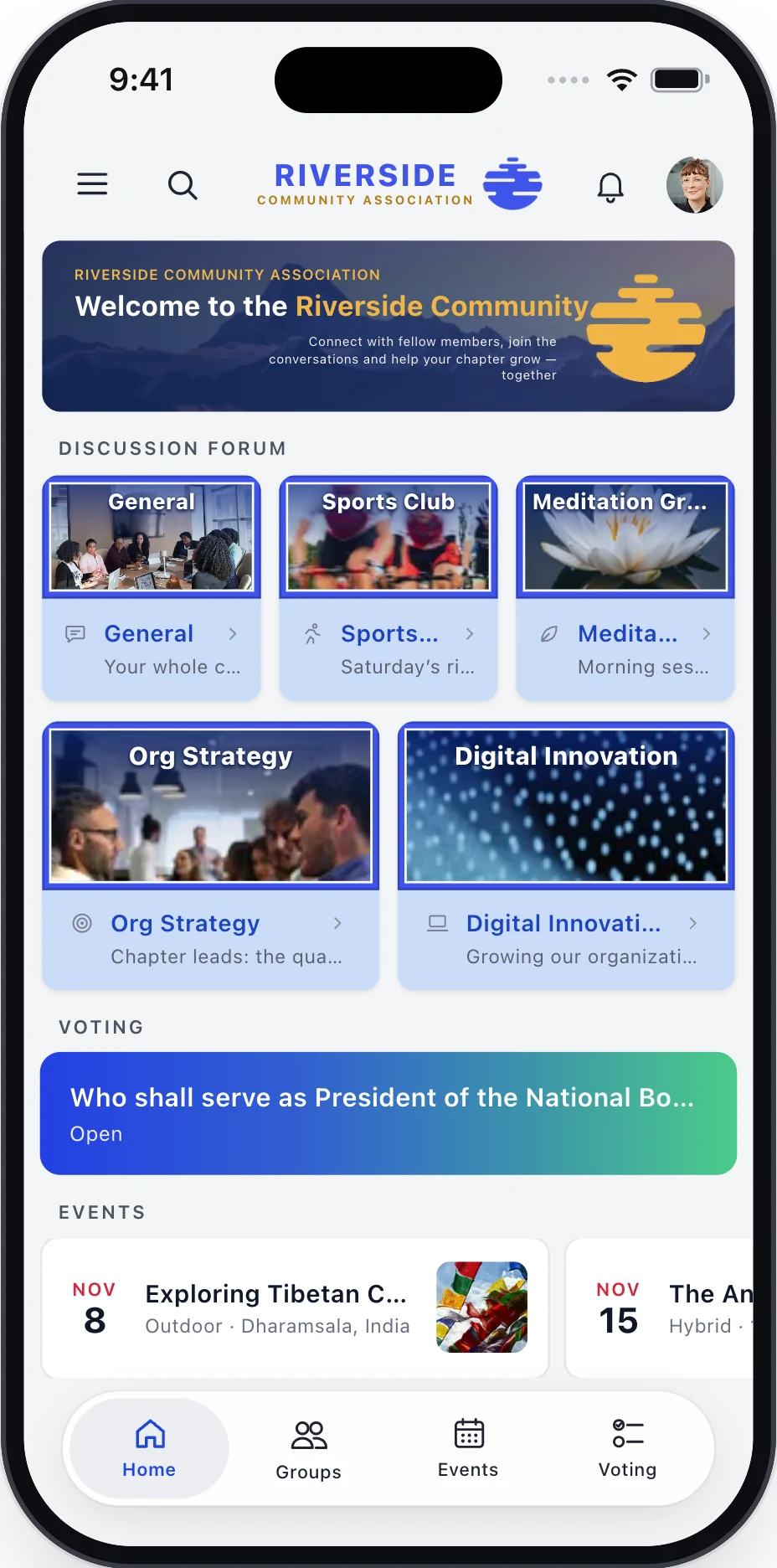
Votes, events and discussions reach members on the lock screen. Publishing and closing a vote sends a notification in the app and by email to members who chose instant alerts.
Orgo can publish a separate App Store and Google Play listing with your party's name and icon. Orgo provisions it with your Apple and Google developer accounts.
The Event App carries the programme, the attendee feed and networking for a multi-day congress.

Member data as special-category data
In the European Union, party membership is special-category personal data under Article 9 of the GDPR. Orgo gives the party the controls, and the party remains the data controller.
Two settings set the minimum permission to browse members and to filter them by branch. Both start on All Users, so a party should raise them before the first member joins.
Restrict Profiles to Shared Local Centers stops a member of one branch from opening profiles in another. National and regional administrators are exempt.
Text, number and date custom fields can be encrypted at rest with AES-256-GCM, up to five per organisation. Every decrypted read is logged with the reader and IP address.
Exporting members to CSV needs a branch HR permission at least. Every export writes an entry to the activity log naming who ran it.
Case study REPER, a Romanian political party
REPER has run its membership on Orgo since September 2023. The party uses Orgo for member records across its regional branches, dues collection, campaign coordination and internal votes. In the words of REPER's leadership: "Orgo has been instrumental in modernizing our operations and engaging our members. It's not just a tool, it's a catalyst for our growth."

“I've been using ORGO since September 2023 and I am extremely satisfied. The biggest advantage of the platform is the team behind it. I needed help at various times, and each time I received quick responses and effective solutions.”

Adela Șpaimoc, Human Resources Manager, REPER
Political fundraising at national scale
Orgo ran the donation platform for Nicușor Dan's presidential campaign in Romania. The campaign raised €1.3 million from 18,700 individual donors in three months. Read the political fundraising case study for the donation pages, donor messages and the suggested-amount tests behind the result.
Move your party's records into Orgo
Branches first, then members
CSV import creates your chapters first, then members linked to their branch, then past payments. Every member lands in the right branch on the right dues category.
Human-led implementation
An Orgo specialist configures your structure, roles and application form with you. Not a self-service wizard.
One test application before launch
We run one application end to end with you, from signature to approval, before members see it.
Support A team that has set up a party before
You talk to the people who built Orgo, not an account executive working from a script.

Vasile Darie
CEO

Alex Plosceac
CTO

Radu Vrabie
CCO
The same team builds and supports Orgo. When a branch secretary asks why an application cannot move forward, the answer comes from someone who knows the adhesion module and your statutes.
Setup around your statutes
Branch tiers, officer roles and the application template are configured to match how your party is organised.
Help before a congress
Vote audiences, anonymity and delegate lists are checked with you before the first ballot opens.
Patience with volunteers
Many branch officers are volunteers. Support adapts to their pace, technical or not.
Built for your kind of political organisation
National parties
Regions, counties and local branches with officers at every tier and one national membership register.
New parties and movements
Online applications and donations from day one, before there is an office in every county.
Regional and local parties
A smaller tree of branches with the same signed applications and secret-ballot votes.
Youth wings
A unit or a separate branch tier with its own officers, events and dues category.
Party foundations and think tanks
Donations, events and newsletters for supporters who are not party members.
Trade unions and other formal bodies
Any organisation where joining and leaving are formal acts with a signed document behind them.
If your organisation is a federation of separate bodies
Some political networks join separately registered organisations rather than individual members. See federation management for that model, or multi-chapter management for the branch tools in detail.
See your party structure in Orgo
- 1 Pick a 30-minute slot. You talk to the people who built Orgo, not an account executive working from a script.
- 2 We set up your branch tiers, membership categories and application form during the call.
- 3 You keep the sandbox to test with your team, plus a written plan for moving your member records.
Political party membership platform FAQ
Yes. Orgo's adhesion module lets an applicant fill in your membership form, upload an identity document and sign the application on screen. Orgo turns the signed application into a PDF built from your own template. The application then waits in the review queue of the applicant's branch.
Orgo collects the identity document and puts it in front of a human reviewer. It reads Romanian ID cards and passports automatically, and a reviewer types in details for other countries. Orgo does not check the document against a national register or compare the photo to the person.
Yes. Each branch is a chapter in Orgo, and branch officers with chapter-level roles manage that branch's members, applications and dues. Regional officers with parent-chapter roles manage every branch below their region. National officers see the whole party.
Yes, by default. Orgo stores an anonymous ballot with no link to the voter, so administrators can see who voted but not how. The anonymity setting cannot be changed once a vote is published or the first ballot is cast.
Yes. A private vote limits the electorate to a named list of delegates, and a vote started from the congress event limits it to registered attendees. Results appear per option and can be shown fullscreen on a projector. Orgo reports counts and percentages, and your commission applies the quorum rules in your statutes.
Yes. Orgo runs dues and donation campaigns side by side, with payments through Stripe or recorded bank transfer. Donation campaigns get a public page, suggested amounts, one-time or monthly giving and embeddable widgets. Orgo powered the donation platform for Nicușor Dan's presidential campaign, which raised €1.3 million from 18,700 donors.
No. Orgo does not enforce donation caps or file reports with an electoral authority. It can require an identity document before an online payment and keeps every payment in an exportable ledger. Your treasurer applies the legal limits and prepares statutory reports.
Orgo treats who can see the member list as a setting the party controls. Administrators set the minimum permission to browse members, can keep branches out of each other's profiles, and can encrypt sensitive custom fields. The party remains the data controller under the GDPR.
Yes. Members use the Orgo Community app on iOS and Android, with push notifications for votes, events and discussions. Orgo can also publish a branded app under the party's own name and icon.
Related features
Multi-chapter management
Branch tiers, officer permissions and transfers between branches.
Learn moreElectronic voting
Anonymous, auditable ballots for leadership elections and congress motions.
Learn moreFundraising software
Donation pages, widgets and recurring giving for campaigns.
Learn moreData privacy
Member visibility, encryption and the audit log.
Learn more