

A Circle alternative built
for membership organizations
Circle is an excellent platform for creators, coaches, and course builders who want to monetize communities. Its interface is polished and intuitive, and its native payments, courses, events, gamification, and AI tools are genuinely well-built. But when your organization needs formal dues management, multi-chapter governance, and eVoting tools your bylaws require, there's Orgo.
This page includes an honest comparison. We'll show you where Circle actually wins, who should stick with them, and where Orgo genuinely does it better. You decide.
TLDR: Quick verdict
The main difference between Circle and Orgo is that Circle is a community platform built for creators and course builders who sell access to content and coaching, while Orgo is a complete membership management platform that combines native dues collection, multi-chapter coordination, community features, and governance tools in a single system built for nonprofits and associations.
Choose Orgo if:
You collect membership dues and need automated renewals, grace periods, and lapsed-member workflows You manage 500+ paying members across multiple chapters or regional branches You need governance tools: board elections, eVoting, eDocuments, and eSignatures Your members apply and require approval before joining You want a branded mobile app without a separate custom pricing tier
Choose Circle if:
You're a creator, coach, or educator selling access to a paid community or course program Your revenue model is subscription access rather than membership dues tied to a governing structure You want courses, events, live streams, and community in a single polished platform Your audience is a customer base or learner community rather than dues-paying members of an organization
Why organizations look for alternatives to Circle
Circle is a well-built platform that serves creators exceptionally well. Three gaps emerge consistently when associations and nonprofits evaluate it against their operational needs.
Orgo vs Circle
Both platforms include community spaces, discussion threads, events, gamification, and member directories. The overlap is genuine. Where they diverge is in what surrounds those community features. Circle is a creator monetization platform. Orgo is a complete membership management platform that includes community as one of its modules.
The table below covers features both platforms share, areas where Circle has a genuine edge, and areas where Orgo provides capabilities Circle does not.
Side-by-side feature comparison
Every cell has been verified against both platforms' current websites and user-reported data.
| Feature | | |
|---|---|---|
| Core membership | ||
| Member database and profiles | ||
| Membership dues and renewals | Subscription access only; no formal dues workflows | |
| Membership application and approval workflow | ||
| Multi-tier membership categories | ||
| Lapsed member and grace period management | ||
| Community & engagement | ||
| Discussion forums, Q&A, threads | ||
| Gamification (points, levels, leaderboards) | ||
| Member networking and directory | ||
| Event management | ||
| Courses and learning management | ||
| Email campaigns and newsletters | Email Hub add-on (+$99/month per 10k contacts) | |
| Payments & billing | ||
| Online payment processing | ||
| Per-transaction platform fee | 2% (Professional), 1% (Business), 0.5% (Enterprise) | |
| Administration & security | ||
| Granular permissions / RBAC | Admin, moderator roles; limited granularity | |
| Analytics and reporting | ||
| SSO | Auth0-based; Thinkific/Teachable/WordPress integrations | |
| API and webhooks | Admin API 30k req/month (Business+); 5k on Professional | |
| Data residency (EU/US) | Not documented; US-hosted | |
| Platform & integrations | ||
| Native mobile app (iOS/Android) | Shared "Circle Communities" app; branded app = Circle Plus (custom) | |
| CRM and marketing integrations | Zapier-based; no native HubSpot, Salesforce, or Mailchimp | |
| AI features | ||
A Circle alternative with complete membership management
Circle covers community engagement and creator monetization well. These are the capabilities that membership organizations need beyond that, and that only Orgo provides natively.
| Your organization needs... | | |
|---|---|---|
| Membership operations | ||
| Dues collection with approval workflows and membership categories | ||
| Automated renewal sequences and lapsed-member handling | ||
| Learning management system (courses, quizzes, certificates) | Courses and drip content; no quizzes or certificates | |
| Multi-chapter management | ||
| Multi-chapter hierarchy (HQ, regions, local chapters) | ||
| Member transfers between chapters | ||
| Per-chapter Stripe payment accounts | ||
| Governance | ||
| eVoting and elections | ||
| eDocuments and eSignatures | ||
| Mobile | ||
| Branded native mobile app (iOS/Android) | Circle Plus only (custom pricing above Enterprise) | |
These capabilities are outside Circle's product scope because Circle was designed for a different use case. If your operations depend on any of them, Orgo was built with them as first-class features from the start.
Why membership organizations choose Orgo over Circle
Both platforms charge members for access. The difference is what they do around that transaction.
The Orgo way
Orgo manages the full membership lifecycle. A prospective member submits an application, which an admin reviews and approves. The member pays dues through Stripe and gets assigned to their chapter and membership category.
From there, the member participates in discussion groups, votes in elections, and renews automatically each year with automated reminders. No external tools. No manual steps.
The community features are connected to the membership record. Campaigns can target members by chapter, tenure, or membership tier.
Lapsed members enter a grace period workflow. Renewals route to the correct Stripe account for the member's chapter. The administrative overhead that consumes staff time in most associations is handled by the platform.
The Circle way
Circle's native paid memberships are a genuine strength for creators. The platform makes it straightforward to gate a community behind a monthly or annual subscription, offer free trials, and run discount coupons.
For a coach or educator whose revenue model is subscription access to content and community, Circle handles this well with minimal setup.
For a member-based organization, dues carry formal significance. Different members pay different rates based on category. The renewal process involves invoicing, grace periods, and compliance with governing documents. Circle's subscription system covers the payment layer. It does not cover the membership administration layer.
The question is not which platform takes payments more easily. It is whether your organization needs payment collection alone, or payment collection as part of a formal membership administration system.
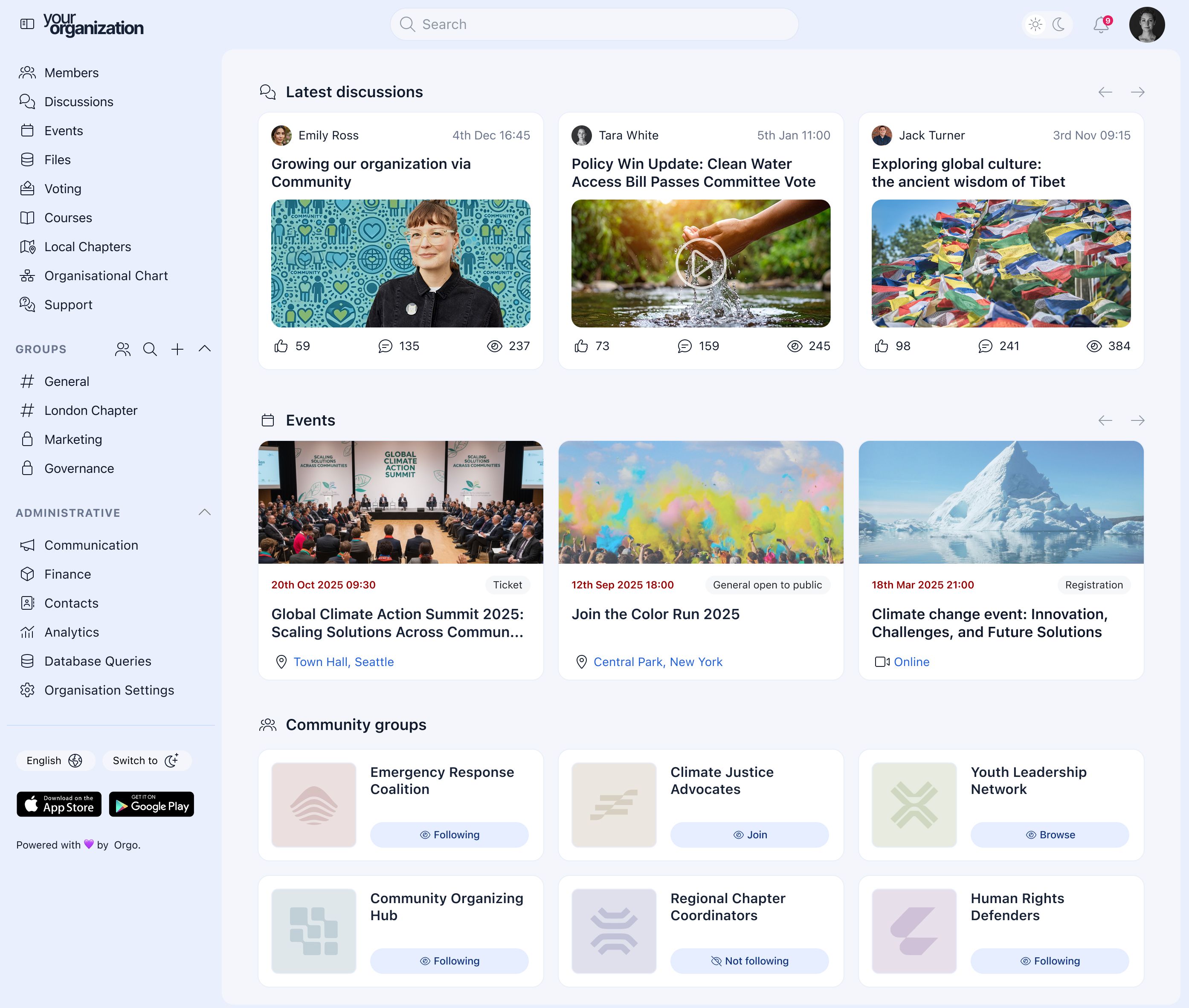
Orgo dashboard
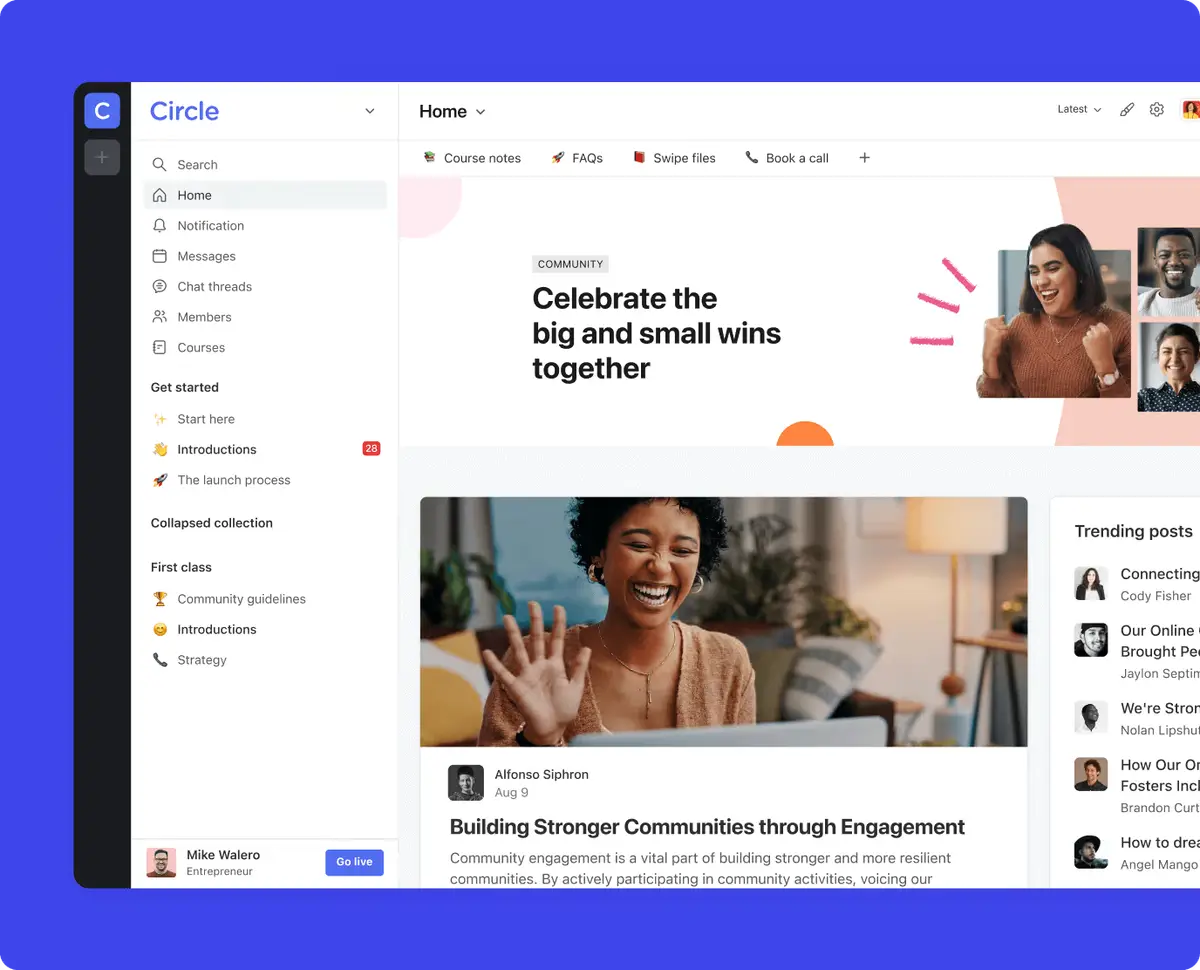
Circle community dashboard
Nonprofits and associations operate under governing documents that define how decisions are made. Community engagement tools and governance-grade systems serve different purposes.
The Orgo way
Orgo's eVoting module runs binding elections with anonymous encrypted ballots, configurable eligibility rules, audit trails, and result reporting.
Organizations use it to elect board members, pass resolutions, and conduct ratification votes under their governing documents. Chapters can run local elections independently while headquarters maintains oversight.
eDocuments and eSignatures (Scale plan) cover the document layer: membership agreements, consent forms, board resolutions.
The Circle way
Circle is designed for community engagement: discussions, comments, reactions, events, and courses. These tools work well for the creator use case, where the goal is building an active, engaged learner or customer community.
Governance functionality is not part of Circle's product. The platform does not include board election tools, anonymous ballot functionality, configurable eligibility rules, audit trails, or document signing.
Circle was not built for this use case and does not position itself as serving it.
Organizing content into spaces is different from running a multi-chapter organization. One is a community feature. The other is an organizational structure with financial, permission, and governance implications.
The Orgo way
Orgo supports a multi-tier structure (headquarters, regions, local chapters) in a single account. Each chapter gets its own leadership roles, its own Stripe account for local dues, and granular permissions.
Chapter leaders manage their members without visibility into the rest of the system. Headquarters sees everything in one consolidated dashboard.
Member transfers between chapters are a built-in workflow. Local chapters run their own events, collect fees, and manage their own communications, while the national office maintains oversight.
The Circle way
Circle's Spaces are a clean content organization system. Creators use them to organize cohorts by level, separate content tracks, or create private areas for different audience segments. For a creator managing a few distinct content streams within one community, this works well.
Spaces do not carry organizational structure. There is no chapter-level financial autonomy, no per-chapter admin hierarchy, no member transfer workflow, and no consolidated cross-unit reporting.
Circle is one community per account by design. That suits the creator use case. It does not suit the federation structure of a multi-chapter association.
What our clients say about Orgo
""As someone who appreciates what technology can do but is easily overwhelmed by learning new systems, I was delightfully surprised to discover Orgo. Their streamlined menus, uncluttered visual layout, and simple intuitive navigation make the user experience joyful."














Find the right fit
When Orgo is the better fit
Orgo is built for organizations like yours if:
You collect formal dues and need the full renewal lifecycle managed natively You manage 500+ paying members across multiple chapters or regional branches You need elections or board votes that comply with your governing documents Membership requires an application and admin approval, not open sign-up You want a branded mobile app your members can download from the App Store You care about EU-based data hosting and GDPR compliance
If this sounds like your organization, get a demo and we'll show you exactly how Orgo handles your structure.
Get a DemoWhen Circle is the better fit
We believe in transparency. Circle is probably the better choice if:
You're a creator, coach, or educator monetizing a community around your content or expertise You want courses and community in the same platform without a formal membership structure Your members subscribe for access rather than joining as dues-paying members of a governed organization You want gamification and live streaming alongside community discussion You want AI-powered features like AI Agents and AI Workflows built natively into the platform Governance, multi-chapter management, and formal dues workflows are not requirements
But if your organization needs formal dues management, chapter hierarchy, governance tools, and a native app alongside community features, that is the combination Orgo was built to provide.
Switching from Circle is easier than you think
The biggest objection after "does it do what I need?" is "how painful is the switch?" Our team handles the migration end to end. You stay focused on your members while we move your data, configure your structure, and get your team up to speed.
Data migration
We handle the heavy lifting. Your member database, organizational structure, and community content are imported by our team. Not your staff. We've successfully migrated 40 years' worth of member lifecycle data for one of our clients. No matter how deep your records go, we've done it before.
Stripe payment continuity
Circle routes payments through your Stripe account. Since Orgo also integrates directly with Stripe, active subscriptions can be migrated without interrupting members. No re-billing. No member disruption. Your existing Stripe setup transfers cleanly.
Dedicated onboarding
A real person walks your team through setup, configuration, and training. Typical timeline: 2 to 4 weeks from kickoff to launch.
Chapter setup
We configure your multi-tier hierarchy (headquarters, regions, local chapters) to mirror your actual organization from day one. Regional coordinators and chapter leaders get their own access and permissions immediately.
Your brand first
Extensive white-label branding options ensure your platform looks and feels like your organization. Not like a generic software tool.
Orgo vs Circle pricing
Both platforms publish transparent pricing. Here is how they compare at each tier, and what you get for the cost.
Orgo pricing
Orgo offers 3 plans based on active member count, starting at $59/month for 200 members on the Grow plan (annual billing).
Grow includes core membership management, eVoting, LMS (courses), fundraising, gamification, and custom branding. Platform fee: 2%.
Impact (most popular) adds multi-chapter management (up to 50 chapters), workflows, and API access, starting at $359/month for 1,000 members. Platform fee: 1%.
Scale offers custom pricing with unlimited chapters, eDocuments, eSignatures, a branded mobile app, and a dedicated customer success manager. Platform fee: 0%.
All plans use Stripe directly (46+ countries). No forced payment processor.
See full Orgo pricingCircle pricing
Professional: $89/month (annual). Includes unlimited members, courses, events, live streams, gamification, and a member directory. Platform fee: 2%.
Business: $199/month (annual). Adds unlimited automations, custom profile fields, branded email notifications, and a more capable API. Platform fee: 1%.
Enterprise: $419/month (annual). Adds custom SSO and AI features. Platform fee: 0.5%.
Circle Plus: Custom quote. Adds a branded iOS/Android app in the App Store under your organization's name.
Each plan includes a per-transaction platform fee: 2% on Professional, 1% on Business, and 0.5% on Enterprise. This fee applies to every transaction processed through the platform, in addition to Stripe's standard processing rate.
Native email marketing is not included. The Email Hub add-on costs an additional $99/month per 10,000 contacts.
The bottom line
Circle Professional ($89/month) starts below Orgo Grow ($59/month for 200 members). But Circle adds a 2% platform fee on top of Stripe's standard processing rate.
For a membership organization collecting $100/year in dues from 500 members, the combined transaction fees at Circle Professional represent a meaningful additional cost layer that increases with revenue volume.
The right comparison is total cost against total capability. Orgo delivers dues workflows, multi-chapter management, and governance tools alongside community features. The two platforms serve different organizational models.
Circle migration: Frequently asked questions
Yes. Most organizations run both platforms for 2 to 4 weeks during onboarding. This lets your team get comfortable with Orgo before you fully switch over. We help you plan the transition timeline so nothing falls through the cracks.
We recommend timing your migration to align with your Circle renewal date. Our onboarding team will work with your schedule to minimize billing overlap. Most transitions complete within one billing cycle.
Circle routes payments through your connected Stripe account. Since Orgo also integrates directly with Stripe, active subscriptions can be migrated without interrupting members. Our team handles the migration and will walk you through the steps to avoid any billing disruption.
Yes. Orgo includes a full learning management system with courses, quizzes, and completion tracking. Circle's course features are well-designed and suit creators delivering online programs. Orgo's LMS is built specifically for the professional development, training, and certification needs of associations and nonprofits.
Orgo is THE Circle alternative
for membership organizations
Circle works for creators monetizing communities through subscriptions. But when your organization needs formal dues management, multi-chapter governance, eVoting, and a branded mobile app alongside community features, Orgo is the alternative built for exactly that.
Also worth reading:
- Orgo vs Bettermode: Another community platform comparison for membership organizations.
- Orgo vs Hivebrite: How Orgo compares to Hivebrite for nonprofits and associations.
- Orgo Pricing