
The Springly Alternative
for Organizations That Have Outgrown It
Springly is an all-in-one platform that works well for small nonprofits and clubs. If your organization is growing into multi-chapter structure, needs governance tools, or is moving into Springly's higher pricing tiers, you're likely hitting limits the product wasn't designed to solve.
This page includes an honest comparison. We'll show you exactly where Springly wins, who it's genuinely right for, and where Orgo does it better. You decide.
TLDR: Quick verdict
The main difference between Springly and Orgo is that Springly is a horizontal all-in-one platform optimized for small nonprofits and clubs, while Orgo is purpose-built for associations and federations with 500+ members, multi-chapter structures, and governance requirements.
Choose Orgo if you need:
- Your organization has 500+ paying members across one or more chapters
- You coordinate multiple chapters or regional branches
- You need governance tools: eVoting, eDocuments, eSignatures
- You landed on Springly's Networks tier and found it shallow on features
- Your Springly bill has climbed as your contact count grew and you want member-based pricing
- You need per-chapter reporting without exporting to Excel
Springly may still be right if you:
- Run a small nonprofit, club, or congregation with straightforward membership needs
- Need built-in fund accounting because you don't have a separate bookkeeper
- Require QuickBooks integration as a hard requirement
- Your primary needs are email campaigns, basic events, and donation collection alongside membership
Why growing organizations look for alternatives to Springly
These are the friction points driving growing federations and associations to explore alternatives, based on verified user reviews on Capterra and GetApp, and on Springly's own published pricing and feature pages.
Orgo vs Springly
Both platforms handle membership dues, renewals, events, and email campaigns. Where they diverge is in depth: how membership is structured, how chapters are managed, what governance tools exist, and how payment processing works.
Every cell has been verified against both platforms' current websites. Where Orgo lacks a feature Springly has (fund accounting), that is noted honestly. Where a feature works differently between the two, like website building, the plan and pricing details are noted too.
| Feature | | |
|---|---|---|
| Core membership | ||
| Member database and profiles | ||
| Membership dues and renewals | ||
| Automated renewal reminders | ||
| Member self-service portal | ||
| Custom membership fields | ||
| Family membership plans | Confirmed missing per user reviews | |
| Membership numbers | ||
| Membership cards and certificates | ||
| Federation and multi-chapter | ||
| Multi-chapter hierarchy (HQ, regions, chapters) | Included from Scale, up to 100 chapters. Unlimited on Enterprise | Networks tier only (quote-only, CRM grouping) |
| Per-chapter autonomy with local leadership roles | ||
| Per-chapter reporting | ||
| Granular role-based permissions | Unlimited roles, scoped per chapter | Basic admin roles |
| Governance | ||
| eVoting (anonymous, encrypted) | Included on all plans | |
| eDocuments | Scale and Enterprise plans | |
| eSignatures | Scale and Enterprise plans | |
| Payments and billing | ||
| Bring your own Stripe account | Subscriptions stay in your account | Springly's gateway only |
| Platform transaction fee | 0% on every plan | 3.1% + $0.30 per transaction (Adyen) |
| Built-in accounting and fund accounting | Professional plan and up: balance sheet, fund accounting, bank reconciliation | |
| QuickBooks integration | ||
| Pricing metric | Active members (generous contact limits included) | Total contacts in database |
| Free plan | Liberty plan (very limited scope) | |
| Starting price | From $340/mo (Grow, 1,000 members) | From $45/mo (Serenity, contact-count based) |
| Communications and events | ||
| Email campaigns | ||
| Event management and ticketing | ||
| Fundraising and donations | ||
| Member networking and discussion groups | Profiles, DMs, groups, forums | Member directory only |
| Platform and tools | ||
| Website builder | Included on all plans | Included from Serenity plan up; criticized by users |
| Custom reporting | Limited (recurring user complaint) | |
| Integration ecosystem | Open API, Webhooks (Scale and Enterprise) | QuickBooks primarily |
| Data migration support | Handled by Orgo team | Self-serve CSV import |
| Dedicated onboarding | Scale and Enterprise plans | Paid tiers only |
A Springly alternative with governance features
Springly's Networks tier is marketed for federations and parent organizations. These are the capabilities it doesn't include, and that Orgo builds into the Scale and Enterprise plans as core functionality.
| Your organization needs... | | |
|---|---|---|
| Membership features | ||
| Membership numbers assigned to every member | ||
| Membership cards and certificates | ||
| Family membership under one campaign (adult + children) | ||
| Federation and governance | ||
| Native multi-chapter hierarchy (not CRM grouping) | HQ, regions, local chapters in one account | |
| Per-chapter financial and member reporting | ||
| eVoting for board elections and bylaw ratification | Anonymous, encrypted, tamper-evident audit trail | |
| eDocuments for governance record distribution | ||
| eSignatures for officer confirmations and agreements | ||
| Payments | ||
| Connect your own Stripe account (no processor lock-in) | Active subscriptions stay in your account, 0% Orgo platform fee | Springly's gateway, 3.1% + $0.30 per transaction (Adyen) |
| Open API for custom integrations | Scale and Enterprise plans | Professional plan and up |
Alternative to Springly for federations needing real multi-chapter tools
A chapter hierarchy that reflects your actual org structure
How a platform handles chapter structure determines how much administration scales automatically and how much stays manual. The difference between CRM grouping and a native hierarchy is not cosmetic.
The Orgo way
Orgo builds the chapter hierarchy into the core data model. HQ, regions, and local chapters exist as distinct organizational units within a single account. Each chapter gets its own space with local leadership roles scoped specifically to that chapter. A chapter coordinator can manage their chapter's members and events without seeing anything outside their scope.
National leadership holds consolidated visibility across all chapters: membership trends by region, revenue breakdowns, chapter-level performance comparisons, all in a single dashboard without exporting spreadsheets. Member transfers between chapters follow a built-in workflow with full record history intact.
The Springly way
Springly's Networks tier allows organizations to group contacts by chapter using CRM-style segmentation. For organizations with a handful of local units and limited reporting needs, this can work. The platform also supports a multi-level CRM for parent organizations managing chapters under the Networks tier.
Cross-chapter reporting requires exporting data and assembling it externally. Governance workflows (elections, document signing, formal approval chains) are not part of the Networks tier. The Networks tier is also quote-only, meaning you enter a sales process before knowing what you'll pay.
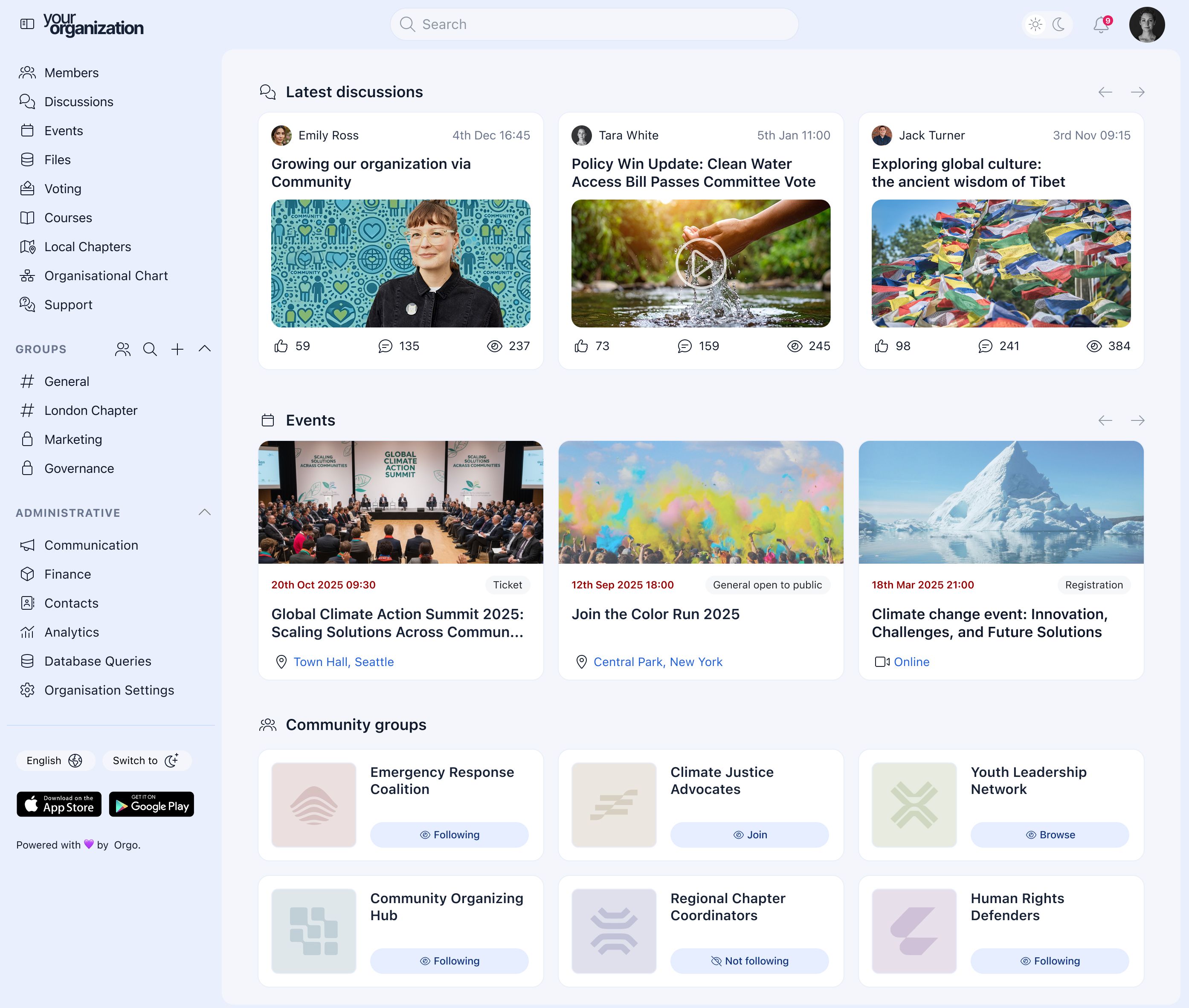
Orgo dashboard
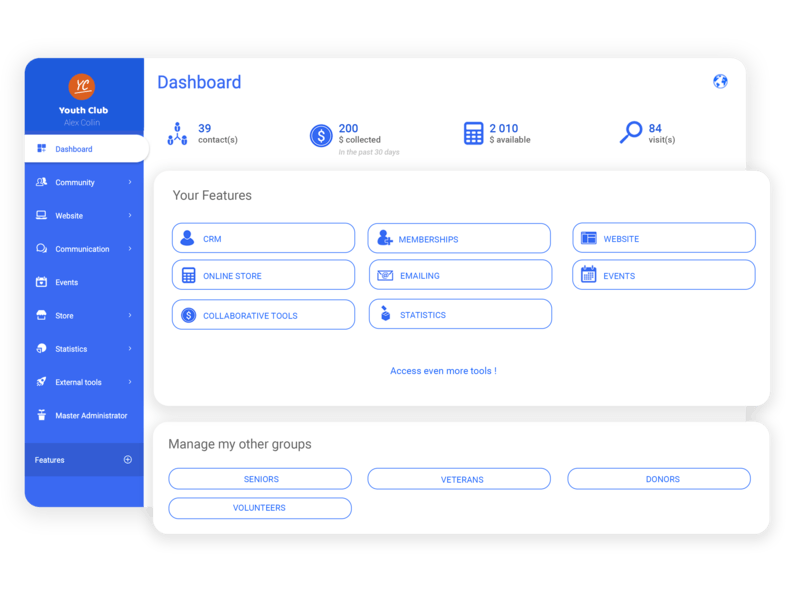
Springly dashboard
Governance tools built for associations, not donor-focused nonprofits
Springly was designed broadly for nonprofits. Many of its core features (accounting, donations, events) serve donor-driven organizations well. Orgo is built around the workflows that drive member-governed associations.
The Orgo way
eVoting is built for board elections, bylaw ratification, and officer votes. Ballots are anonymous and encrypted with a tamper-evident audit trail. eDocuments handle governance record distribution to members. eSignatures cover officer confirmations and member agreements.
These are not add-ons or roadmap items. eVoting is included on every plan, including Grow, and eDocuments and eSignatures are included on the Scale and Enterprise plans as core workflows, because associations run elections, ratify documents, and confirm officer appointments as a matter of regular governance. A platform built for associations has these as first-class features.
The Springly way
Springly's strengths are on the operational side: automated dues renewals, event registration, donation collection, built-in accounting, and email campaigns. For organizations whose primary governance need is managing memberships and running events, this covers most of the ground.
For formal governance (board elections, binding votes, document ratification, signed agreements), Springly does not offer these tools. Associations that need them work around this by using separate platforms or manual processes alongside Springly.
Payment processing without lock-in
How your membership payments are routed affects your data ownership, your pricing flexibility, and what happens if you ever switch platforms.
The Orgo way
You connect your own Stripe account. Member subscriptions live in your Stripe account, not in Orgo's. If you ever change platforms, your active member subscriptions continue without interruption. No re-billing. No data held hostage in a vendor's payment system.
Orgo charges a flat 0% platform fee on every plan. The only cost is Stripe's standard processing fee, and Orgo lets you offer members the choice to cover that fee at checkout. More than half of members opt to do so.
The Springly way
Springly routes all payments through its own payment gateway (Adyen) at 3.1% + $0.30 per transaction, with no option to opt for a different rate. Organizations cannot connect their own Stripe account or use a different processor. Member subscriptions live in Springly's system.
For organizations that are comfortable with this model and the locked-in rate, it is a functional approach. For organizations comparing the actual cost of processing dues at volume, the gap between a fixed 3.1% + $0.30 and a 0% platform fee on Orgo is worth running the numbers on.
What growing federations say about Orgo
""With an organization of 8,000 members and more than 80 chapters coordinated almost exclusively by volunteers, Orgo is at the heart of our digitisation process, allowing us to focus on our mission: learning by doing, nature, and personal development."














Find the right fit
When Orgo is the better fit
Orgo is built for organizations like yours if:
- Your organization has 500+ paying members and expects to keep growing
- You coordinate multiple chapters or regional branches with separate finances
- Membership dues and renewals are your primary operational workflow
- You need governance tools that aren't on Springly's published roadmap
- Your board or finance team needs per-chapter reporting without exporting CSVs
- Member-based pricing that scales on your terms matters to you
If this describes your organization, book a demo and we'll show you exactly how Orgo handles your structure.
Get a DemoWhen Springly is the better fit
We believe in transparency. Springly is probably the better choice if:
- You run a small nonprofit, club, or congregation and Springly's self-serve pricing tiers fit your scale
- You're volunteer-run or have a part-time admin who needs one tool for everything
- Built-in fund accounting is essential and you don't want a separate bookkeeping tool
- A completely free Liberty plan covers your basic payment collection and form needs, with no monthly bill
- Email campaigns, basic event registration, and donation collection cover most of what you need
Springly is genuinely good at serving this profile. It's built for this profile. If you're in it, the case for switching to Orgo is weak.
Switching from Springly is easier than you think
The biggest concern after "does it do what I need?" is "how painful is the switch?" On Scale and Enterprise plans, our team handles the migration end to end. Grow-plan organizations migrate using self-serve CSV import and documentation. Either way, you stay focused on your members while your data and structure get configured.
Data migration
Orgo accepts standard CSV exports from Springly. Our team maps your member records, contact history, and dues data to Orgo's data model and validates everything before go-live. Not your staff. Our team. We've successfully migrated 40 years of member lifecycle data for one client. No matter how deep your records go, we've done it before.
Stripe payment continuity
If your members pay via Stripe, their active subscriptions continue seamlessly in Orgo. No re-billing. No member disruption. No gap in renewal cycles. The cutover is aligned with your renewal calendar to avoid any billing overlap during the transition period.
Dedicated onboarding
On the Scale and Enterprise plans, a real person walks your team through setup, configuration, and training. Typical timeline: 2 to 4 weeks from kickoff to launch. Not a knowledge base and a ticket queue. A person who knows your organization's structure. Grow-plan teams set up through self-serve resources.
Chapter setup from day one
Your chapter hierarchy is configured before go-live, not figured out after. Regional coordinators and chapter leaders get their own access and permissions immediately. For organizations moving from Springly's Networks tier, this is the part that makes the most visible difference from day one.
Your brand first
Extensive white-label branding options ensure your member portal looks and feels like your organization. Not like a generic software product. Your members see your name, your colors, your identity.
Orgo vs Springly pricing
The two platforms use fundamentally different pricing metrics. Understanding the difference matters before you compare starting prices.
Orgo pricing (2026)
Orgo offers 3 plans based on active member count. The Grow plan starts at $340/month for up to 1,000 members and serves one organization, with the website builder, API access, and eVoting included, not billed as add-ons. The Scale plan is where chapter support arrives, up to 100 chapters, along with per-chapter Stripe accounts, eDocuments, eSignatures, workflows, and open API access; it starts at $450/month for up to 1,000 members and rises with member count toward 10,000, with the exact rate confirmed on a call. Enterprise is custom-quoted and includes unlimited chapters, unlimited members, and a dedicated Customer Success Manager.
Orgo prices on active member count. Contact limits per tier are set generously above the member count to accommodate donors, past members, event attendees, and newsletter subscribers in the same database. Growing your contact database does not move you to a higher pricing tier on its own.
All plans use Stripe directly, with a flat 0% Orgo platform fee on every plan. No forced payment gateway, no per-tier fee schedule to track.
Get a demo for full pricing detailsSpringly pricing (2026)
Springly's free Liberty plan has a limited scope: no CRM, no email campaigns, no accounting, no website builder. The paid Serenity plan starts at $45/month for its base band (up to 250 contacts) and includes the website builder, rising as your contact count grows. The Professional plan starts at $119/month for the same base band and adds accounting tools and API access. Larger organizations enter the Networks tier, which is quote-only with no published pricing.
Springly prices on total contacts: every person in the database counts, whether they are a current member, a lapsed member, a donor, or a newsletter subscriber. Organizations that grow their contact database move through pricing tiers independent of their actual member count.
Transaction fee: 3.1% + $0.30 per payment (Adyen), processed through Springly's gateway. You cannot use your own Stripe account. Annual billing costs less than monthly, though Springly does not publish an exact discount rate on its primary pricing page.
Members vs. contacts: what's the difference?
In Orgo, a "member" is a person actively enrolled in a membership plan and paying dues. A "contact" is anyone else in the database: lapsed members, donors, event attendees, newsletter subscribers, chapter staff. Most organizations have more contacts than active members.
Orgo prices on member count and includes generous contact limits per tier. Springly prices on total contacts, which means every person in your database counts toward your tier regardless of membership status. For growing organizations, this is the most important structural difference between the two pricing models.
Springly migration: frequently asked questions
Yes. On Scale and Enterprise plans, most organizations run both platforms for 2 to 4 weeks during dedicated onboarding; Grow-plan teams typically move faster with self-serve setup. Member renewals are paused or rerouted on Springly while Orgo is configured. Traffic flips once the team is confident. We help you plan the timeline so nothing falls through the cracks.
Align the cutover with your primary renewal cycle. Members whose dues fall in the migration window are handled manually or delayed slightly. The Orgo onboarding team coordinates this as part of setup so you don't have to manage it independently.
Yes. Orgo accepts standard CSV exports. The migration team maps Springly's fields (custom fields, membership tiers, contact groups) to Orgo's data model and validates the data before go-live. You export from Springly, the Orgo team handles the rest.
No. Orgo does not include built-in fund accounting. If your finance team relies on Springly's double-entry bookkeeping and balance sheet, you will need a dedicated accounting tool alongside Orgo such as QuickBooks or Xero. Orgo integrates with Stripe for payment data and can export to your accounting system. This is a genuine tradeoff worth evaluating before switching.
The migration follows the same 2 to 4 week onboarding. The main difference is that your chapter structure needs to be mapped before go-live rather than added later. The Orgo onboarding team configures the chapter hierarchy, per-chapter reporting, and governance workflows as part of the setup. These are not post-launch items. For organizations moving from the Networks tier, this is typically where the most visible improvement over the previous setup appears.
Orgo is the Springly alternative
for organizations that have outgrown it
Springly works for small nonprofits and clubs with straightforward membership needs. When your organization needs multi-chapter coordination, governance tools, member-based pricing, and payment processing without lock-in, Orgo is the alternative built for exactly that.
Related comparisons: Wild Apricot Alternative·Neon CRM Alternative