
Community building is the deliberate process of creating belonging, trust, and collective purpose among a group of people. It applies across social, professional, and digital contexts. Organizations that invest in it sustain stronger member engagement and achieve goals that individuals cannot reach alone.
What is community building?
Community building refers to the structured development of relationships, shared norms, and governance among people who organize around common goals or values. It operates across social, business, and digital contexts, each with distinct dynamics but the same foundational requirements: a clear purpose, willing participants, and consistent leadership.
The defining characteristic of a community is not physical proximity but shared identity. Members recognize themselves as part of something larger than the individual. This recognition drives participation, loyalty, and collective action over time.
Community building differs from audience building in a fundamental way. An audience consumes content passively. A community contributes actively, holds shared norms, and maintains relationships between members rather than only between members and an organizer.

Why does community building matter?
Strong communities generate social capital: the networks of trust, reciprocity, and shared norms that enable groups to coordinate and solve problems together. Sociologist Robert Putnam's research on civic participation established that communities with higher social capital achieve better collective outcomes across health, safety, and economic resilience.
For organizations, community building affects member retention directly. Members who feel connected to a group renew more consistently, contribute more actively, and recruit others. This reduces acquisition costs and creates sustainable organic growth.
Organized communities also amplify advocacy. A coordinated group can mobilize resources, raise public awareness, and influence policy in ways that isolated individuals cannot. This applies equally to nonprofit associations, professional bodies, civic organizations, and political movements.
What are the main types of communities?
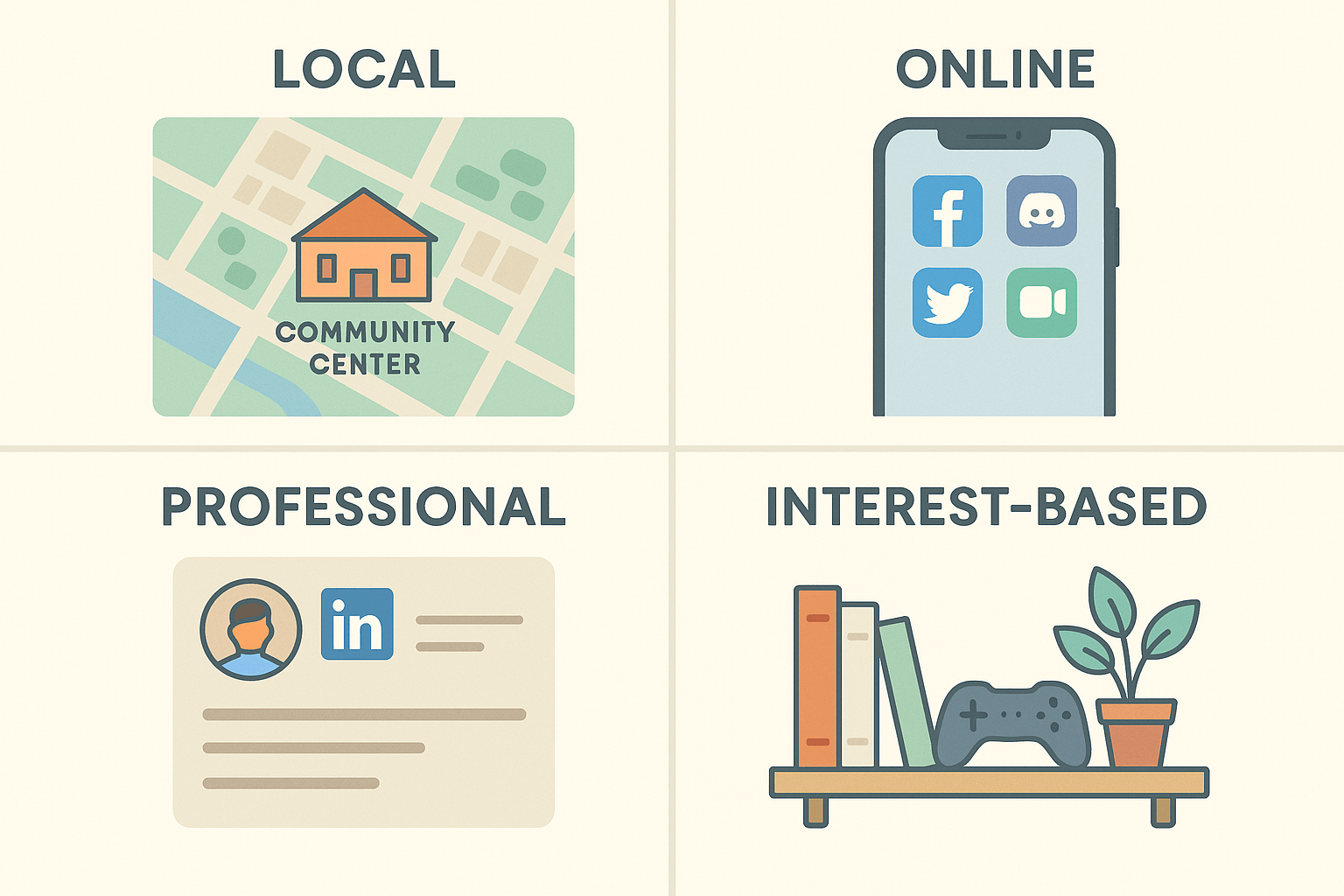
Communities differ by structure, purpose, and interaction mode. Four types account for most organized communities.
Local communities are defined by geography. Neighborhoods, towns, and districts organize around shared physical spaces and public resources. Governance tends to be formal, with elected or appointed leadership structures.
Online communities connect members across geographic boundaries through digital platforms. Forums, social media groups, and dedicated community platforms enable real-time interaction without physical limitation. Shared interest defines membership rather than location.
Professional networks bring together practitioners from the same industry or discipline. Knowledge exchange, career development, and industry advocacy are the primary functions. Trade associations, sector-specific forums, and certification bodies are common forms.
Interest-based communities organize around hobbies, causes, or specific activities. Sports clubs, cultural organizations, and advocacy groups fall into this category. Personal values and passion drive participation more than professional incentives.
What are the core principles of effective community building?
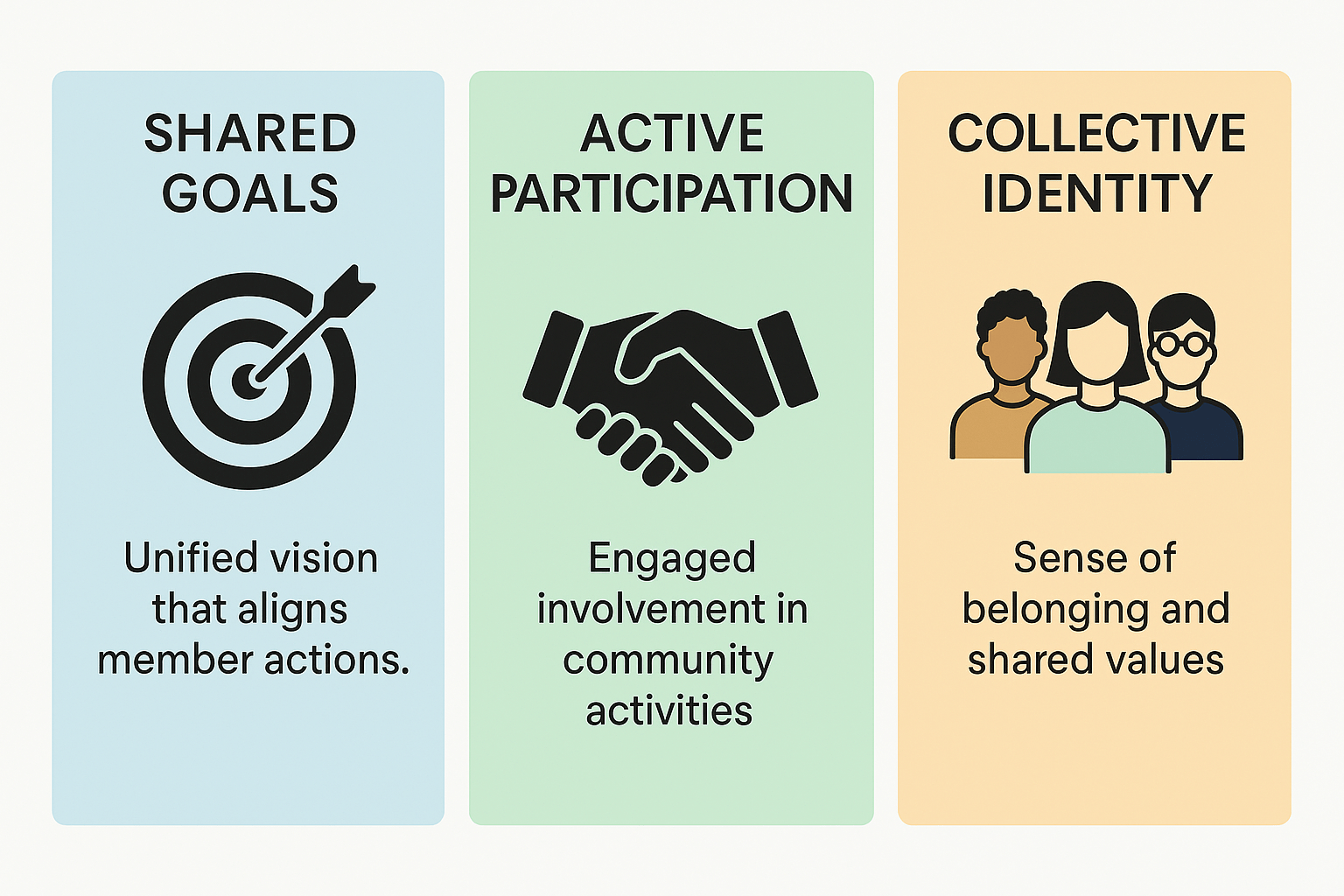
Effective community building depends on consistent principles regardless of community type or size.
Shared purpose is the foundation. A community without a clear mission struggles to recruit members and retain them long-term. The purpose must be specific enough to guide decisions and broad enough to accommodate growth.
Trust develops through consistent behavior over time. Leaders who follow through on commitments, resolve conflicts transparently, and treat members fairly create the conditions for genuine participation. Trust takes time to build and is lost quickly.
Participation structures matter as much as membership numbers. A community of 500 engaged members produces more value than one with 5,000 passive ones. Participation depends on clear roles, meaningful tasks, and recognition of individual contributions.
Regular feedback loops sustain communities over time. Member surveys, open forums, and transparent reporting on community decisions ensure members feel heard and keep leadership accountable.
How do you build a community?
Community building follows a recognizable process. The timeline and scale vary, but the underlying steps are consistent.
Define the mission and membership criteria. Vague criteria attract the wrong people and create culture problems later. Specific criteria simplify recruitment and set clear expectations from the start.
Establish leadership structures. Communities without defined leadership default to informal hierarchies that favor the most vocal members. Assign clear roles: a coordinator for operations, a moderator for conflict resolution, and a communications lead for outreach.
Create regular touchpoints. Communities that only convene during crises lose cohesion between events. Scheduled meetings, recurring events, and consistent communication channels maintain momentum and keep members connected.
Onboard new members deliberately. The first experience shapes long-term engagement. A structured onboarding process that includes introductions, orientation materials, and an assigned contact increases the likelihood that new members become active contributors.
Measure engagement, not just size. Track event attendance, discussion activity, and renewal rates alongside raw membership numbers. Growth in members without growth in participation is an early warning sign of disengagement.
What are the most common challenges in community building?
Participation drop-off is the most predictable challenge. Initial enthusiasm fades as novelty wears off. Communities address this by rotating responsibilities, introducing new projects, and recognizing long-term contributors publicly.
Member conflict is inevitable in any sustained group. Unresolved disputes fracture communities faster than low participation does. Establishing conduct standards before conflict arises and maintaining a clear resolution process is more effective than responding ad hoc.
Resource constraints affect grassroots and volunteer-led communities most severely. Limited budgets restrict programming and outreach. Transparent budgeting, community-led fundraising, and partnerships with aligned organizations extend resources without compromising independence.
Leadership burnout often goes unaddressed until key people leave. Distributing responsibilities, creating succession plans, and compensating leaders where feasible reduces dependence on a small core group.
Frequently asked questions
What is the difference between community building and community management?
Community building refers to the process of forming and developing a community: defining its purpose, recruiting members, establishing norms, and creating structures. Community management covers the ongoing operational work of maintaining an existing community through moderation, event coordination, conflict resolution, and engagement tracking. In practice, both functions often sit with the same person or team, particularly in smaller organizations.
What tools support community building?
The right tools depend on community size and structure. Small local communities often rely on email lists and in-person meetings. Larger or geographically dispersed communities benefit from dedicated platforms. Communication-first communities use tools like Slack or Discord. Membership-based organizations that need structured member management, event coordination, chapter governance, and financial tools alongside community features use dedicated membership platforms like Orgo.
How long does it take to build a community?
There is no fixed timeline. A small interest group can form and stabilize within weeks. A professional association or federated organization with multiple chapters may take years to reach operational maturity. The more useful measure is engagement quality: a community functions well when members initiate activities without prompting from leadership.
What is social capital and why does it matter for community building?
Social capital refers to the networks of relationships, trust, and norms of reciprocity within a group. It determines how effectively a community can coordinate action and resolve disputes without formal enforcement. Communities with high social capital accomplish more with fewer formal structures because members trust one another and follow shared norms voluntarily. Building social capital is a long-term process that cannot be manufactured through a single event or campaign.