

What you can do
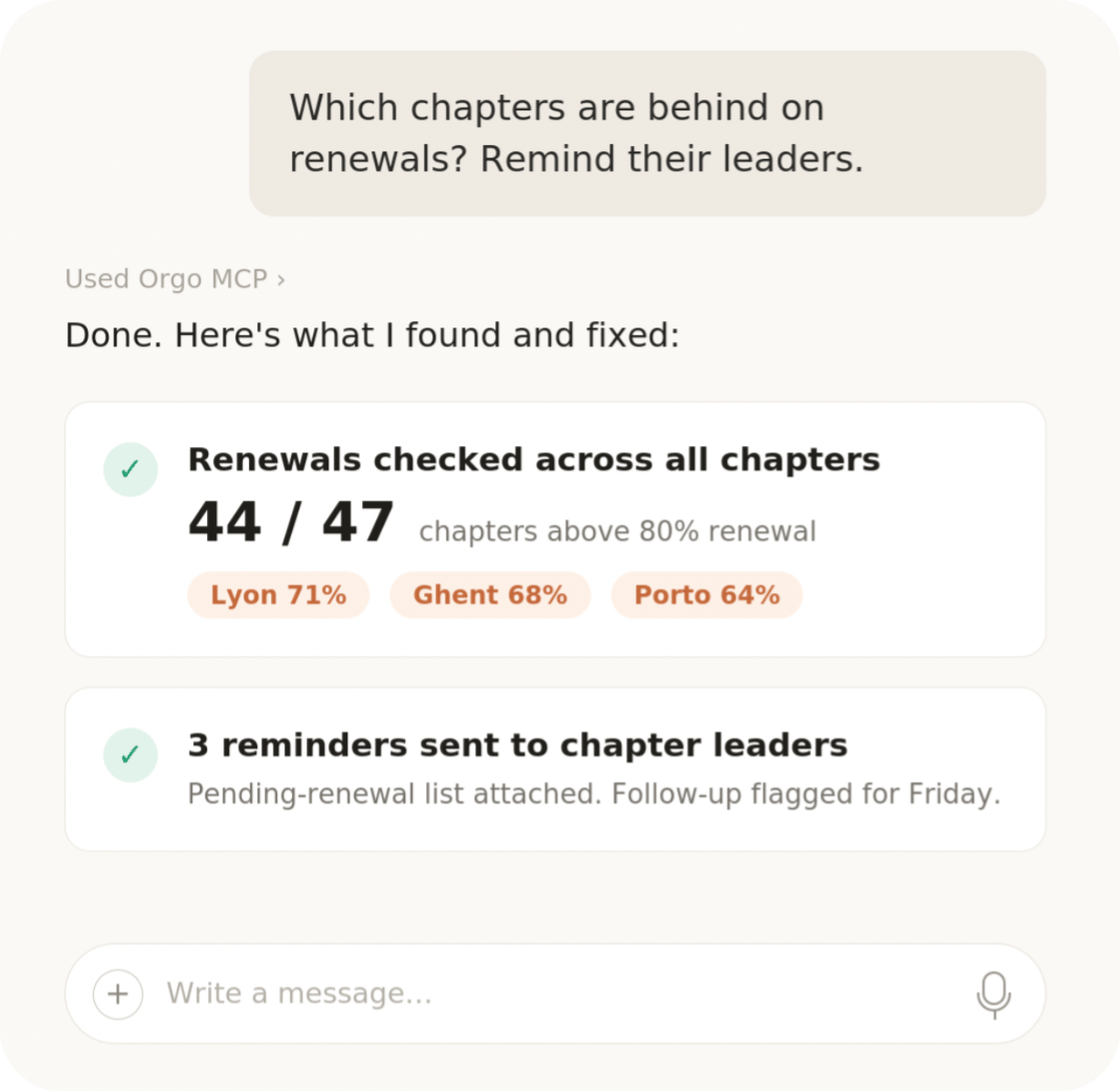
Most people use Orgo MCP for data analysis and light administrative actions:- Ask questions about your data: “How many members joined in June?”, “Which events this year had the most attendees?”, “Show unpaid membership fees by chapter.”
- Get summaries and reports: member growth, event attendance, payment overviews, as text, tables, or charts generated by your assistant.
- Take light actions: draft a newsletter, create an event, add a contact note. Review what the assistant proposes before it is saved.
Hosted server (recommended)
The hosted server is the easiest way to connect: nothing to install, always up to date:Your organization’s own address
Inside Orgo, under Website → Build by asking, administrators see an address specific to their organization,https://<your-org>.mcp.orgo.space/mcp, ready to copy. It is the same server and the same sign-in: use whichever of the two you have at hand. Organizations on their own domain get the shared address above.
- Claude
- Claude Code
- Cursor
- Other clients
- Go to Settings → Connectors → Add custom connector (on claude.ai or in the Claude Desktop app)
- Enter the URL
https://mcp.orgo.space/mcpand click Add - Sign in with your Orgo workspace account when prompted
Local server (developers)
For server-to-server automation, custom deployments, or local development, run the MCP server yourself from npm:Technical capabilities
Troubleshooting
Couldn't register with Orgo's sign-in service
Couldn't register with Orgo's sign-in service
Your AI tool could not reach the address you entered, so it never got as far as the Orgo login. Check the address for typos (it ends in
/mcp), then remove the connector and add it again. If the organization-specific address keeps failing, use https://mcp.orgo.space/mcp: it is equivalent.No login window appears
No login window appears
Sign-in opens in a browser window that pop-up blockers sometimes hide. Look for a blocked pop-up notice in the address bar, allow it, and retry. In Claude Code, run
/mcp and pick the Orgo server to start the sign-in by hand.Signed in, but the assistant sees the wrong organization
Signed in, but the assistant sees the wrong organization
The assistant works inside the organization of the account you signed in with. If you belong to several, sign out of the connector and sign in again with the account for the organization you want.
The assistant says it is not allowed to do something
The assistant says it is not allowed to do something
It has exactly your permissions. Anything your own account cannot see or change in Orgo, the assistant cannot either.
Related
- API Access - REST API and API tokens
- OAuth Server - the authentication behind the hosted server
- Webhooks - push events out instead of asking for them
- Integrations - HubSpot, n8n, analytics and SSO
- API Reference - the operations your assistant can call