

Who moderates what
Moderation rights follow the same routing as the rest of discussions: where the post sits decides who can act on it.
Local moderators only ever see their own local center’s held posts, never another center’s.
Holding posts with the word filter
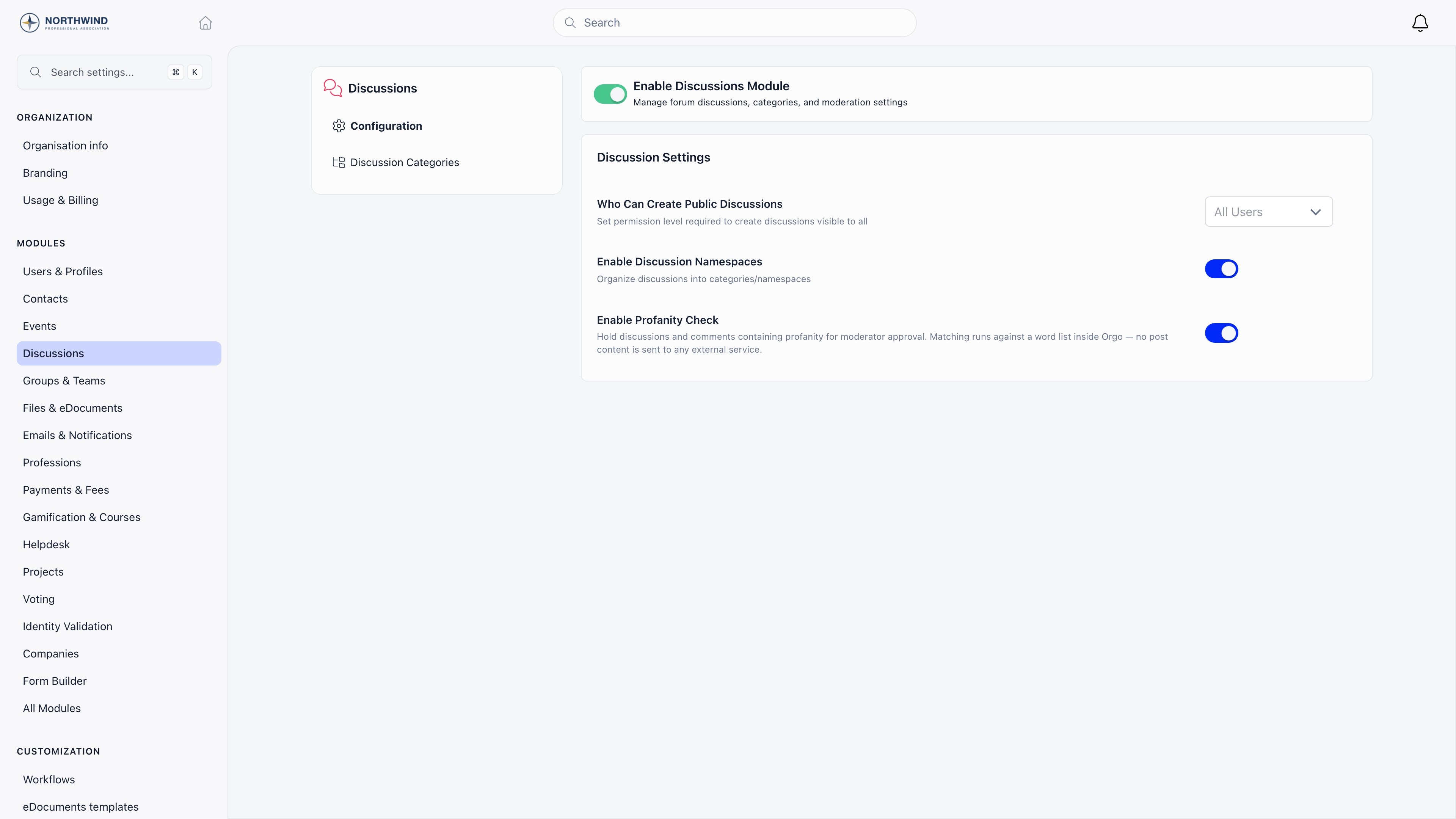
ADMIN_TENANT can change it.
Once on, the filter runs on the title and body of every new discussion, every comment, every reply and every edit of one. If it matches, the post is held before it becomes visible.
Matching runs inside Orgo against a word list. No post content is sent to any external service.
What the author sees
The post saves, and a message says it was flagged for review and will not be visible until a moderator approves it. Nothing else changes for them: they can still edit it, and editing out the flagged words releases the post immediately, without a moderator. That self-release does not apply once a moderator has rejected the post.What everyone else sees
Nothing. A held post is hidden from the feed, from comment threads, from its direct link and from the API, for every member including the author. Notifications that would have gone out (followers, mentions, replies) are held back and sent only if the post is approved.The moderation queue
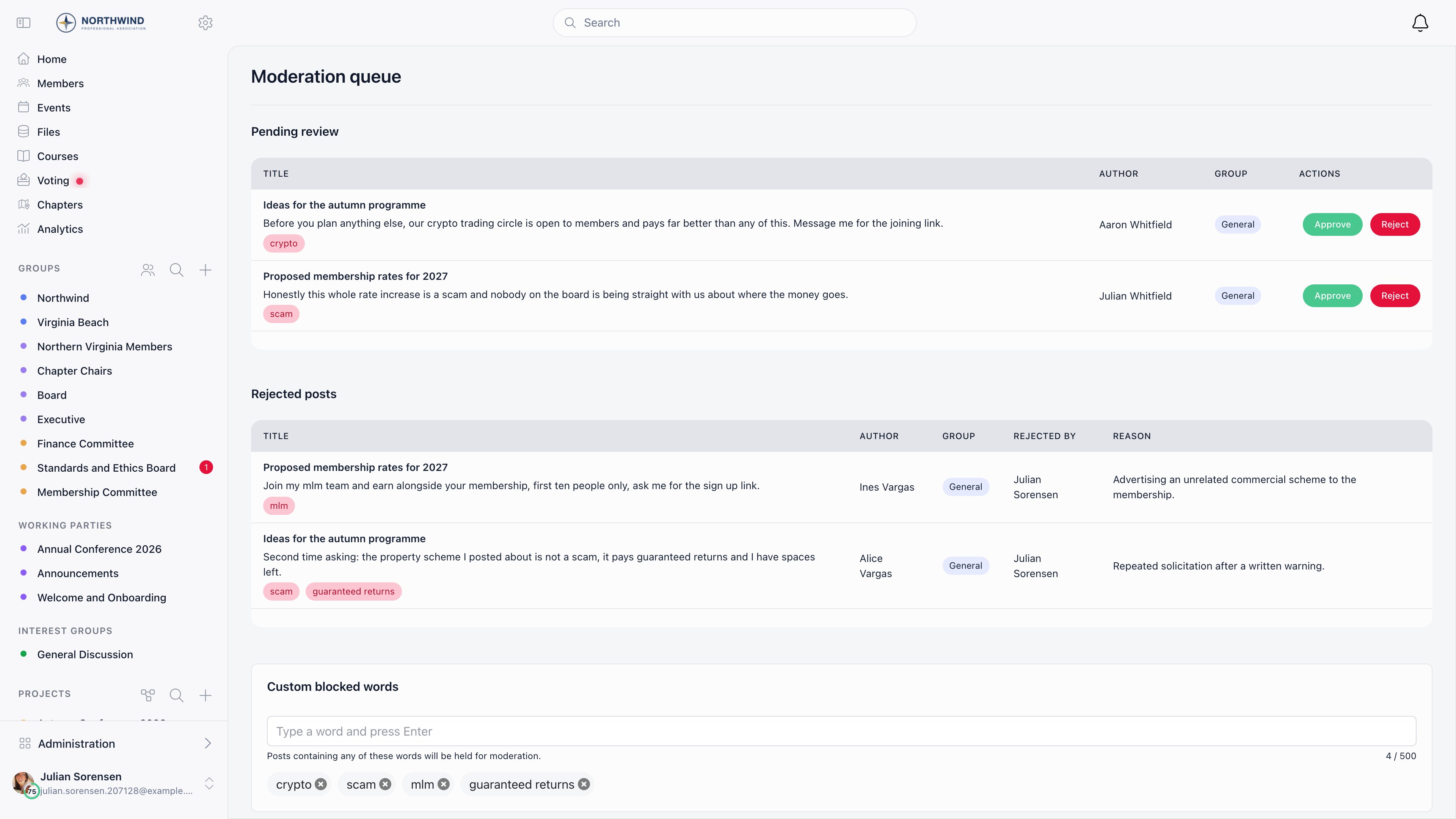
/discuss/moderation-queue. Two things link to it: a Moderation queue entry appears in the COMMUNICATION section of the Administration sidebar once the profanity check is on, and on a local center a Moderation queue button with a pending count appears in the header next to Info.
The screen has two tables:
- Pending review: everything waiting for a decision, newest first. Each row shows the discussion title, the post text (with Show more for long ones), the words that were flagged, the author and the group, plus Approve and Reject.
- Rejected posts: the audit trail, showing who rejected each post and the reason.
Approving a rejected post reverses the rejection.
Below the tables,
ADMIN_TENANT holders manage the Custom blocked words list. It is a single organization-wide list, so one edit changes what gets held everywhere. Moderators can work the queue without being able to change it.
Being told about a hold
When a post is held, every moderator for that scope gets an in-app notification linking to the queue, and an email. The author is never alerted about their own held post. Email is capped at 50 moderators per held post; anyone past that still gets the in-app notification and the queue badge.Hiding a published post
The word filter only catches what it knows. For anything already published, open the post or the comment, then use the three-dot menu.
Hiding is reversible and keeps the evidence. Prefer it to deletion when a decision might be challenged later.
Member reports
Any member can use Report on a post or comment that is not their own. The report is recorded against the post, once per member. A member who simply does not want to read another member does not need a moderator at all. See Blocking Members, which hides one member’s content for one other member and leaves it up for everybody else.Common questions
A member says their post vanished
A member says their post vanished
Check the moderation queue. If the word filter is on, the post is held and invisible to everyone, including its author, until it is approved. The author can also release it themselves by editing out the flagged word.
The filter is holding harmless posts
The filter is holding harmless posts
Words of four letters or more match inside longer words, which is what usually causes it. You cannot remove entries from the built-in list, so if a specific term keeps misfiring, turn the check off for a while and rely on Moderate, or keep the check on and work the queue.
I cannot find the moderation queue
I cannot find the moderation queue
The sidebar entry needs
COMMUNICATION_TENANT and only appears once Enable Profanity Check is on, and the header button only appears in a local center. Open /discuss/moderation-queue directly if you have neither. If both tables are empty, either there is nothing held or you do not hold moderation rights for any group with held posts.Private group posts never appear in the queue
Private group posts never appear in the queue
By design. Private groups are excluded from the filter entirely, so their posts publish straight away and no one can moderate them from the queue. Group admins can still delete content there.
Related
- Discussions posting, comments and reactions
- Discussion Categories category scope and posting permissions
- Permissions what
COMMUNICATION_TENANTandCOMMUNICATION_LOCALcover - Notifications how moderators are alerted
- Groups public, private and role groups