

Turning it on
Settings → Modules → Users & Profiles → Configuration → Enable Profile Notes & Activity. It needsADMIN_TENANT and it is off
until you switch it on.
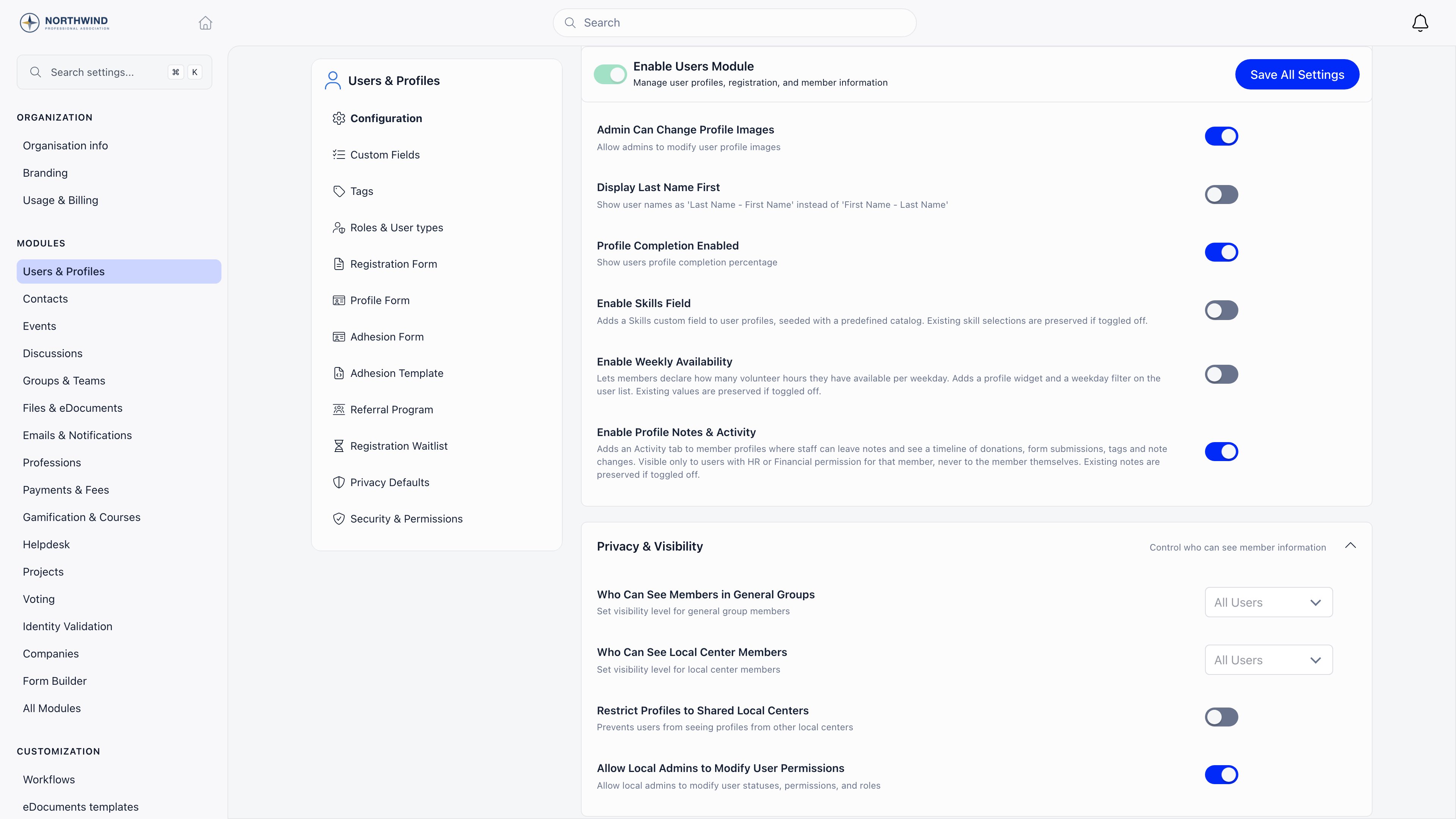
Switching it back off deletes nothing. Notes stay in the database, and they
reappear exactly as they were, with their authors and dates, when the setting
goes back on.
Who can see it
Two conditions have to hold at once: the setting is on, and you hold HR or Financial permission over the person you are looking at.ADMIN_TENANT
covers everybody. Contacts use the identical gate.
So the two tabs answer different questions for different people. A chapter
secretary with
HR_LOCAL gets Activity on their own chapter’s members and never
sees Logs. Someone auditing a disputed profile edit wants Logs, and only a
tenant administrator has it.
Where it lives
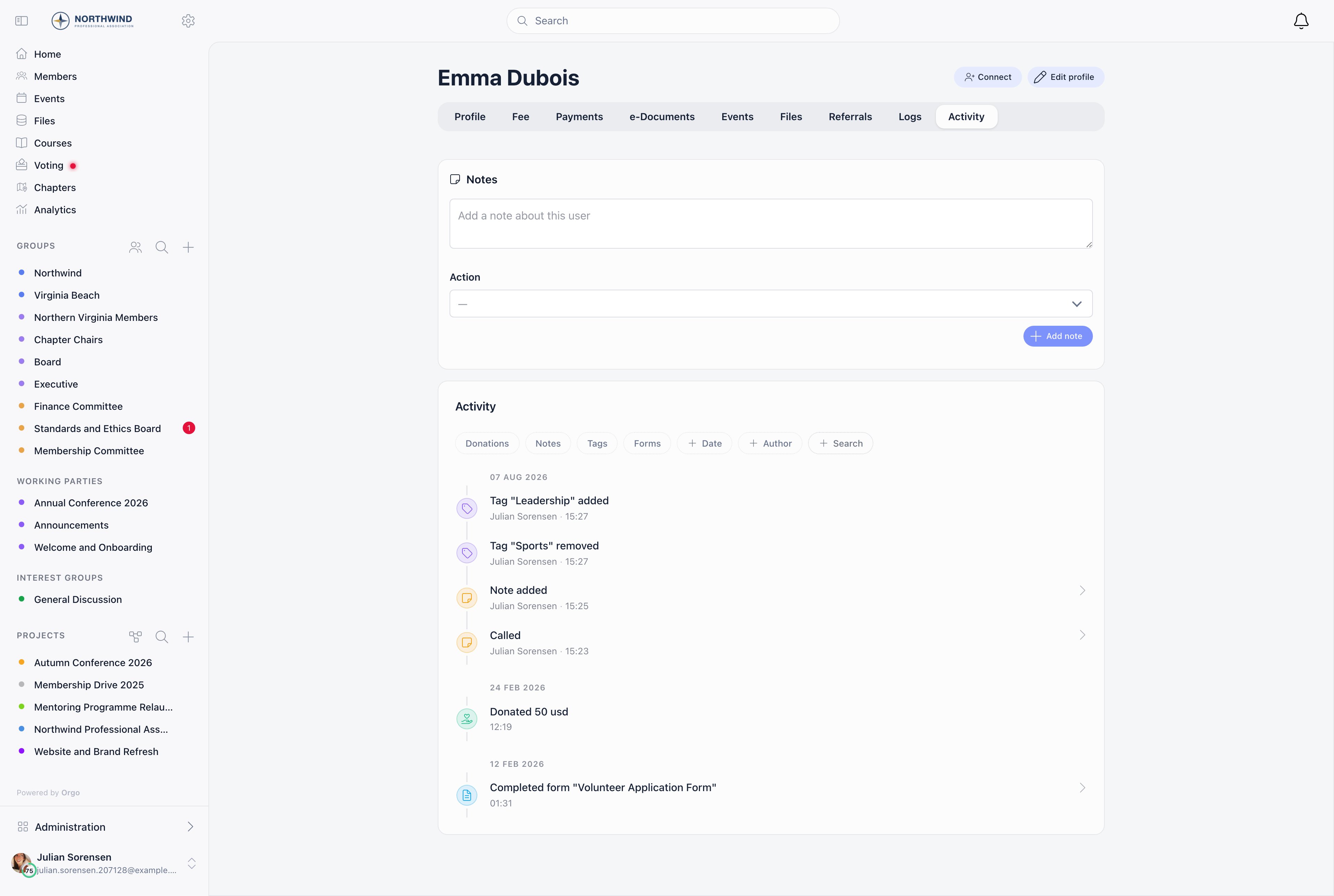
On a member profile, Activity is a tab, next to Logs. The note composer sits at the top of the tab and the feed underneath it. On a contact record, there is no tab strip, so Notes and Activity are two stacked cards in the body of the record, below Tags. They behave the same way.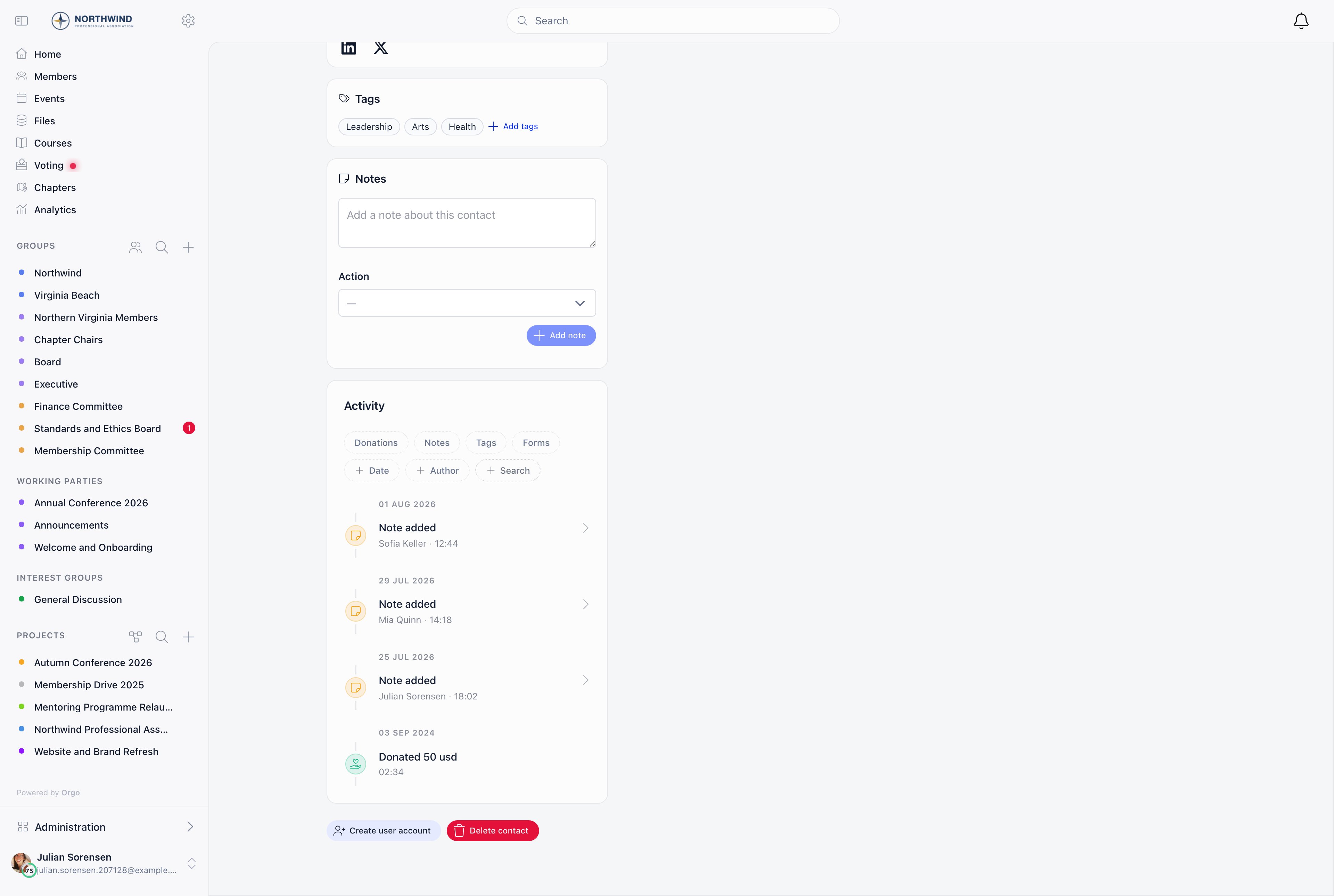
What appears in the feed
Four kinds of entry, merged into one list, newest first.
A fifth row appears once a note is deleted: Note removed, recording that
something was there. It carries no text and it does not open, because the text
is gone.
Donations and form submissions never carry an author, because they are things
the person did rather than things somebody did to their record. Tag changes are
recorded wherever a tag is added or removed through the app, which includes
workflow automations and the public newsletter signup form. Nobody is signed in
for those, so they appear with no author name against them. Bulk CSV imports
write tag links directly and produce no entry at all.
What never appears
Profile field edits are deliberately absent. Somebody changing a member’s email address or town writes nothing to Activity. Those belong in the Activity Log, which stores the old value beside the new one, and they are reachable from the Logs tab on the same profile. Also absent, and not planned for this feed: fees and any payment that is not a donation, event registrations, emails sent or received, logins, e-documents, roles, permission changes, custom field changes and badges. Payments have the Payments tab, emails have the email log, and everything else with an audit trail is in Logs.Notes
Writing one
Type into the composer at the top of the tab, or the Notes card on a contact, and press Add note. A note is capped at 512 characters, and an empty or whitespace-only note is refused. The optional Action select marks what the note records: Called or Emailed. Leave it blank for a plain note. When it is set, the feed shows the action as the entry’s label and as a badge on the note itself, so a run of calls is readable at a glance without opening anything.Reading, editing and deleting
The composer only writes. Everything else happens in the feed: click a note entry and it opens in a modal with the full text, the action badge, the author and the time.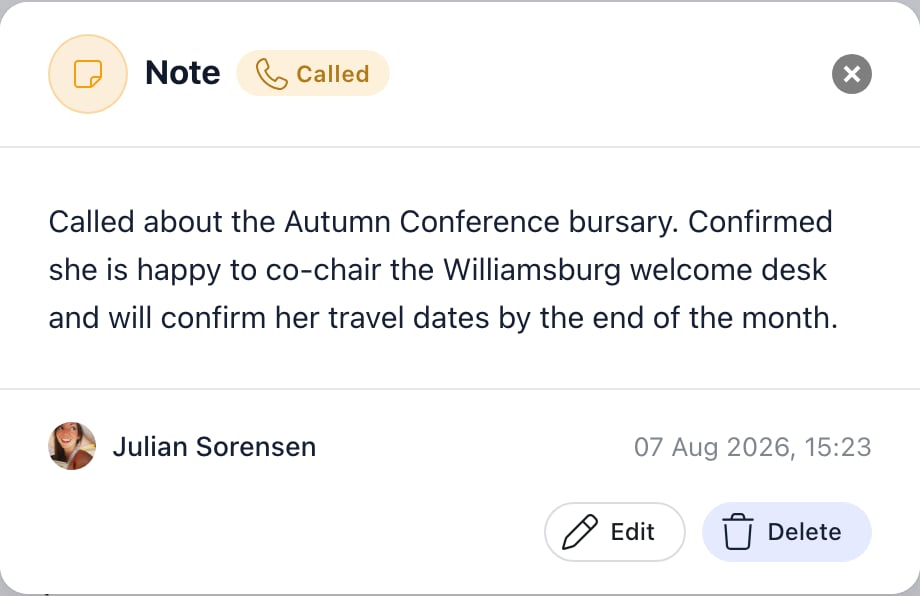
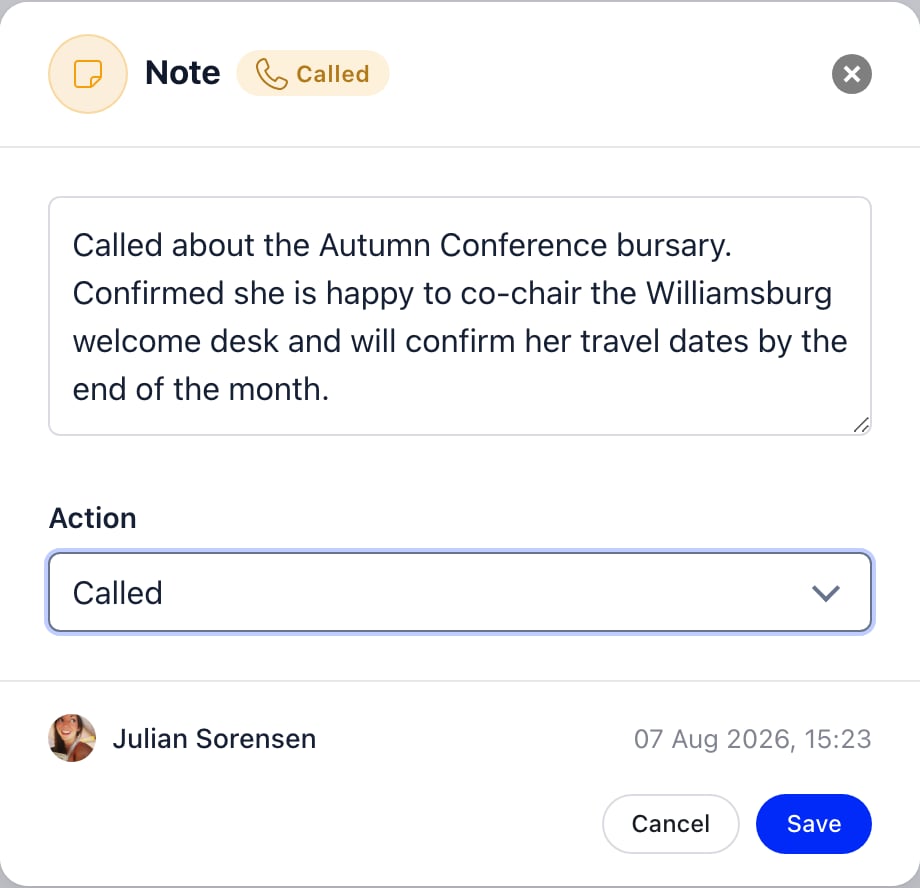
ADMIN_TENANT, and to nobody else. A colleague with the same HR permission can
read a note you wrote but cannot change or remove it.
Notes that existed before this feature keep their original date and appear in
the feed at that point in time. Contact notes carried over from the older
single-box field have no author recorded, so only an
ADMIN_TENANT can edit or
delete those.Opening a form submission
Clicking a Completed form entry opens the whole submission, read-only. Every field on the form is shown, including the ones the person left blank, so you can see what was asked as well as what was answered.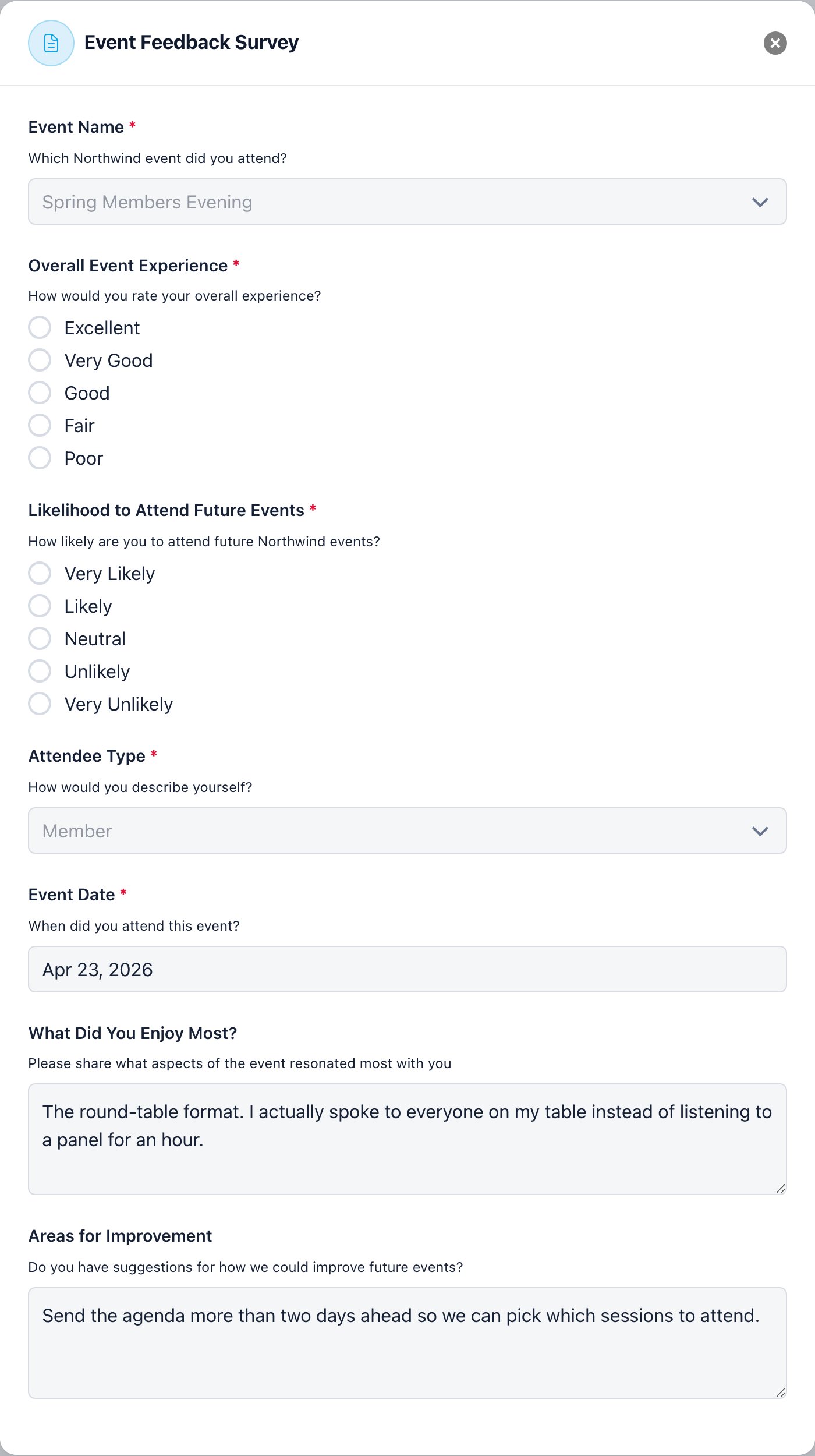
Filtering and searching
The chips above the feed narrow it. They combine, and they all apply at once.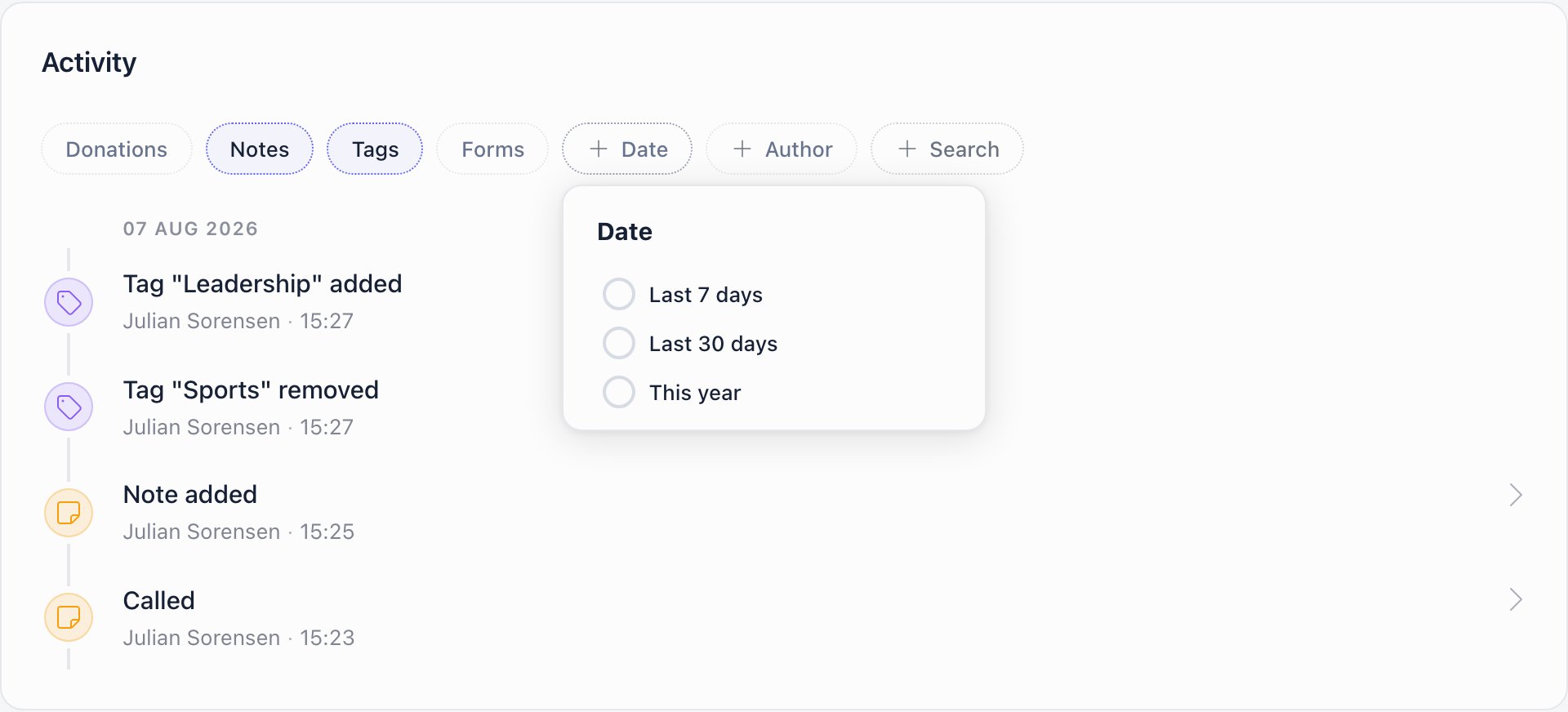
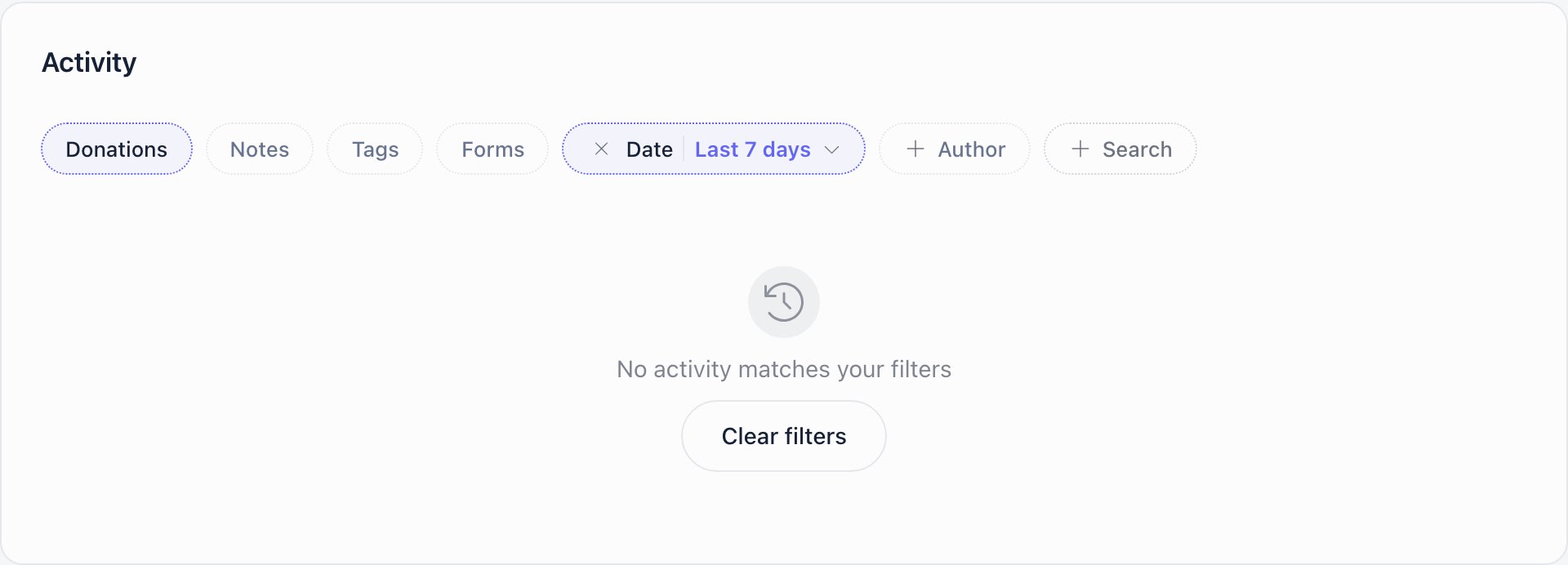
Reading the feed
Entries are grouped under a day heading, in reverse date order, and each row shows its own time under the label. Days with nothing in them are skipped, so a quiet year collapses to a handful of headings. The feed loads 40 entries at a time. When there are more, a Load more button appears at the bottom and adds the next 40 below what you are already looking at. Filters apply to the whole feed, not to the page on screen, so narrowing by type or date searches everything and not only the first 40 rows.Common questions
The Activity tab is not there
The Activity tab is not there
Two gates, and both have to pass. First, Enable Profile Notes & Activity
under Settings → Modules → Users & Profiles →
Configuration. It is off by default, and a tenant administrator has to
switch it on once for the whole organisation.Second, your permission over the person you are looking at:
HR_LOCAL or
FINANCIAL_LOCAL on their chapter, or ADMIN_TENANT. EVENT_LOCAL,
COMMUNICATION_LOCAL and ADMIN_LOCAL on their own are not enough.Do not use the Logs tab as a guide. That one asks for ADMIN_TENANT and
nothing else, so seeing Logs but not Activity means the setting is off, and
seeing Activity but not Logs is entirely normal for a chapter administrator.I can see notes colleagues wrote about me
I can see notes colleagues wrote about me
That is how it works, not a fault. The tab appears on every profile you hold
HR or Financial permission over, and your own profile is one of them.The setting’s help text claims the feature is never visible to the member
themselves. That holds for ordinary members, who have no HR or Financial
permission and get no tab. It does not hold for staff. Brief your team on
that before you switch the feature on, and keep anything sensitive about a
colleague out of the notes field.
A note was deleted and there is still a row for it
A note was deleted and there is still a row for it
Deleting a note leaves a Note removed entry in its place, with the time
and the person who removed it, but no text: the text is gone rather than
hidden, and the row does not open.The deletion is also written to the Activity Log as a
remove action, so a tenant administrator can see it there alongside
everything else that happened that day. Neither record brings the text back,
so treat deletion as final.
Related
- Members - the profile the Activity tab sits on
- Contacts - the same notes and feed on a contact record
- Activity Log - profile field edits, with before and after values
- Permissions - the HR and Financial permissions named here
- Forms - the module that owns the submissions this feed links to
- Donations - where the donation entries come from