

This page is about member companies, not about adding people to your
organization in general. Everything below applies once a company record exists
and holds the membership. To create an account for an ordinary member, use
Register member in the member directory: see
Adding Members.
How to enable
Settings → Modules → Companies → Configuration. RequiresADMIN_TENANT.
With Enable Company Fees on, mark fee prices Company only in the fee product settings and give each a Company slots number: company members then inherit membership status from the company and cannot buy an individual fee. A separate switch, Settings → Modules → Payments & Fees → Company Fee Payment Mandatory, locks company members out of the platform until the company fee is paid.
Creating a company
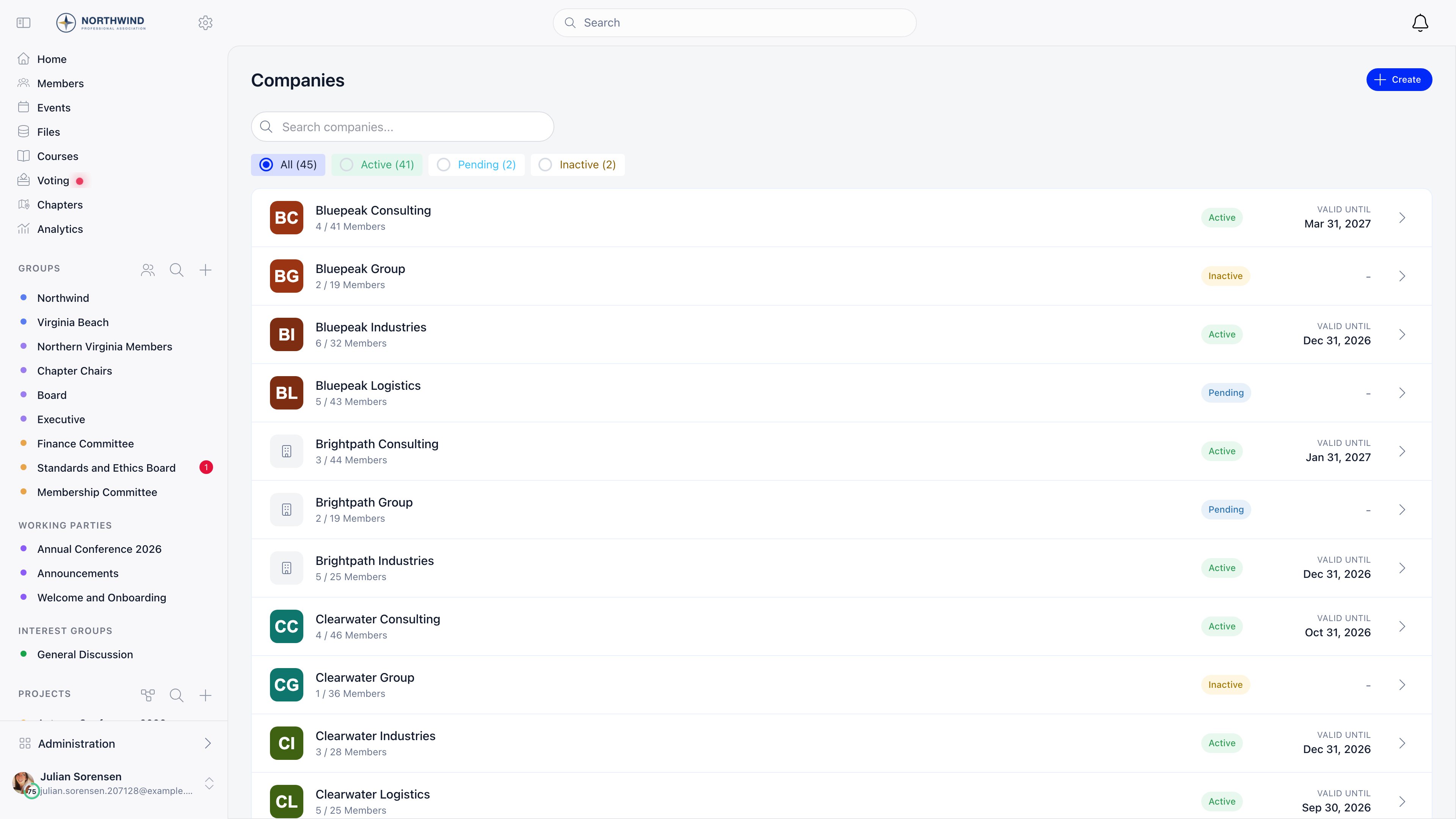
Create on the Companies list opens one form. Only Company Name is required, though payment needs the billing block completed.
Companies start Pending and flip to Active on the first paid membership fee.
ADMIN_TENANT can also set status by hand from the company page. Delete Company is a soft delete: the record moves to status Deleted and disappears from every list.
An ordinary member who creates a company is added to it as Primary Contact and can only ever belong to one company. Administrators (
ADMIN_LOCAL and above) create companies on behalf of others, so they are exempt from the one-company rule and are not enrolled in what they create.Roles inside a company
Roles are stored per membership; a person may hold several.
Assigning Primary Contact or Voting Representative takes it from whoever held it before, in the same action.
ADMIN_TENANT can do anything on any company in the tenant, and so can whoever Who can create companies names, with a floor of ADMIN_LOCAL. Setting it to “Any member” does not grant access to companies you do not belong to.
That reach is organization-wide by design, chapter admins included. A company is not attached to a chapter anywhere in its record, so there is nothing for a chapter-scoped permission to narrow down to: an ADMIN_LOCAL holder in one chapter sees, edits and manages members and payments on every company in the organization. If that is wider than you want, set Who can create companies to Organization admins only, which raises the floor to ADMIN_TENANT.
Members: users and contacts
A membership points at either a User (has an account) or a Contact (in your database, no account). Both appear in the member list, occupy a seat, and can carry a joined date; contacts are tagged Contact and link to the contact record rather than a member profile. Only user memberships inherit the company’s validity date: a contact has no fee date, so membership sync skips it. Add Member is anADMIN_TENANT action and searches users and contacts not already in a company. Company admins invite by email instead.
Both act on people who are already in your database: Add Member attaches an existing user or contact to this company, it does not create anybody. To create a member who is not joining through a company, use Adding Members.
Inviting employees
The Team Members panel and its Invite and Add Member buttons put a person into this company, taking one of its seats and passing the company’s membership validity to them. That is a narrower job than adding a member to your organization, which starts from the member directory instead: Adding Members.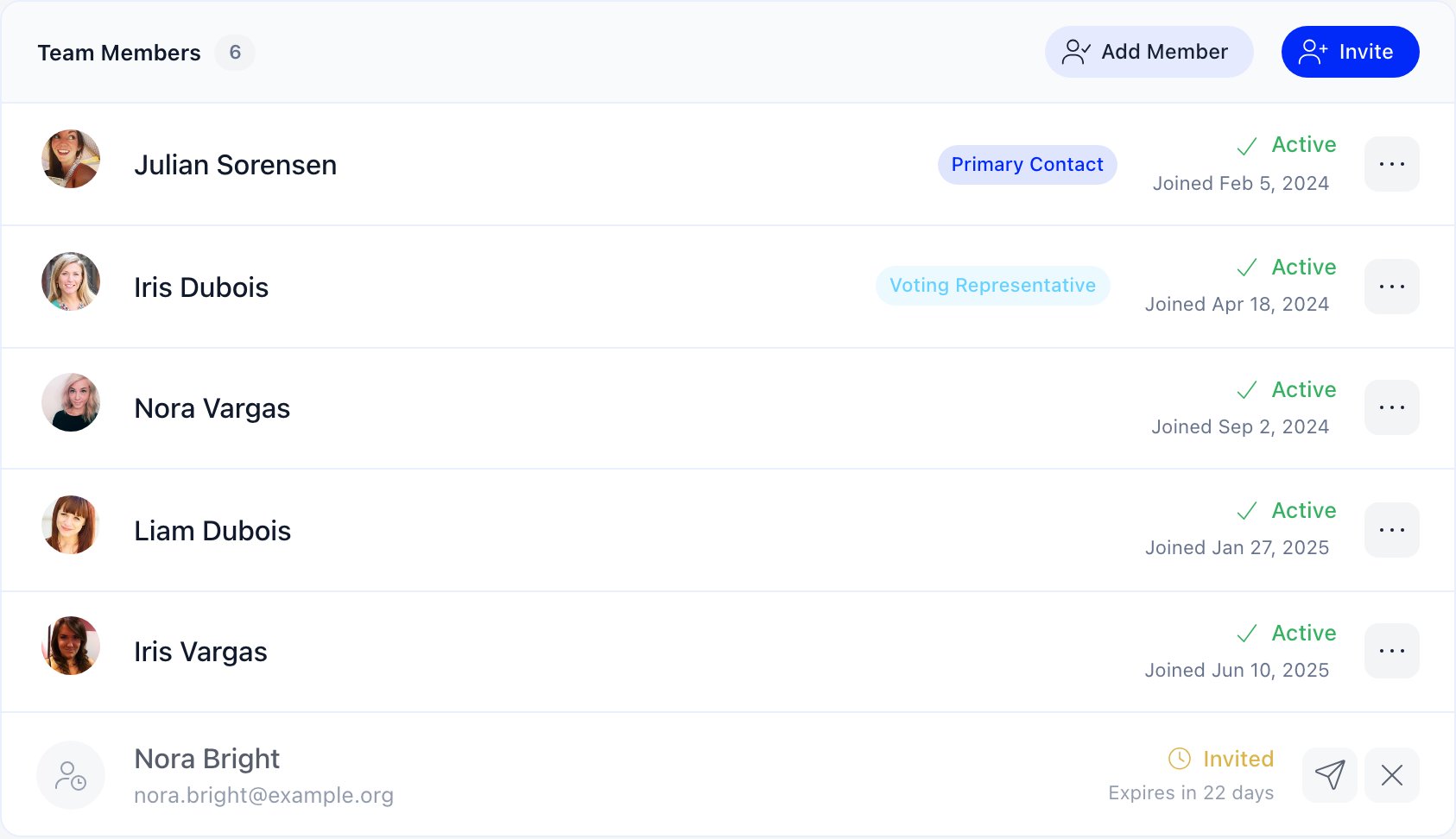
1
Send the invitation
Invite on the company page. Enter the email, first name and last name, pick a role, and add an optional personal message.
2
The recipient opens the link
The email carries a link to
/company-invitation/{hash}, which shows the company name and logo, who invited them, the message, and the role they were offered.3
They accept or decline
Accepting joins them to the company and emails a one-time login code, creating their account first if they do not have one.
Seats
Seats come from the fee price the company bought: each Company only price carries a Company slots value, and paying for it writes that number onto the company. 0 means unlimited. The count is active members plus pending invitations, so an outstanding invitation holds a place. Memberships that ended, and those whose user was deleted, do not count. When the allowance is full, Invite and Add Member disappear.Paying the company fee
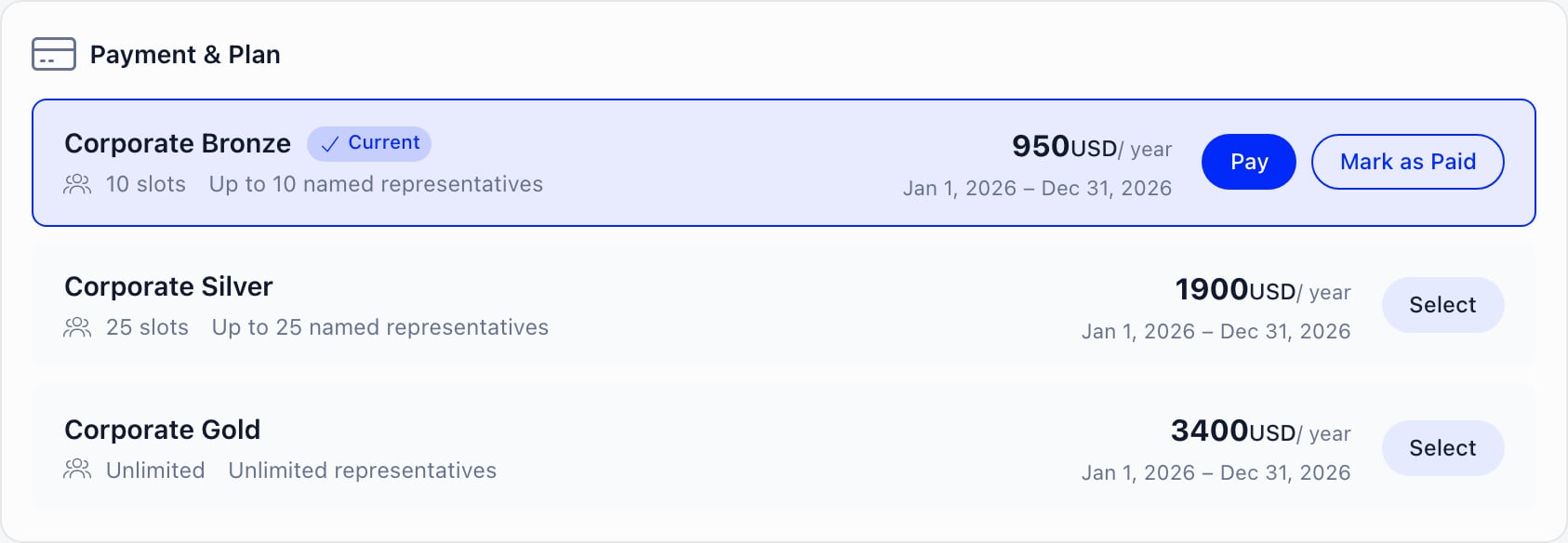
ADMIN_TENANT. It lists every non-archived Company only price on the tenant fee product, with its slot count and price.
Select a plan, then Pay. Orgo checks that Legal Name, Billing Address, Financial contact full name and Financial contact email are filled in, sending you to the edit form if any are missing, then offers:
- Pay online: a Stripe checkout. VAT is added on top of the configured net price as a separate line when your tenant charges VAT on fees and the price is not exempt.
- Get invoice for bank transfer: generates an unpaid invoice, emails it, and shows a reference to quote on the transfer. Only offered when both bank-transfer membership payments and invoicing are enabled.
- Mark as Paid (
ADMIN_TENANTonly): records money received outside the platform. It asks for a period start, defaulting to the current expiry so it extends rather than overwrites, records a payment, updates the seats, and voids any pending bank-transfer invoice.
What members get from a company fee
When a payment lands, Orgo copies the company’s valid-until date onto every active member who has an account, sets the company to Active, and applies the plan’s seat count. Joining an existing paid company inherits its date immediately; leaving or being removed clears the person’s fee date and fee price. On their own fee screen, company-covered members see “Membership managed by company” with a link to the company, instead of the individual payment options. If Company Fee Payment Mandatory is on and the membership has lapsed, members are blocked out: Primary Contacts land on/company-fee-payment, a guided three-step page (Billing Information, Select a Plan, Complete Payment), everyone else on /company-fee-required, which names the company and points them at the financial contact.
Renewal reminders
Companies get their own reminder ladder, separate from individual member reminders: about a month before expiry, 7 days before, 1 day before, on the expiry date, then 7, 14 and 30 days after. Each goes To the financial contact email, copying the active Primary Contacts and the two additional Cc addresses. Without a financial contact email, the first Primary Contact is promoted to the To line. A company with nobody reachable is skipped. Only Active and Pending companies with a plan and a renewal date are reminded. Setting a company to Inactive, or deleting it, stops both the reminder and the renewal invoice that goes with it.Importing companies
Settings → Import offers Companies (with membership details) and Company Members (assigning users to companies with roles), both gated on the module being active. Example CSV files are linked next to each.Related
- Adding Members - the four ways people get into your organization, and where this one fits
- Family Members - the household equivalent, without shared fees
- Membership Fees - fee products, prices and cycles
- Record a Payment - payments taken outside the platform
- VAT - how VAT is added to a fee price
- Contacts - non-member records that can hold a company seat
- Permissions - what
ADMIN_TENANTandADMIN_LOCALcover